
Global Guide Quarterly
The Global Guide Quarterly (Quarter 3, 2026)
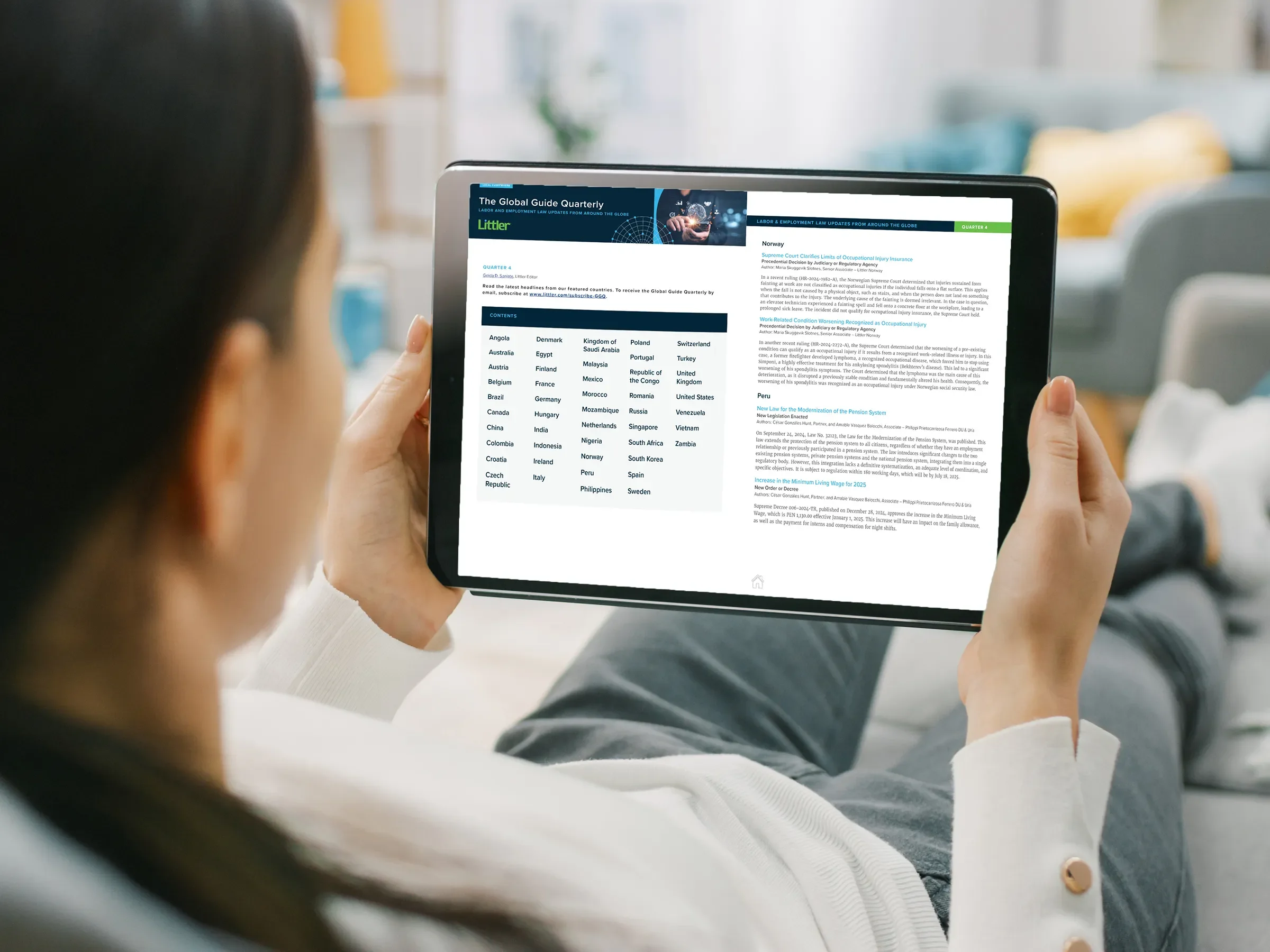
The Global Guide Quarterly (GGQ) is a newsletter published by Littler on a quarterly basis to provide high-level and concise coverage of global labor and employment (L&E) law developments in key countries across the Americas, the Asia-Pacific (APAC) region, and Europe, the Middle East, and Africa (EMEA). The GGQ aims to help multinational enterprises stay informed about important changes in the L&E law framework by covering enacted legislation, significant judiciary or regulatory decisions, legislative initiatives, and trends impacting employers.
The GGQ brings together a curated collection of legal updates by attorneys from Littler offices and contributing firms worldwide. This quarter, the newsletter includes updates from 50 jurisdictions, including but not limited to Australia, Brazil, Czech Republic, Denmark, El Salvador, Finland, Guatemala, Honduras, India, Kingdom of Saudi Arabia, the Netherlands, Norway, Philippines, Singapore, Vietnam, and Zambia featuring developments pertinent to various regional and industry-specific labor and employment issues.
Headlines include:
- Belgium: Caregiver Leave Expanded and Made More Flexible
- Colombia: New Rules Strengthen Scrutiny of Labor Outsourcing Arrangements
- Dominican Republic: Minimum Wage Increase Approved for Construction and Related Workers
- Egypt: Decree Establishes New Requirements for Internal Work Rules
- Finland: New Protections Against Pregnancy and Family Leave Discrimination
- Hungary: Supreme Court Requires Daily Rest Before Weekly Rest Period
- Ireland: Artificial Intelligence Act Signed Into Law
- Malaysia: Employment Insurance System Amendments Expand Employer Notification Obligations
- New Zealand: New Employment Leave Act Introduces Hours-Based Leave System
- Peru: Telework Regulations Updated
- Senegal: Parliament Adopts New Labor Code
- Thailand: Employee Welfare Fund Contributions to Begin in October 2026
This newsletter is not a substitute for legal advice. The material is for informational purposes only, and not for the purpose of establishing an attorney-client relationship.
To receive the Global Guide Quarterly by email, subscribe at littler.com/subscribe-GGQ.
- Australia
Federal Court Rejects Claims Supported by AI-Generated Evidence List
Precedential Decision by Judiciary or Regulatory Agency
Authors: Naomi Seddon and Michael Whitbread – LittlerIn Ba v. Sterling Parts Australia Pty Ltd [2026] FedCFamC2G 1245, the Federal Circuit and Family Court of Australia dismissed an employee’s general protections and worker misclassification claims after the employee failed to produce documents referenced in an “evidence list” cited throughout the pleadings.
Despite a court order requiring production, the employee provided only a termination email already in the employer’s possession. The court inferred that the evidence list had likely been generated with the assistance of generative AI and referred to documents that either did not exist or could not be identified.
The court emphasized that while generative AI may be used to assist with administrative and research tasks, litigants remain responsible for verifying the accuracy, authenticity, and existence of any materials relied upon in legal proceedings.
Federal Court Strikes Employment Claim and Orders Return of Confidential Information
Precedential Decision by Judiciary or Regulatory Agency
Authors: Naomi Seddon and Michael Whitbread – LittlerIn Ulasowski v. Neurophysiology Services Australia Pty Ltd [2026] FedCFamC2G 1641, the Federal Circuit and Family Court struck the amended complaint in a Fair Work Act proceeding, finding the claim failed to comply with pleading requirements and did not give the respondents fair notice of the claims.
The court granted the applicant leave to replead and emphasized that pleadings must identify material facts and causes of action, rather than evidence, submissions, or broad allegations. The court also ordered the applicant to disclose, return, or permanently delete the former employer’s confidential information including sensitive business and patient information.
Proposed Work-from-Home Provision for Clerical Employees
New Regulation or Official Guidance
Authors: Naomi Seddon and Michael Whitbread – LittlerThe Fair Work Commission has proposed adding a new work-from-home provision to the Clerks—Private Sector Award 2020. The Commission found that work from home has become widespread among clerical and administrative employees and that existing provisions governing working hours, employer control over working time, and break arrangements do not adequately reflect current workplace practices.
Under the proposal, employees would be able to request work-from-home arrangements, and employers and employees could agree in writing to vary certain provisions relating to working hours and breaks. The Commission rejected proposals to establish a broad right to work from home or to expand ordinary working hours to reduce overtime obligations.
Victoria’s Proposed Work-from-Home Legislation Referred to Parliamentary Inquiry
Proposed Bill or Initiative
Authors: Naomi Seddon and Michael Whitbread – LittlerVictoria’s proposed Equal Opportunity Amendment (Work from Home) Bill 2026 has been referred to a legislative select committee for review, with a report due by October 20, 2026. Further parliamentary debate on the bill has been deferred pending the committee’s findings.
The referral is expected to prevent the bill from being passed during the current parliamentary term. The proposed legislation would grant eligible employees a right to work from home in specified circumstances and has already been the subject of discussions between the Victorian Government and business groups.
Victoria Proposes Workplace Surveillance and AI Monitoring Legislation
Proposed Bill or Initiative
Authors: Naomi Seddon and Michael Whitbread – LittlerVictoria’s government has announced plans to introduce workplace surveillance legislation if re-elected in November 2026. The proposed legislation would regulate workplace monitoring practices and the use of artificial intelligence in employment-related decision-making.
The proposed measures would require employers to provide advance notice of workplace surveillance, consult with employees before introducing or changing surveillance practices, maintain written surveillance policies, and limit the collection and use of biometric information to situations where there is a legitimate purpose and no less intrusive alternative. The government has also proposed restrictions on the use of AI and surveillance data in employment decisions, including requiring human review of significant automated decisions affecting employees’ rights.
- Austria
Supreme Court Limits Accident Insurance Coverage for “Second Journey Home”
Precedential Decision by Judiciary or Regulatory Agency
Authors: Linda Gahleitner and Armin Popp – LittlerAustria’s Supreme Court (OGH) recently clarified the scope of statutory accident insurance coverage for employee commutes. Under the Austrian General Social Insurance Act (ASVG), accident insurance generally applies only to accidents occurring during an employee’s commute to or from work and does not extend to parts of a journey undertaken solely for personal reasons.
The court reaffirmed that deviations from the normal route made predominantly for personal purposes are generally not covered. While insurance coverage may resume once a personal interruption has ended, the OGH held that this principle does not apply to a “second journey home.” In the case before the court, an employee returned to the workplace to retrieve a forgotten personal item and was involved in an accident while traveling home again. The court held that this second journey home was not covered by statutory accident insurance.
Heat Protection Requirements for Outdoor Workers Remain in Focus
Trend
Authors: Linda Gahleitner and Armin Popp – LittlerFollowing this summer’s heatwaves, Austria’s Heat Protection Regulation (Hitzeschutzverordnung), which took effect on January 1, 2026, remains a key consideration for employers with outdoor workforces. The regulation generally applies to outdoor work performed at workplaces, construction sites, and other external locations, with limited exceptions for short-duration work.
Employers must assess and address risks arising from heat and natural UV radiation and implement appropriate protective measures. Depending on the circumstances, these measures may include adjusting working hours, providing shade, rotating tasks, relocating work to shaded areas, supplying suitable protective equipment, and ensuring access to sufficient drinking water. Employers must also be prepared to respond to heat-related incidents through appropriate emergency and first-aid measures.
As periods of extreme heat become more frequent, employers with outdoor workers may wish to review their existing heat-protection measures and ensure they are prepared to comply with the regulation’s requirements.
- Belgium
Government Preserves Sectoral Limits Under Expanded Flexi-Job Regime
New Legislation Enacted
Authors: Isabel Lysens and Julie Rousseau – LittlerAn act that took effect on July 1, 2026, expanded the availability of flexi-jobs to all private and public employment sectors. However, a Royal Decree issued on August 30, 2026, fully or partially excluded several sectors from the expanded regime, including domestic service, agriculture, horticulture, sea fisheries, and certain funeral services.
The Royal Decree also introduced a limit in the childcare sector, where flexi-job workers may not represent more than 20% of an employer’s annual workforce. The sectoral restriction is notable given a separate bill currently pending before Parliament that would impose a similar 20% cap on the use of flexi-job workers across all sectors. Together, these developments reflect an effort to expand access to flexi-jobs while preserving their supplementary nature and limiting their use as a substitute for regular employment.
Caregiver Leave Expanded and Made More Flexible
New Legislation Enacted
Authors: Isabel Lysens and Julie Rousseau – LittlerEffective July 1, 2026, the Act of March 22, 2026, expanded caregiver leave for employees who provide care to a dependent person due to advanced age, health condition, or disability. Employees who are officially recognized as caregivers may now take up to six months of full-time leave per dependent person, or an equivalent period of part-time leave. The reform doubles the previous leave entitlement and allows employees to combine different forms of leave, provided the overall maximum entitlement is not exceeded.
A Royal Decree issued on July 12, 2026, implemented the reform and introduced greater flexibility in how caregiver leave may be taken. Subject to employer consent, employees may take full-time caregiver leave in weekly increments and half-time caregiver leave in monthly increments. The decree also clarifies the rules governing the combination of different leave arrangements and the calculation of leave taken before July 1, 2026.
Social Penal Code Revised to Align with New Criminal Code
New Legislation Enacted
Authors: Isabel Lysens and Julie Rousseau – LittlerBelgium has revised its Social Penal Code to align with the new Criminal Code. Changes that took effect on April 11, 2026, include extending the limitation period for administrative fines from five to 10 years and providing protection for victims of human trafficking who performed undeclared work as a direct consequence of their exploitation. The revisions also modernize terminology and update references throughout social legislation.
Effective September 1, 2026, courts may impose a broader range of sanctions for social law violations, including probation measures, community service orders, and financial penalties linked to unlawful benefits obtained through infringement. For the most serious offenses, courts may also impose electronic monitoring. The new sanctions apply to violations involving wages, working time, social security obligations, social documents, workplace safety, mandatory registrations, and undeclared work.
Electronic Registration Rules Implemented for Construction Sites
New Legislation Enacted
Authors: Isabel Lysens and Julie Rousseau – LittlerA Royal Decree issued on September 16, 2026, implemented new electronic attendance registration requirements for temporary and mobile construction sites. The decree implements amendments introduced by the Program Act of May 30, 2026, and requires individuals working on qualifying construction sites to electronically register both their arrival and departure. It also abolishes anticipatory registrations, requiring attendance to be recorded immediately on site through an electronic system.
Effective January 1, 2027, attendance registration will be considered complete only once the transmitted data has been recorded and time-stamped into the National Social Security Office database. The decree also updates data protection requirements to align the framework with the EU General Data Protection Regulation (GDPR). The National Social Security Office has indicated that mandatory use of its new electronic check-in and check-out application will begin on April 1, 2027.
Government Proposes Annualized Working Time Arrangements
Proposed Bill or Initiative
Authors: Isabel Lysens and Julie Rousseau – LittlerThe Belgian government has introduced a preliminary legislative proposal that would allow employers and employees to agree in writing to annualized working time arrangements, known as “accordion schedules.” Under the proposal, employees could work more hours during busy periods and fewer hours during quieter periods, provided that average working time over the year remains within statutory limits.
The proposal would also introduce new grounds for requiring overtime work in continuous-operation businesses. The draft is currently under review by the National Labor Council and the Council of State and may be amended before a formal bill is submitted to Parliament.
- Brazil
New Rules for Holiday Work in the Commerce Sector
New Order or Decree
Authors: Marília Nascimento Minicucci and Pâmela Almeida da Silva Gordo – Chiode Minicucci AdvogadosOn July 21, 2026, Brazil’s Ministry of Labor and Employment issued Ordinance No. 1,316/2026, revoking Ordinance No. 3,665/2023 and updating the rules governing Sunday and public holiday work, effective July 22, 2026.
Under the new rules, Sunday work remains authorized without special approval. Public holiday work, however, is permitted only where authorized by a collective bargaining agreement (CBA) under Law No. 10,101/2000, unless the activity qualifies as a statutory exception. If no representative union exists, negotiations must follow Article 611(2) of Brazil’s Labor Code (CLT). Businesses listed in Annex IV of Ordinance No. 671/2021, including pharmacies, bakeries, gas stations, hotels, restaurants, beauty salons, and vehicle rental agencies, remain exempt from the CBA requirement.
The ordinance also provides that any future changes to the list of exempt activities must be preceded by tripartite consultation among workers, employers, and the government.
Supreme Court Redefines Standards for Court Fee Waivers in Labor Claims
Precedential Decision by Judiciary or Regulatory Agency
Authors: Marília Nascimento Minicucci and Pâmela Almeida da Silva Gordo – Chiode Minicucci AdvogadosOn September 3, 2026, Brazil’s Supreme Federal Court (STF), in Declaratory Action of Constitutionality (ADC) 80, established new requirements for court fee waivers in labor and other judicial proceedings, excluding Small Claims Courts. The STF ruled that the Labor Code provision allowing fee waivers based on income below 40% of the General Social Security System (RGPS) threshold is unconstitutional, ending the practice of granting waivers solely on the basis of a declaration of financial hardship.
Pending federal legislation, individuals earning up to BRL 5,000 per month will benefit from a rebuttable presumption of financial hardship, while those earning above that threshold must provide evidence of financial need. Judges may also deny waiver requests from lower-income claimants if household income or assets contradict the claimed hardship. The ruling places the burden of proof on applicants and is expected to increase scrutiny of fee waiver requests, particularly in cases involving higher-earning claimants. The decision applies only to lawsuits filed after publication of the judgment minutes.
Supreme Court Extends Pause on NR-1 Psychosocial Risk Sanctions
Precedential Decision by Judiciary or Regulatory Agency
Authors: Marília Nascimento Minicucci and Pâmela Almeida da Silva Gordo – Chiode Minicucci AdvogadosOn September 25, 2026, Brazil’s Supreme Federal Court (STF) extended for an additional 90 days the suspension of fines and other sanctions related to psychosocial risk management requirements under Occupational Health and Safety Regulatory Standard No. 1 (NR-1).
Although enforcement measures remain suspended, employers must continue to comply with NR-1’s psychosocial risk management obligations. The decision delays punitive enforcement but does not postpone the underlying compliance requirements.
Labor Courts Increase Oversight of Workplace Electoral Harassment
Trend
Authors: Marília Nascimento Minicucci and Pâmela Almeida da Silva Gordo – Chiode Minicucci AdvogadosUnder Resolution No. 452/2026 issued by the Superior Council of Labor Justice (CSJT), Brazilian labor court judges must immediately notify both the Labor Prosecutor’s Office (MPT) and the Electoral Prosecutor’s Office (MPE) whenever a case involves potential electoral harassment. The notification requirement applies regardless of which party raises the allegation and does not affect the underlying lawsuit.
The resolution defines electoral harassment as any distinction, exclusion, or preference based on political beliefs in employment relationships, including recruitment and hiring. It does not apply to elections involving union officers, Internal Accident Prevention Committee (CIPA) members, or employee representatives, which remain subject to separate legal rules.
The resolution also introduces enhanced monitoring measures, including mandatory tagging of such claims in the Electronic Judicial Process (PJe), data sharing with the CSJT and Regional Internal Affairs Offices, and ongoing administrative oversight. These changes reflect increased coordination among labor courts and enforcement authorities in addressing workplace electoral harassment.
- Canada
Ontario Court of Appeal Clarifies Enforceability of Termination Provisions
Precedential Decision by Judiciary or Regulatory Agency
Authors: Stephen Shore and Micah Fysh – LittlerIn a recent decision, the Ontario Court of Appeal held that provisions terminating restricted stock unit (RSU) vesting immediately upon the termination of employment, without regard to the statutory notice period, violated Ontario’s Employment Standards Act, 2000 (ESA). Because the RSUs formed part of the employee’s compensation, the court found that the forfeiture provisions unlawfully altered a term of employment during the statutory notice period and were therefore unenforceable. The employee was awarded damages for the RSUs that would have vested during that period.
Ontario Court of Appeal Upholds Clauses Permitting Termination “at Any Time” or “for Any Reason”
Precedential Decision by Judiciary or Regulatory Agency
Authors: Shana French and Micah Fysh – LittlerIn Baker v. Van Dolder’s Home Team Inc. and Li v. Wayfair Canada ULC, the Ontario Court of Appeal upheld clauses permitting termination “at any time” or “for any reason” where the employment agreements preserved minimum entitlements under the Employment Standards Act, 2000. The Court rejected arguments that these phrases authorized employment termination in circumstances prohibited by statute and cautioned against isolating particular words, searching for remote hypothetical violations, or imposing a “magic words” approach. Instead, courts should apply ordinary contractual principles, consider context, and determine the parties’ objective intention.
British Columbia Court of Appeal Upholds Common Employer Finding for Franchisor and Franchisees
Precedential Decision by Judiciary or Regulatory Agency
Authors: Paul Pulver and Daniel Heath – LittlerIn 1197785 B.C. Ltd. v. 1315949 B.C. Ltd., the British Columbia Court of Appeal upheld a Labor Relations Board declaration that a company and four franchisees were common employers under Labor Relations Code §38. The appellants accepted that the company exercised sufficient control over each franchisee but argued that the Board also had to find “horizontal” control among the franchisees themselves. The Court rejected that interpretation, concluding that section 38 does not prescribe a particular configuration of common control or direction and that substantial “vertical” control by a franchisor may support a declaration covering the franchisor and multiple franchisees. The Court found the Board’s interpretation consistent with the text, context, and labor-relations purpose of the legislation in dispute.
Federal Bill C-39 Proposes Significant Collective Bargaining Reforms
Proposed Bill or Initiative
Authors: Stephen Shore and Liam McMunagle – LittlerBill C-39, the proposed Building Canada Strong Act, was introduced in the House of Commons on September 21, 2026. If enacted, the legislation would apply only to federally regulated employers governed by the Canada Labour Code, including employers in banking, telecommunications, interprovincial and international transportation, and certain federal corporations.
The bill would introduce significant changes to the federal collective bargaining framework, including expanded mediation and dispute-resolution mechanisms, broader access to first-contract arbitration, successor-rights protections in certain contractor-replacement situations, and the potential expansion of multiemployer bargaining. It would also codify circumstances in which the Labor Minister may intervene in strikes or lockouts affecting the national interest and make additional amendments relating to paid medical leave.
- China
AI-Based Replacement Did Not Justify Employee Termination
Precedential Decision by Judiciary or Regulatory Agency
Authors: Grace Yang and Jerry (Gongyu) Zhang – LittlerIn a recent employment case, a Chinese adjudicative authority held that an employer could not lawfully terminate an employee solely because the employee’s role had been replaced by artificial intelligence. The employer argued that AI-driven automation constituted a “major change in objective circumstances” under the Labor Contract Law, but that argument was rejected.
The decision suggests that the adoption of AI tools is generally viewed as a business or operational decision by the employer rather than an unforeseeable external change that automatically justifies unilateral termination of employment.
Shanghai Extends Wage Payment Measures Through 2031
New Regulation or Official Guidance
Authors: Grace Yang and Jerry (Gongyu) Zhang – LittlerEffective August 1, 2026, Shanghai extended its enterprise wage payment measures through July 31, 2031. The measures address wage payment cycles, overtime compensation, wage deductions, wage payment records, and related employer compliance obligations.
Shanghai Moves Closer to National Sick Leave Pay Standard
New Regulation or Official Guidance
Authors: Grace Yang and Jerry (Gongyu) Zhang – LittlerShanghai’s long-standing local sick leave pay standard ended in August 2026. Historically, the city applied rules that generally tied sick leave pay to an employee’s length of service and provided greater protection than the national minimum standard.
Following the change, Shanghai has moved closer to the national framework, under which sick leave pay generally may not be less than 80% of the local minimum wage, unless more favorable terms apply under employment contracts, collective agreements, employee handbooks, or other company policies.
Beijing Issues Trial Guidance on Unilateral Terminations
New Regulation or Official Guidance
Authors: Grace Yang and Jerry (Gongyu) Zhang – LittlerIn August 2026, Beijing authorities issued trial guidance intended to standardize employer unilateral termination procedures and reduce termination-related labor disputes. The guidance provides that employers should notify the company union in writing at least five working days before a unilateral termination and provide the reasons for the proposed action. Where no company union exists, notice should be provided to the relevant higher-level union.
The guidance also encourages employers to maintain supporting evidence, communicate with employees, and address procedural deficiencies before finalizing a termination decision. The guidance highlights the importance of procedural compliance, particularly union-notification requirements, in Beijing termination matters.
New Entry-Exit Administration Rules Increase Compliance Requirements
New Regulation or Official Guidance
Authors: Grace Yang and Jerry (Gongyu) Zhang – LittlerEffective September 15, 2026, new State Council entry-exit administration rules introduced additional compliance obligations for employers, foreign nationals, and service providers involved in visa, residence, and cross-border travel matters.
The rules address immigration intermediary services, false statements and fraudulent supporting materials, restrictions on entry for certain foreign nationals subject to Chinese legal measures, and compliance obligations relating to immigration applications and supporting documentation.
- Colombia
New Rules Strengthen Scrutiny of Labor Outsourcing Arrangements
New Order or Decree
Authors: María Paula Monroy – LittlerDecree No. 0581 of 2026 strengthens Colombia’s framework for labor outsourcing and intermediation. The decree provides that lawful outsourcing requires contractors to maintain genuine operational, administrative, financial, and managerial autonomy. It also establishes a rebuttable presumption of an employment relationship when third parties perform a company’s permanent activities.
The decree identifies indicators of unlawful outsourcing, including a lack of contractor autonomy and the exercise of employer-like control over outsourced workers by the beneficiary company. It also reinforces restrictions on the use of temporary staffing agencies, which may be used only in limited circumstances, such as temporary assignments, employee replacements, or short-term increases in business demand.
The measure emphasizes that compliance will be assessed based on the substance of the working relationship rather than the contractual arrangement used by the parties.
Ministry of Labor Repeals Prior Administrative Guidance
New Regulation or Official Guidance
Authors: María Paula Monroy – Littlersolution No. 2708 of 2026 repealed 11 internal and external circulars issued by Colombia’s Ministry of Labor, citing legal and technical concerns. According to the Ministry, the repealed circulars introduced requirements not established by law, treated nonbinding guidance as mandatory obligations, exceeded the Ministry’s regulatory authority, or misinterpreted labor legislation and judicial precedent.
The withdrawn guidance addressed matters including working time and overtime, enhanced job stability, gender equity, freedom of association, labor reform, collective bargaining, digital platforms, domestic work, and disciplinary procedures. The resolution emphasizes that labor obligations must be grounded in applicable law and clarifies that the repeal affects administrative guidance only, without modifying employees’ statutory rights or protections.
42-Hour Workweek Takes Effect
Legal Compliance
Authors: María Paula Monroy – LittlerEffective July 15, 2026, Colombia completed the phased reduction of the statutory workweek from 44 to 42 hours under Law 2101 of 2021, without reducing employees’ monthly compensation. The 42-hour workweek may be distributed over five or six days by agreement between the employer and employee, subject to statutory daily limits and mandatory weekly rest requirements.
The reduction affects overtime calculations, as work exceeding 42 hours per week will generally qualify as overtime unless an exemption applies. It also increases the ordinary hourly rate used to calculate overtime and premium pay for night, Sunday, and holiday work. In addition, employers are no longer required to provide the biannual Family Day benefit beginning July 15, 2026, although employers may continue offering it voluntarily. Employers should review work schedules, payroll calculations, and overtime policies to ensure compliance with the new workweek limit.
- Costa Rica
Supreme Court Clarifies Dismissal Standards for Unjustified Absences
Precedential Decision by Judiciary or Regulatory Agency
Authors: Lucía Solórzano – LittlerIn Judgments No. 2823-2025 and No. 3216-2025, Costa Rica’s Supreme Court Labor Chamber held that termination for unjustified absences is permissible under Article 81(g) of the Labor Code only when an employee is absent for two consecutive days or for more than two non-consecutive days within the same calendar month.
The court rejected employers’ attempts to rely on the Labor Code’s residual dismissal provision for “other serious misconduct” when unjustified absences are expressly regulated by Article 81(g). As a result, repeated isolated absences that do not meet the statutory threshold may be subject to disciplinary action, such as warnings or reprimands, but generally will not support dismissal. The decisions leave unresolved how employers should address recurring attendance issues that disrupt operations but do not trigger the statutory grounds for termination.
- Croatia
Implementation of EU Pay Transparency Directive Remains Pending
Proposed Bill or Initiative
Authors: Marija Gregoric and Matija Skender – Babic & Partners Law FirmThe transposition deadline for one of the most awaited employment-related Directives – the EU Pay Transparency Directive (Directive) – expired on June 7, 2026. However, the process of aligning the Croatian Labor Act with the Directive is still underway. Although earlier indications pointed to the relevant legislative amendments entering public consultation in September 2026, most recent information indicates that the text of the draft amendments to the Employment Act is still awaiting government approval.
Currently, it is anticipated that the draft will enter public consultation procedure no later than the end of 2026, with the remaining parliamentary procedure following.
Ministry Launches Role Evaluation Tool to Support Pay Transparency Compliance
Important Action by Regulatory Agency
Authors: Marija Gregoric and Matija Skender – Babic & Partners Law FirmIn September 2026, the Ministry of Labor introduced the “Role Evaluation Methodology”, a novel and free-of-charge digital tool aimed to help with the implementation of the EU Pay Transparency Directive. The tool is available to all employers and aims to assist with the application of rules on objective and gender-neutral assessment of the value of work and pay.
The tool features three role evaluation models tailored to small, medium, and large businesses, considering the size and complexity of the organization. The tool also includes features corresponding to the chosen model, which enable automatic score calculation, the creation of evaluation tables, and the determination of the appropriate role complexity category.
- Czech Republic
Minimum Wage to Increase in 2027
New Legislation Enacted
Authors: Dominik Brůha and Zuzana Dufalová – AKBR PartnersPursuant to the Czech Republic’s statutory minimum wage indexation mechanism, the minimum wage will increase in 2027. For employees working a standard 40-hour workweek, the monthly minimum wage will rise to CZK 24,900 (approximately EUR 1,000), and the hourly minimum wage will increase to CZK 148.30 (approximately EUR 6).
In the public sector, the lowest monthly wage will also be CZK 24,900, while the highest monthly wage for highly skilled professions will be CZK 39,840.
Pay Transparency Legislation Advances
Proposed Bill or Initiative
Authors: Dominik Brůha and Zuzana Dufalová – AKBR PartnersAmendments to the Labor Code implementing new pay transparency requirements are advancing through Parliament. If adopted, the changes would take effect on January 1, 2027, and require employers to establish a pay transparency system covering both compensation and nonmonetary employee benefits.
In support of the proposed reforms, the Ministry of Labor and Social Affairs has introduced a tool designed to assist employers with the objective, gender-neutral assessment of roles and the creation of groups of work of equal value. Proposed gender pay gap reporting obligations would take effect no earlier than 2028, depending on employer headcount.
Proposed Redefinition of “Dependent Work”
Proposed Bill or Initiative
Authors: Dominik Brůha and Zuzana Dufalová – AKBR PartnersIn connection with implementation of the EU Platform Work Directive, proposed legislation would revise the definition of “dependent work” under Czech labor law. The proposal identifies three core elements of dependent work: work performed on behalf of the employer, a relationship of subordination and supervision, and personal performance of the work.
The proposal would also more clearly define the concept of subordination and supervision. Because dependent work may only be performed within an employment relationship governed by the Labor Code, the revised definition would be significant for worker-classification issues, including the assessment of platform-worker relationships.
Further Changes to Unemployment Benefits Under Discussion
Trend
Authors: Dominik Brůha and Zuzana Dufalová – AKBR PartnersWithin a matter of a few months, a new proposal is being put forward to further change and unify the amount of unemployment benefits. It is proposed that for the first two months the benefit will be 65% (currently 80%) of the average monthly net earnings or the assessment base. The maximum amount of unemployment benefits is also to change to 0.6 times the average wage in the national economy (currently 0.8 times). In principle, this change amounts to rolling back the legislation to the year 2025.
Proposed Changes to Employee Benefit Taxation
Proposed Bill or Initiative
Authors: Dominik Brůha and Zuzana Dufalová – AKBR PartnersA proposed bill would introduce changes to the taxation of employee benefits effective January 1, 2027. Under the proposal, the current cap on tax exemption for nonmonetary leisure-time benefits would be eliminated. Nonmonetary benefits provided through recreational and travel packages would instead be exempt from income tax up to an aggregate amount of CZK 20,000 per tax period.
The bill would also introduce new tax incentives for certain healthcare benefits, including above-standard preventive medical examinations and selected health screenings, by excluding them from taxable income. Contributions toward selected social services would likewise become tax-exempt. In addition, the proposal would introduce a tax credit for a child’s placement in a preschool facility, capped at the minimum wage.
- Denmark
Holiday Allowance Excluded from Equal Treatment Act Compensation
Precedential Decision by Judiciary or Regulatory Agency
Authors: Bo Enevold Uhrenfeldt – LittlerOn May 12, 2026, the Eastern High Court ruled that holiday allowance should not be included when calculating compensation under Section 16 of the Danish Act on Equal Treatment. The case arose from the calculation of compensation awarded to an employee who was unlawfully dismissed.
The court concluded that the statutory reference to salary means the employee’s ordinary monthly salary and does not include holiday allowance. Finding no basis in the legislation, legislative history, or established practice to reach a different conclusion, the court reduced the compensation award from DKK 350,000 to DKK 315,000, while otherwise maintaining compensation at approximately nine months’ salary.
Court Finds Retention Bonus Not Subject to Proportional Payment Rules
Precedential Decision by Judiciary or Regulatory Agency
Authors: Bo Enevold Uhrenfeldt – LittlerOn May 1, 2026, the District Court of Aarhus held that a retention bonus fell outside the scope of Section 17a of the Danish Salaried Employees Act because it was designed to encourage employees to remain employed rather than compensate them for work performed.
The employee had been granted an extraordinary bonus payable in four installments, each conditioned on continued employment on the payment date. After resigning before the final installments became due, the employee claimed a proportional share of the unpaid amounts. The court rejected the claim, emphasizing that the bonus was introduced to promote employee retention and was not linked to individual performance, targets, or specific work performed. The judgment has been appealed to the High Court.
Court Declines Compensation for Missing Employment Contracts
Precedential Decision by Judiciary or Regulatory Agency
Authors: Bo Enevold Uhrenfeldt – LittlerOn June 25, 2026, the Western High Court held that four employees were not entitled to compensation under the Danish Employment Certificate Act despite not having received written employment contracts. The employees, who were brothers, had worked in their father’s company for several years and later became indirect co-owners following a business merger.
The court upheld the lower court’s decision, finding that compensation was not justified under the specific circumstances of the case. In particular, the employees had extensive knowledge of the business through their long-standing employment and ownership interests. However, the court awarded the employees outstanding salary for the period before the agreed takeover date after finding that the employer had failed to prove payment had been made.
Failure to Record Working Time Results in Back Pay Award
Precedential Decision by Judiciary or Regulatory Agency
Authors: Bo Enevold Uhrenfeldt – LittlerOn July 22, 2026, the Danish Disputes Board ruled that an apprentice was entitled to back pay, including overtime compensation, after the employer failed to maintain working-time records or provide a system for recording hours worked.
The Board accepted the apprentice’s records as reliable, supported by witness testimony from former apprentices. The Board also held that the employer could not deduct the cost of stabling a company-owned horse from the apprentice’s wages, as the horse was provided as part of her training and was necessary for the employer’s approval as a training establishment.
International Organization’s Immunity Did Not Prevent Employee from Filing Court Claim
Precedential Decision by Judiciary or Regulatory Agency
Authors: Bo Enevold Uhrenfeldt – LittlerOn August 27, 2026, Denmark’s Supreme Court held that the immunity of the Organization for Security and Co-operation in Europe Parliamentary Assembly (OSCE PA) did not prevent a former employee from pursuing an employment claim before the Danish courts.
The court found that the employee lacked an effective alternative means of challenging the termination because the internal disciplinary committee could issue only non-binding recommendations and no independent appeal process was available. As a result, dismissing the claim on immunity grounds would have violated the employee’s right to a fair trial under Article 6 of the European Convention on Human Rights.
- Dominican Republic
Minimum Wage Increase Approved for Construction and Related Workers
Important Action by Regulatory Agency
Authors: Javier A. Suárez and Albin Suberví Fernández – LittlerThe National Wage Committee (CNS) approved, through Resolution No. CNS-04-2026, a 20% increase in the minimum wage for construction and related workers, to be implemented nationwide and in stages.
The decision was reached through tripartite dialogue among representatives of workers, employers, and the government, following meetings held by the National Wage Committee on May 12, 19, and 26, and June 2, 2026.
- Egypt
Decree Establishes New Requirements for Internal Work Rules
New Order or Decree
Authors: Abdalla Shohdy (Managing Associate) and Seifeldin Hamad – ADSERO - Ragy Soliman & PartnersMinisterial Decree No. 162 of 2026, published on August 13, 2026, establishes the requirements for internal work rules that private-sector employers with 10 or more employees must adopt under Labor Law No. 14 of 2025. The decree requires work rules to address key employment matters, including recruitment, employee records, performance evaluations, promotions, wage protection, working hours, overtime, leave, workplace health and safety, disciplinary measures, and grounds for termination. Employers that use remote, hybrid, or other flexible work arrangements must also address working hours, performance measurement, and supervision for those employees.
The decree confirms that employment termination may be ordered only by the competent labor court and only for gross misconduct as defined by law. It also establishes a ratification process under which trade unions or employee representatives may review proposed work rules, with approval deemed granted if no objection is raised within the prescribed timeframes.
Sunday Remote Work Requirement Extended Through Third Quarter 2026
New Order or Decree
Authors: Abdalla Shohdy (Managing Associate) and Seifeldin Hamad – ADSERO - Ragy Soliman & PartnersThe Sunday remote work requirement introduced by Decree No. 982 of 2026 was extended throughout the third quarter of 2026 through a series of Prime Ministerial decrees covering July, August, and September (i.e., Prime Minister’s Decree No. 2033 of 2026 for July, Decree No. 2377 of 2026 for August, and Decree No. 2590 of 2026 for September).
The measure continues to apply to specified private-sector activities, including information and communications technology, financial and accounting services, marketing, media, real estate, remote training, nonprofit organizations, professional unions, and certain administrative functions such as HR, legal, and accounting, where operations permit remote work.
The existing exemptions remain unchanged, including healthcare, transportation, infrastructure, industrial operations, education, and other roles requiring on-site presence. Although the decrees do not establish specific penalties, noncompliance remains subject to the general enforcement provisions of Egypt’s Labor Law.
- El Salvador
New Data Protection Guidelines and Enforcement Rules Take Effect
New Regulation or Official Guidance
Authors: Noé A. Martínez and Jaime Solis Canjura – LittlerOn August 11, 2026, the State Cybersecurity Agency (ACE) published new guidelines and regulations implementing the Personal Data Protection Law (LPDP), including Guidelines for Data Protection Officers (DPOs) and Regulations Governing Administrative Penalty Proceedings.
Both measures took effect on August 19, 2026. Covered entities were granted a 20-business-day transition period to adapt their processes and obtain accreditation for their DPOs, with compliance required by September 16, 2026.
- Finland
New Protections Against Pregnancy and Family Leave Discrimination
New Legislation Enacted
Authors: Samuel Kääriäinen and Anni Kaarre – Dottir Attorneys Ltd.Amendments to the Act on Equality between Women and Men will take effect on October 1, 2026. The changes expressly prohibit discrimination based on parenthood and family responsibilities and clarify that these protections apply to fixed-term employment relationships. In certain circumstances involving pregnancy or family leave, employers will be required to provide a written explanation for the expiration or non-renewal of a fixed-term contract without a separate request.
The amendments also extend the time limit for bringing recruitment-related discrimination claims under the Equality Act from one year to two years.
Employer May Terminate Employment Without Awaiting the Outcome of Criminal Proceedings
Precedential Decision by Judiciary or Regulatory Agency
Authors: Samuel Kääriäinen and Anni Kaarre – Dottir Attorneys Ltd.In KKO 2026:65, the Supreme Court held that an employer may terminate an employee’s employment based on suspected criminal conduct without waiting for the outcome of criminal proceedings, even if the criminal charge is later dismissed.
The case involved a sales manager charged with money laundering in connection with a significant financial transaction that resulted in losses and undermined the employer’s trust. Given the employee’s independent and responsible position, the court found the conduct sufficiently serious to justify termination without a prior warning or an obligation to consider reassignment.
Proposed Administrative Penalties for Working Time and Leave Violations
Proposed Bill or Initiative
Authors: Samuel Kääriäinen and Anni Kaarre – Dottir Attorneys Ltd.A proposed bill would introduce a new administrative penalty payment for employers that fail to comply with certain working time and annual leave obligations. The proposal, which is intended to take effect on January 1, 2027, is aimed at combating labor exploitation and the gray economy.
Under the proposal, occupational safety and health authorities could impose penalties on employers that intentionally or negligently fail to comply with statutory requirements relating to work schedules, working time records, or annual leave records.
Government Proposes Pay Transparency Legislation
Proposed Bill or Initiative
Authors: Samuel Kääriäinen and Anni Kaarre – Dottir Attorneys Ltd.On July 9, 2026, the Finnish government submitted legislation to Parliament to implement the EU Pay Transparency Directive, with a proposed effective date of January 1, 2027. The proposal would amend the Act on Equality between Women and Men and related legislation to strengthen pay transparency and combat gender-based pay discrimination.
Under the proposal, employees would have the right to receive written information on average pay levels, broken down by gender, for employees performing the same work or work of equal value. Employers would also be required to provide job applicants with information on the starting salary or salary range for a position. Employers with at least 100 employees would be subject to gender pay gap reporting requirements, and certain employers would be required to conduct joint pay assessments with employee representatives to identify and address unjustified pay disparities. Failure to conduct the required joint pay assessment could result in an administrative penalty. The proposal would also extend the limitation period for pay discrimination claims to three years.
Proposed Legislation Would Regulate Platform Work
Proposed Bill or Initiative
Authors: Samuel Kääriäinen and Anni Kaarre – Dottir Attorneys Ltd.A draft law implementing the EU Platform Work Directive has been submitted to Parliament and is intended to take effect on December 2, 2026. The proposal seeks to introduce a new Act on Platform Work aimed at improving protections for digital platform workers.
A key feature of the proposal is a legal presumption of employment, which would shift the burden to platform companies to demonstrate that a worker is not an employee where the statutory conditions are met. The proposal would also establish rules governing algorithmic management, automated monitoring, and automated decision-making systems. In addition, it would prohibit retaliation against platform workers and authorize occupational safety and health authorities to impose administrative penalties for violations of the new law.
- France
Employee Working Voluntarily During Sick Leave Not Entitled to Damages
Precedential Decision by Judiciary or Regulatory Agency
Authors: Guillaume Desmoulin and Magali Marguerite – LittlerIn a July 1, 2026, decision, the Court of Cassation held that an employee who works during sick leave on their own initiative is not automatically entitled to damages. The court distinguished between situations where an employer requires an employee to work during leave, which gives rise to presumed harm, and situations where the employee chooses to work voluntarily.
In the latter case, the employee must prove both the existence and extent of any loss suffered. Because the employee alleged that the employer had breached its duty of care by requiring her to work during sick leave, but the work had been performed on her own initiative, damages were not automatically available.
Court Treats Retention of Former Employer’s Confidential Data as Illegal Appropriation
Precedential Decision by Judiciary or Regulatory Agency
Authors: Guillaume Desmoulin and Magali Marguerite – LittlerIn a September 2, 2026, decision, the Court of Cassation held that a former employee’s retention of confidential company information on a professional laptop may constitute illegal appropriation of data. The court further held that where a new employer ultimately acquires or benefits from that information, the conduct may amount to unfair competition.
The decision reinforces that employees may not retain confidential information belonging to a former employer after the employment relationship ends and highlights potential liability for employers that obtain or use such information.
Bill Would Expand Protections Against Gender-Based and Sexual Violence
Proposed Bill or Initiative
Authors: Guillaume Desmoulin and Magali Marguerite – LittlerA bill currently under consideration in Parliament would introduce at least 10 days of paid leave for victims of gender-based or sexual violence to obtain legal, medical, psychological, administrative, social, or professional assistance. The leave would be in addition to annual leave, treated as time worked, and would require employees to provide at least 24 hours’ notice before each absence.
The bill would also expand employer obligations by requiring consideration of gender-based and sexual violence in mandatory company-level collective bargaining, enhancing employee information requirements, and requiring training for supervisory and HR personnel in companies with at least 250 employees. In addition, the threshold for appointing a workplace sexual harassment and sexist conduct officer would be reduced from 250 to 50 employees.
The bill would further require employers to promptly conduct an internal investigation following reports of sexual assault, sexual harassment, or sexist conduct in the workplace. For the first time, French legislation would establish statutory procedures governing such investigations, and employers that fail to comply could face financial penalties.
Parliament Considers Revisions to Pay Transparency Legislation
Proposed Bill or Initiative
Authors: Guillaume Desmoulin and Magali Marguerite – LittlerOn September 10, 2026, revised legislation implementing the EU Pay Transparency Directive was submitted to Parliament. The revised bill retains the core framework of the original proposal while clarifying several employer obligations relating to pay transparency and pay-gap reporting.
Among other changes, the bill would establish a two-month deadline for responding to employee requests for pay information and permitting employers to withhold information where disclosure could identify an individual employee’s remuneration. Companies with at least 50 employees would be required to publish seven pay-transparency indicators, and a 5% gender pay gap would trigger corrective measures. In companies with at least 100 employees, explanations could be requested regarding all reported indicators relating to pay differences between men and women performing the same work or work of equal value.
The revised text also adds technical skills to the criteria for assessing work of equal value and provides for future regulations defining the objective factors that may justify pay differences. The proposed sanctions framework remains unchanged.
- Germany
Effective January 1, 2028, Employees Certified with Partial Incapacity to Work May Work on a Limited Basis
New Legislation Enacted
Authors: Dr. Nico Querbach – LittlerEffective January 1, 2028, employees who are unable to work for more than four weeks due to illness may return to work on a limited basis if a physician certifies a partial incapacity to work and the employee agrees. Employees may work 25%, 50%, or 75% of their regular working hours while remaining partially incapacitated.
The arrangement requires the employer’s consent, and employees have no legal entitlement to a modified position. Either party may end the arrangement early, in which case the employee will again be treated as fully incapacitated for work. The medical criteria for certifying partial incapacity will be addressed in future guidance.
Federal Labor Court Limits Lost-Earnings Claims in Discriminatory Hiring Cases
Precedential Decision by Judiciary or Regulatory Agency
Authors: Alke Helene Sundermann, LL.M. – LittlerIn a September 10, 2026, decision (Case No. 8 AZR 153/25), the Federal Labor Court held that an applicant unlawfully rejected during a discriminatory hiring process may recover lost earnings under the General Equal Treatment Act (AGG), but such claims are not unlimited.
The case involved an applicant who was denied a trainee position in 2009 because of his age and later sought approximately EUR 236,000 in additional lost earnings for the period from 2020 to 2023. The court clarified that liability for lost earnings ends once an applicant becomes sufficiently established in suitable alternative employment. Because the applicant had subsequently secured employment appropriate to his qualifications, the court rejected his claim for further compensation.
Regional Labor Court Awards Equal Pay Based on Comparator Group
Precedential Decision by Judiciary or Regulatory Agency
Authors: Maria Rutmann – LittlerOn August 18, 2026 (Case No. 2 Sa 14/24), the Baden-Württemberg Regional Labor Court revisited an equal-pay claim brought by a female employee seeking retroactive compensation. The court reaffirmed that where a female employee receives lower pay than a male employee performing the same or equivalent work, a presumption of gender-based discrimination generally arises.
Although the employer successfully rebutted that presumption with respect to a specifically identified male comparator by demonstrating relevant differences, including longer tenure, the court found that it failed to justify the pay disparity when compared with the broader group of male employees at the same hierarchical level. As a result, the court awarded the employee the difference between her compensation and the median compensation of the male comparison group.
Minor Errors in a Mass Layoff Notice Do Not Invalidate Terminations
Precedential Decision by Judiciary or Regulatory Agency
Authors: Maria Rutmann – LittlerIn a June 25, 2026, decision (Case No. 6 AZR 7/26), published on August 11, 2026, the Federal Labor Court held that minor errors in a mass layoff notice do not invalidate subsequent terminations if the error does not prevent the employment agency from carrying out its statutory functions.
The case involved a mass layoff notice that slightly overstated the number of planned dismissals. The court found that the error did not impair the employment agency’s ability to prepare placement assistance or consider labor market measures. Accordingly, the notice remained valid despite the incorrect employee count.
Deutsche Post Revises Registered Mail Process Following Landmark Court Decision
Trend
Authors: Dr. Stefanie Reiche – LittlerFollowing a recent Federal Labor Court decision holding that the existing delivery process for registered mail with delivery to a mailbox (Einwurf-Einschreiben) no longer supported a presumption that a document had been received, Deutsche Post has reportedly revised its delivery procedures.
Under the revised process, postal workers must complete an additional digital confirmation step after depositing an item in the recipient’s mailbox, creating a documented post-delivery verification. The change is expected to strengthen the evidentiary value of Einwurf-Einschreiben for proving delivery.
- Guatemala
Government Updates Manual Load Handling Limits
New Regulation or Official Guidance
Authors: Heidy Chinchilla Trampe – LittlerGovernment Agreement No. 127-2026, effective July 24, 2026, amended the Occupational Health and Safety Regulation to update authorized weight limits for manual load handling based on International Labour Organization (ILO) standards. The revised limits permit male employees aged 18 to 22 to lift up to 20 kilograms manually, while employees over age 22 may lift up to 45.36 kilograms (100 pounds). For female employees, the maximum authorized weight may not exceed 75% of the limit applicable to male employees.
The amendment also prohibits certified pregnant employees from manually handling loads during pregnancy and for 10 weeks following childbirth. In addition, it reinforces employers’ obligations to reduce manual handling risks through appropriate work practices and training. Only employees who have received specialized training may manually handle loads of up to 45.36 kilograms, and only on an occasional basis under safe working conditions. Where heavier or frequent lifting is required, employers must use mechanical lifting equipment or distribute the load among multiple employees.
- Honduras
Ban on Imports of Goods Produced with Forced Labor
New Regulation or Official Guidance
Authors: Marielos Acosta and Ángel Herrera – LittlerThrough Ministerial Agreement No. SETRASS-527-2026, Honduras’s Ministry of Labor and Social Security (SETRASS) approved regulations implementing Executive Decree PCM-014-2026 and adopted the first edition of a list of goods subject to import restrictions. The agreement was published on August 21, 2026.
The regulations implement Executive Decree PCM-014-2026, which prohibits the importation into Honduras of goods produced wholly or partially through forced or compulsory labor, regardless of the country of origin, customs regime, method of importation, or value. The measure is intended to strengthen enforcement against forced labor in supply chains and imported goods.
- Hungary
Supreme Court Requires Daily Rest Before Weekly Rest Period
Precedential Decision by Judiciary or Regulatory Agency
Authors: Zoltán Csernus and Eszter Csáki – VJT & Partners Law FirmA recent Hungarian Supreme Court decision held that employees must receive the statutory daily rest period even when it immediately precedes a weekly rest period. The court found that failing to provide the required daily rest may entitle employees to claim the wage supplement applicable to extraordinary work.
Supreme Court Upholds Limitation Period for Unused Leave Claims
Precedential Decision by Judiciary or Regulatory Agency
Authors: Zoltán Csernus and Eszter Csáki – VJT & Partners Law FirmIn a recent case involving a substantial amount of unused annual leave accumulated over several years, the Hungarian Supreme Court addressed whether an employer was required to compensate an employee for leave accrued in prior years upon termination of employment. The employer had failed to grant all annual leave, in part because of staff shortages, and compensated the employee for only a portion of the accrued leave when the employment relationship ended.
The court held that claims relating to unused annual leave may be time-barred where the failure to grant the leave was due to a justifiable reason. In this case, the employer’s inability to provide the full amount of annual leave because of staffing shortages constituted a justifiable reason, and the limitation period applied to the employee’s claim.
- India
Delhi High Court Issues Guidelines on Post-Maternity Reintegration
Precedential Decision by Judiciary or Regulatory Agency
Authors: Vikram Shroff and Apurva Vats – AZB & PartnersIn Rakhi Bisht v. Union of India (W.P.(C) 14785/2024), decided on August 31, 2026, the Delhi High Court held that Section 12 of the Social Security Code extends to all adverse employment actions arising from pregnancy or maternity leave, including demotion, reduction of responsibilities, reassignment to a substantially inferior role, and the denial of promotion opportunities.
The court endorsed the government’s Suggested Interim Guidelines and held that they are binding within its jurisdiction for private establishments covered by the Social Security Code. The guidelines establish a protected period beginning when an employee discloses her pregnancy and continuing for six months after her return to work. During that period, the employer bears the burden of proving that any adverse employment action was unrelated to the employee’s pregnancy or maternity leave.
New Social Security Schemes Take Effect and Coverage Threshold Increases
New Regulation or Official Guidance
Authors: Vikram Shroff and Ananya Gandhi – AZB & PartnersEffective July 1, 2026, India implemented the Employees’ Provident Funds Scheme, 2026, Employees’ Pension Scheme, 2026, and Employees’ Deposit-Linked Insurance Scheme, 2026 under the Code on Social Security, 2020. The new schemes replace the corresponding provident fund, pension, and insurance schemes previously in force under the Employees’ Provident Funds and Miscellaneous Provisions Act, 1952.
In addition, on September 17, 2026, the Ministry of Labor and Employment increased the wage ceiling for Employees’ Provident Fund coverage from INR 15,000 to INR 25,000 per month. As a result, a larger number of employees will fall within the social security framework, potentially increasing employers’ contribution obligations. The government has also issued guidance addressing implementation of the revised wage threshold.
Government Clarifies Statutory Bonus Eligibility and Calculation Thresholds
New Regulation or Official Guidance
Authors: Vikram Shroff and Ananya Gandhi – AZB & PartnersThe Ministry of Labor and Employment has confirmed that, effective November 21, 2025, employees earning up to INR 21,000 per month are eligible for a statutory bonus under the Code on Wages, 2019. To qualify, employees must have worked at least 30 days during the relevant financial year.
The bonus must be calculated based on monthly wages of INR 7,000 or the applicable minimum wage, whichever is higher.
State-level Initiatives to Align Existing Labor Laws with the Labor Codes
New Regulation or Official Guidance
Authors: Vikram Shroff and Ananya Gandhi – AZB & PartnersFollowing implementation of the Occupational Safety, Health and Working Conditions Code, 2020 (OSH Code) on November 21, 2025, several state governments have initiated measures to harmonize their labor legislation with the federal framework:
- Gujarat: Establishments covered by the OSH Code must register through the state’s Shram Setu portal and migrate existing registrations to the OSH Code framework within 60 days of the OSH Code becoming applicable to them. The notice also requires establishments previously registered under the labor law to migrate their registrations to the framework prescribed under the OSH Code within 180 days of the OSH Code becoming applicable to them.
- Karnataka: In Karnataka, amendments effective September 4, 2026, exempt establishments employing at least 10 workers and registered under the OSH Code from separate registration requirements under the state shops and establishments law, reducing overlapping compliance obligations.
Changes to State Shops and Establishments Laws
New Regulation or Official Guidance
Authors: Vikram Shroff and Apurva Vats – AZB & PartnersRecent developments under state-specific Shops and Establishments laws continue to modernize employer compliance requirements and align state frameworks with broader labor reforms.
Karnataka: In Karnataka, the Karnataka Shops and Commercial Establishments (Amendment) Act, 2026, effective September 4, 2026, allows registration and fee payments to be completed electronically and provides that registration remains valid until an establishment ceases operations, eliminating periodic renewals. The amendments also prohibit employers from retaining employees’ original documents, require the issuance of service certificates upon termination, and introduce mechanisms for compounding offenses and appeals while decriminalizing certain violations.
Tamil Nadu: In Tamil Nadu, a notification dated August 24, 2026, permits establishments to remain open on all 365 days of the year for an additional three-year period, subject to specified employee protections. These include weekly rest days, limits on working hours, payment of overtime wages, transportation and safety measures for female employees working shifts, and the maintenance of an Internal Complaints Committee in accordance with applicable workplace harassment laws.
- Indonesia
New Incentives for Disability-Inclusive Employers
New Regulation or Official Guidance
Authors: Stephen Igor Warokka – SSEK Law FirmGovernment Regulation No. 31 of 2026 provides greater clarity regarding disability-inclusive employment and workplace accessibility. While the regulation does not introduce new employment quotas, it establishes a clearer framework for employers seeking to promote the inclusion of persons with disabilities in the workplace.
Employers that hire persons with disabilities may be eligible for government incentives, including public recognition, licensing facilitation, and support for accessible workplace facilities. The regulation is intended to encourage disability inclusion while providing employers with clearer guidance on workplace accessibility obligations.
New Labor Inspection Framework Expands Employer Compliance Obligations
New Regulation or Official Guidance
Authors: Stephen Igor Warokka – SSEK Law FirmMinister of Manpower Regulation No. 11 of 2026, effective July 3, 2026, introduces a new framework for labor inspections in Indonesia. The regulation expands inspectors’ enforcement powers and extends the maximum inspection period from three business days to 60 business days.
The regulation also introduces digital compliance self-assessments through the SIAPkerja platform and updates occupational health and safety (K3) requirements. Employers may wish to review their compliance procedures and recordkeeping practices considering the expanded inspection and reporting requirements.
- Ireland
Artificial Intelligence Act Signed Into Law
New Legislation Enacted
Authors: Ailbhe Marsh and Niall Pelly – LittlerThe Regulation of Artificial Intelligence Act 2026 was signed into law, with most provisions taking effect on July 31, 2026. The Act establishes Ireland’s framework for implementing Regulation (EU) 2024/1689 (the EU AI Act) and creates national oversight and enforcement mechanisms, including direct supervisory powers for Irish regulators.
Employers are classified as deployers of AI systems under the Act, including when using off-the-shelf AI solutions. As a result, employers must comply with the deployer obligations under the EU AI Act, including requirements relating to risk management, transparency, and human oversight.
EU Digital Omnibus on AI Now in Effect
New Regulation or Official Guidance
Authors: Ailbhe Marsh and Niall Pelly – LittlerThe Digital Omnibus on AI was formally adopted on July 24, 2026, amending Regulation (EU) 2024/1689 (the EU AI Act). Employers using high-risk systems in HR functions will have until December 2, 2027, to ensure compliance.
The European Commission has also published draft Guidelines on the classification of high-risk AI systems. The amendments clarify the regulatory framework applicable to AI systems used in employment-related decision-making.
Proposed Pregnancy Loss Leave
Proposed Bill or Initiative
Authors: Ailbhe Marsh and Niall Pelly – LittlerThe Irish government has approved publication of the General Scheme of the Pregnancy Loss Leave Bill 2026. The proposal would provide employees who experience pregnancy loss before 23 weeks’ gestation with a statutory entitlement to five days of paid leave per year to obtain support and assistance related to their loss.
Under the proposed framework, the leave would be available from the first day of employment, although payment would be subject to a 13-week service requirement. Employers would pay the leave at the same rate as statutory sick pay, currently 70% of normal gross earnings, subject to a daily cap of EUR 110. The bill has not yet been published and must still complete the legislative process before becoming law.
Autumn 2026 Legislation Program Signals Key Employment and Regulatory Reforms
Proposed Bill or Initiative
Authors: Ailbhe Marsh and Niall Pelly – LittlerThe government’s Autumn 2026 Legislative Program identifies several employment-related reforms as legislative priorities. Among them is the Employment Equality (Gender Pay Gap Information) (Amendment) Bill, which would require employers to submit gender pay gap information through a centralized reporting portal. The government also confirmed that legislation implementing the EU Pay Transparency Directive remains in development.
The program further indicates that work is continuing on proposed reforms relating to pregnancy loss leave and surrogacy leave, signaling continued legislative focus on workplace equality and family-related leave entitlements.
- Israel
Convalescence Pay Rate Increased in the Private Sector
New Order or Decree
Authors: Adar Moussel – N. Feinberg & Co.An extension order published on August 18, 2026, increased the private-sector convalescence pay rate for the 2026 convalescence year from NIS 418 to NIS 451.50 per day. The order extends the agreement between the Histadrut and the Presidium of the Business Sector concerning employers’ participation in employees’ convalescence expenses.
Under a 2023 interpretive opinion issued by the Commissioner of Labor Relations, the applicable convalescence pay rate is determined by the date the payment is made rather than the period to which it relates. As a result, employers that paid convalescence benefits for the period from July 1, 2025, through June 30, 2026, using the prior rate may need to make supplemental payments.
Because the Commissioner’s opinion is not binding and the issue has not yet been definitively addressed by the National Labor Court, employers should assess the implications considering their specific circumstances and existing workplace arrangements.
Extension Order Governs Wage Payments During Operation “Roaring Lion”
New Order or Decree
Authors: Adar Moussel – N. Feinberg & Co.A new extension order establishes wage-payment rules for private-sector employees who were unable to work due to security-related circumstances during Operation “Roaring Lion” between March 1 and June 30, 2026. The order applies in specified areas and circumstances, including where employees were unable to attend work because of educational institution closures, childcare responsibilities, disabilities affecting their ability to work in accordance with Home Front Command instructions, or the need to care for a relative with a disability.
Eligible employees are entitled to compensation equal to their regular daily wage, including related social benefits, up to a maximum of NIS 1,540 per day. The order also clarifies that compensation is not available where the absence was covered by sick leave or vacation leave, where the employee worked remotely and received wages, or where duplicate compensation would be payable for the same period.
Maximum Housing Deductions for Foreign Workers Increased
New Order or Decree
Authors: Adar Moussel – N. Feinberg & Co.Amendments to the Foreign Workers Regulations, effective September 1, 2026, significantly increase the maximum amounts employers may deduct from foreign workers’ wages for employer-provided housing. The previous limits had remained largely unchanged for approximately two decades.
Under the revised framework, the maximum monthly deduction is NIS 1,257 in Tel Aviv, NIS 1,095 in Jerusalem, NIS 1,030 in the Central District, and NIS 999 in Haifa, the Southern District, and the Northern District. Compared with the previous limits, the increases range from approximately 77% in Jerusalem to 135% in the Northern District.
The amendments also establish specific rules for certain types of accommodation. The maximum deduction for temporary portable residential structures is NIS 999 per month regardless of location, while housing provided at construction sites is subject to a deduction cap of 50% of the applicable maximum amount. In addition, the previous restriction limiting deductions for employer-owned housing to 50% of the applicable maximum amount has been repealed, allowing employers to deduct the full amount permitted under the regulations. The revised deduction limits are intended to cover housing-related expenses, including municipal taxes, water, electricity, furniture, and household appliances.
- Italy
Social Security Authority Expands Eligibility for Sickness Benefits
New Regulation or Official Guidance
Authors: Carlo Majer and Gaia Bencini – LittlerOn September 4, 2026, the Italian National Social Security Institute (INPS) issued Circular No. 92, revising its guidance on the start date for sickness benefits. Under the new guidance, INPS may recognize sickness benefits for the day immediately preceding the issuance of a medical certificate, even when the employee is examined at the physician’s office, provided the preceding day is not a Saturday, Sunday, or public holiday.
The general rule remains that sickness begins on the date the medical certificate is issued. However, the revised guidance permits recognition of the previous day for purposes of INPS sickness benefit coverage in specified circumstances.
- Ivory Coast
Employment Contract Reforms Simplify Hiring Requirements
New Legislation Enacted
Authors: Nuno Gouveia and Eric Megalou – Miranda Alliance - Cabinet MegalouOn April 15, 2026, Côte d'Ivoire adopted seven decrees aimed at thoroughly modernizing the implementing regulations of the Labor Code, repealing provisions that were nearly 30 years old. Effective upon publication, these laws apply to all employers operating in Côte d'Ivoire.
Decree No. 2026-197 modernizes the rules governing employment contracts. The decree replaces the physical submission of employment contracts to the Youth Employment Agency with a monthly report of new hires and exempts nationals of ECOWAS and UEMOA member states from prior visa requirements.
The decree also reverses the effect of ministerial silence. Under the new framework, failure to respond within the prescribed eight-day period constitutes a refusal of approval rather than automatic approval.
New Rules for Internal Regulations and Works Councils
New Legislation Enacted
Authors: Nuno Gouveia and Eric Megalou – Miranda Alliance - Cabinet MegalouDecree No. 2026-199 introduces new requirements for workplace internal regulations and employee consultation. Where no staff representatives or trade union exist, employers must consult workers designated by their peers. The decree also permits electronic filing of internal regulations with the Labor Inspectorate and requires multi-site employers to adopt internal regulations for each establishment.
In addition, Decree No. 2026-202 requires employers with at least 300 permanent employees to establish a works council. Employers must organize elections within three months of reaching the threshold, and elected members are entitled to paid release time and statutory employee-representative protections.
Reforms Expand Part-Time Work Framework and Simplify Collective Dispute Procedures
New Legislation Enacted
Authors: Nuno Gouveia and Eric Megalou – Miranda Alliance - Cabinet MegalouDecree No. 2026-201 broadens the definition of part-time work to include any working schedule below the statutory working hours, replacing the previous 30-hour weekly threshold. The decree also requires part-time contracts to include specific provisions governing part-time work arrangements and removes several rules that are now governed by general labor legislation.
Separately, Decree No. 2026-200 streamlines collective labor dispute procedures by requiring disputes to be reported directly to the competent labor inspector and allowing notifications and records to be transmitted electronically.
New Standards for Employee Accommodation and Workplace Safety
New Legislation Enacted
Authors: Nuno Gouveia and Eric Megalou – Miranda Alliance - Cabinet MegalouDecree No. 2026-204 establishes new standards for employer-provided housing for permanent employees working away from their home region. The decree includes requirements relating to building construction, ventilation, occupancy levels, accessibility for persons with disabilities, and separate housing for employees with families.
Decree No. 2026-207 overhauls workplace health and safety requirements by introducing nine general prevention principles and requiring employers to maintain a comprehensive occupational risk assessment. The decree also raises ventilation standards, strengthens sanitation requirements, extends cleaning-staff obligations to all establishments regardless of size, and requires workstations to be adapted for employees with disabilities.
- Kingdom of Saudi Arabia
Amendments Clarify Allocation of Employment Liabilities in Privatization Transactions
New Order or Decree
Authors: Sara Khoja and Sarit Thomas – Clyde & Co.The Council of Ministers issued Decision No. 318 of 1448H, amending the Rules and Arrangements for the Treatment of Employees and Workers in Sectors Targeted for Transfer and Privatization. The amendments revise the framework governing employee transfers in privatization transactions and provide greater clarity regarding the allocation of employment-related liabilities.
Most notably, the amended rules expressly allocate responsibility for end-of-service benefits (EOSB) and accrued leave between the transferring and receiving entities while preserving employees’ continuity of service. The transferring entity remains responsible for EOSB and leave accrued before the transfer, while the receiving entity is responsible for benefits accruing after the transfer. Both amounts are to be calculated based on the employee’s last wage. The amendments are intended to provide greater certainty regarding the treatment of historic and future employment liabilities in transfer and privatization transactions.
- Malaysia
Employment Insurance System Amendments Expand Employer Notification Obligations
New Legislation Enacted
Authors: Selvamalar Alagaratnam – SkrineThe Employment Insurance System (Amendment) Act 2026, published on September 15, 2026, expands the role of the Social Security Organization (SOCSO) in employment services and introduces new employer notification requirements effective October 1, 2026. Employers must notify SOCSO of vacancies before hiring and must provide written notice within seven days after filling a position.
Failure to comply with the pre-hiring notification requirement constitutes an offense and may result in fines of up to RM 1,000 for a first offense, RM 3,000 for a second offense, and RM 5,000 for subsequent offenses. The amendments also introduce additional employee benefits under the employment insurance framework.
LINDUNG 24 JAM Scheme Becomes Voluntary for Local Employees
New Order or Decree
Authors: Selvamalar Alagaratnam – SkrineFollowing a Cabinet decision issued on July 8, 2026, participation in the LINDUNG 24 JAM (Non-Employment Injury Scheme) is no longer mandatory for local employees. Local employees were permitted to opt out by submitting an online release form, while those who did not opt out before August 31, 2026, were automatically enrolled.
The scheme remains mandatory for foreign workers. Employees who participate currently contribute 0.75% of monthly salary, subject to a wage ceiling of MYR 6,000, with the contribution rate scheduled to increase to 1% beginning in June 2028.
Tax Authority Clarifies Stamp Duty Requirements for Employment Contracts
New Regulation or Official Guidance
Authors: Selvamalar Alagaratnam – SkrineOn August 7, 2026, the Inland Revenue Board of Malaysia clarified the stamp duty treatment of employment contracts and related employment documents. Under the guidance, employment contracts providing monthly remuneration exceeding MYR 3,000 must be stamped and endorsed.
The requirement applies only to the primary employment contract containing the terms and conditions of employment. Supplementary employment documents and employment contracts with monthly remuneration of MYR 3,000 or less are not required to be stamped or endorsed.
Government Reviewing EPF Contributions for Foreign Workers
Trend
Authors: Selvamalar Alagaratnam – SkrineOn July 8, 2026, the Malaysian Cabinet agreed to review the current 2% Employees Provident Fund (EPF) contribution requirement applicable to foreign employees and the corresponding 2% employer contribution. The review forms part of the government's efforts to reduce compliance costs for businesses.
EPF registration and contributions for foreign workers became mandatory in October 2025 following amendments to the Employees Provident Fund Act 1991. The government has not yet announced any proposed changes to the contribution rates.
- The Netherlands
Legal Presumption of Employment Introduced for Lower-Paid Independent Contractors
New Legislation Enacted
Authors: Wouter Heere – LittlerAn act published on July 15, 2026, introduces a legal presumption of employment for self-employed workers earning less than EUR 38 per hour. Effective December 31, 2026, workers below this threshold may invoke the presumption that an employment relationship exists, shifting the burden to the hiring business to demonstrate that the relationship does not qualify as employment.
The legislation is intended to address bogus self-employment and strengthen protections for vulnerable workers. While the presumption affects the burden of proof, employment status will continue to be determined based on the overall facts and circumstances of the working relationship.
Senate Approves Flexible Workers Act
New Legislation Enacted
Authors: Wouter Heere – LittlerOn July 7, 2026, the Dutch Senate approved the Flexible Workers (Increased Security) Act, with most provisions taking effect on January 1, 2028. The legislation is intended to strengthen protections for flexible workers and follows earlier reforms discussed during the legislative process.
The Act requires agency workers to receive employment terms at least equivalent to those of comparable employees and shortens the period during which agency workers may be employed under reduced dismissal protections. It also provides that agency-work clauses may no longer be invoked during sickness and extends the interruption period under the fixed-term contract chain rule from six months to 36 months, subject to limited exceptions.
In addition, zero-hour contracts will be replaced by bandwidth contracts, under which employers and employees must agree on minimum and maximum working hours in advance, with a maximum variance of 30%. Employees may refuse work beyond the agreed maximum, and employers must offer increased contracted hours where employees consistently work additional hours.
Proposed Leave Act Would Streamline Statutory Leave Framework
Proposed Bill or Initiative
Authors: Wouter Heere – LittlerPublic consultation closed on August 10, 2026, on the proposed Dutch Leave Act (Verlofwet), which would replace the current Work and Care Act (Wazo) with a simplified framework organized around parental leave, care leave, and personal leave. The proposal would harmonize administrative requirements across leave types, including notification procedures and notice periods for most parental leave arrangements.
The proposal would also require employers to continue wage payments during certain benefit-backed leave periods and subsequently recover the applicable benefits from the Dutch Employee Insurance Agency (UWV), creating a new prefinancing obligation for employers. While intended to simplify administration and improve access to leave, the proposal would largely preserve existing leave entitlements and benefit levels. The government currently expects the new framework to take effect in 2028.
Draft Regulation Provides Details for Pay Transparency Reporting
Proposed Bill or Initiative
Authors: Wouter Heere – LittlerOn July 9, 2026, the Dutch government published a draft ministerial regulation for public consultation as part of its implementation of the EU Pay Transparency Directive. The consultation period closed on September 11, 2026.
The draft regulation sets out detailed definitions, calculation methodologies, and reporting requirements for pay transparency disclosures, including a proposed reporting template for employers. The regulation forms part of the broader Dutch pay transparency legislative package, and the government continues to target January 1, 2027, for implementation of the Directive.
- New Zealand
New Employment Leave Act Introduces Hours-Based Leave System
New Legislation Enacted
Authors: Naomi Seddon and Michael Whitbread – LittlerNew Zealand’s Employment Leave Act 2026, enacted on August 6, 2026, will replace the Holidays Act 2003 and introduce a predominantly hours-based approach to leave entitlements. Beginning August 6, 2028, employees will generally accrue annual leave and sick leave based on hours worked. Casual employees and overtime hours will generally attract a 12.5% leave-compensation payment instead of annual and sick leave accrual.
The Act also introduces notional rosters for employees whose standard working patterns cannot be determined from their employment agreements. A notional roster is a written document that defines an employee’s standard hours where those hours are not fully specified in the employment agreement. The Act further expands leave-record and pay-statement requirements and establishes an optional process for remediating historical noncompliance under the existing legislation.
Employers will have a one-year transition period after commencement to bring existing employment agreements into compliance.
Health and Safety Reforms Prioritize Critical Risks
New Legislation Enacted
Authors: Naomi Seddon and Michael Whitbread – LittlerNew Zealand’s Health and Safety at Work Amendment Act 2026 will take effect on April 1, 2027. The Act refocuses workplace health and safety obligations on “critical risks,” including risks likely to result in death, a notifiable injury or illness, a notifiable incident, or a specified occupational disease.
Businesses with fewer than 20 workers will generally be required to comply with specified core duties only in relation to critical risks, while larger businesses must prioritize critical risks when meeting broader health and safety obligations. The Act also clarifies officers’ due diligence duties, recognizes compliance with equivalent requirements under other legislation, and strengthens the role of approved codes of practice.
- Nigeria
Court Finds Performance Appraisal Inconsistent with Performance Records
Precedential Decision by Judiciary or Regulatory Agency
Authors: Ugonna Ogbuagu and Adejumoke Ademola – ǼLEXIn Martins Itua Airekholo v. Nigerian Breweries Plc (Suit No. NICN/LA/389/2022, August 12, 2026), the National Industrial Court of Nigeria found that an employee’s “Partially Meets Expectations” rating was inconsistent with their documented performance results, which reflected an average achievement rate of 111.2% and largely positive supervisory feedback. Although the employer cited qualitative leadership criteria and a calibration process to justify the rating, it failed to produce evidence showing how the final assessment was reached.
The court found the appraisal process arbitrary and inconsistent with the employer’s performance management policy. Although the employee was subsequently placed on a performance improvement plan (PIP), the court upheld a later redundancy dismissal as a separate process, while finding that the premature termination of the PIP was contractually irregular.
Court Rejects ESOP Claim and Clarifies Stock Option Rights
Precedential Decision by Judiciary or Regulatory Agency
Authors: Ugonna Ogbuagu and Brilliant Oziwo – ǼLEXIn Oloso Kaokab Komisola v. OPay Digital Services Ltd. (Suit No. NICN/LA/441/2022, July 7, 2026), the National Industrial Court of Nigeria (NICN) held that an employee stock option plan (ESOP) designed to encourage employee retention does not, by itself, constitute an unfair labor practice. The court noted, however, that intentionally depriving an employee of stock options after entitlement has arisen could present a different case.
The employee had been granted options over more than 100,000 shares, with half becoming exercisable after 24 months of continuous service. After completing the required service period and later resigning, he claimed entitlement to the value of 50,000 shares, arguing that the ESOP had induced him to remain employed without delivering the promised benefit. The court held that completing the vesting period merely made the options exercisable and did not automatically convert them into shares. Because the employee could not prove that he had exercised the options in accordance with the plan, producing no exercise notice, payment records, or other supporting evidence, the claim failed.
The decision highlights the importance of careful ESOP design and administration. Employers should clearly specify when options become exercisable, the steps required to exercise them, and the procedures available to employees following termination of employment.
- Norway
Court of Appeal Enforces Noncompete Arising from Business Sale
Precedential Decision by Judiciary or Regulatory Agency
Authors: Nina Thjømøe – LittlerOn July 8, 2026, the Borgarting Court of Appeal granted a preliminary injunction enforcing a noncompete obligation against a senior broker following a company acquisition, preventing the broker from joining a competitor until March 2027.
The court held that the noncompete was more closely connected to the share sale transaction than to the employment relationship. As a result, the restrictions in Chapter 14 A of the Working Environment Act, including the one-year limit on noncompete clauses and compensation requirements, did not apply. The decision suggests that noncompete obligations agreed as part of a business transaction may remain enforceable beyond the statutory limits applicable to employment-related restrictions.
New Employment Agreement Requirements for Seafarers
New Regulation or Official Guidance
Authors: Nina Thjømøe – LittlerNorway’s Maritime Authority has adopted new requirements for employment agreements and wage statements for employees working on ships, implementing the EU Transparent and Predictable Working Conditions Directive in the maritime sector.
Employment agreements must now include more detailed information regarding working hours, remuneration, paid leave, social security, termination rights, applicable collective agreements, and maritime-specific matters such as the vessel, repatriation, and sickness benefits. Employees in existing employment relationships may also request updated agreements, which generally must be provided within two months of the request.
Working Group Fails to Reach Consensus on Overtime Pay for Part-Time Employees
Proposed Bill or Initiative
Authors: Nina Thjømøe – LittlerOn September 15, 2026, a tripartite working group submitted its report on overtime pay for part-time employees to the Ministry of Labor and Social Inclusion. The group was established following Court of Justice of the European Union (CJEU) case law regarding the equal treatment of part-time workers.
Under current rules, hours worked beyond a part-time employee's agreed schedule, but within statutory ordinary working hours, are treated as "additional hours" and do not trigger the statutory overtime premium of at least 40%. The working group did not reach agreement on whether the rules should be changed or how any changes should be structured. Employer organizations support retaining the current framework, while employee organizations argue that part-time employees should not be subject to the same overtime threshold as full-time employees. Two district court decisions favoring part-time employees are currently under appeal.
On September 25, 2026, the government appointed an expert committee to develop possible legislative proposals, with a deadline of December 15, 2026. Employers with significant numbers of part-time employees may wish to assess their potential exposure, including the risk of back-pay claims should the legal framework change.
- Panama
Ecuador Added to Friendly Nations Visa Program
New Order or Decree
Authors: Ericka Muñoz and Yeris M. Nielsen – LittlerExecutive Decree No. 16 of August 31, 2026, formally added Ecuador to Panama’s Friendly Nations Permanent Resident immigration category. As a result, Ecuadorian nationals may now apply for residence under the program.
Under the new framework, Ecuadorian applicants must complete a two-year provisional residence period before becoming eligible for permanent residence and must obtain a separate work permit from the Ministry of Labor and Workforce Development (MITRADEL).
Regulations Issued for New Youth Internship Program
New Order or Decree
Authors: Yeris M. Nielsen and Ericka Muñoz – LittlerExecutive Decree No. 1 of August 31, 2026, implements Law 513 of 2026 and establishes the operational framework for Panama’s new youth internship program. The program allows eligible individuals, generally between the ages of 18 and 25 who are pursuing or have completed academic, technical, or vocational studies, to gain workplace experience through arrangements that do not constitute an employment relationship.
The regulations establish registration, documentation, insurance, supervision, and recordkeeping requirements and emphasize that internships must have a training purpose and may not be used to replace permanent positions. The new framework provides employers with greater certainty regarding program administration and participation requirements.
New Rules for Verifying Medical Leave Certificates
New Order or Decree
Authors: Ericka Muñoz and Yeris M. Nielsen – LittlerExecutive Decree No. 29 of August 19, 2026, updates Panama’s framework for verifying the authenticity of certified medical leave documents by amending Executive Decree No. 17 of 2025. While the existing verification process remains in place, the decree strengthens oversight by requiring health authorities to refer cases involving potential criminal conduct to the Public Prosecution Office.
The decree also introduces a standardized form for verifying the authenticity of medical leave certificates. The changes are intended to improve oversight, consistency, and traceability in the review of suspected irregularities involving certified medical leave.
- Peru
Telework Regulations Updated
New Order or Decree
Authors: César Gonzáles Hunt and Amable Vasquez Baiocchi – Philippi Prietocarrizosa Ferrero DU & UríaOn July 22, 2026, Peru published Supreme Decree No. 009-2026-TR, amending the regulations implementing the Telework Law. The amendments introduce new requirements regarding the content of telework agreements and address matters such as technical difficulties, changes in the telework location, workplace risk assessments and inspections, active breaks during the workday, and personal activities performed during working hours.
Minimum Wage Increased
New Order or Decree
Authors: César Gonzáles Hunt and Amable Vasquez Baiocchi – Philippi Prietocarrizosa Ferrero DU & UríaSupreme Decree No. 015-2026-TR, published on September 28, 2026, increases Peru’s minimum living wage (RMV) from PEN 1,130 to PEN 1,300 per month. The increase will be implemented in two stages, with the first increase of PEN 100 taking effect on October 1, 2026, increasing the monthly minimum wage to PEN 1,230.
A second increase of PEN 70 is expected to be implemented through a separate supreme decree during the first half of 2027.
Regulation Governing Professional Social Workers Approved
New Order or Decree
Authors: César Gonzáles Hunt and Amable Vasquez Baiocchi – Philippi Prietocarrizosa Ferrero DU & UríaSupreme Decree No. 016-2026-TR, published on September 30, 2026, approved regulations implementing the Law on the Professional Practice of Social Workers (the Regulation of Law No 30112). The regulations recognize occupational welfare, social security, and occupational health and safety as key areas in which professional social workers may contribute.
The regulations also reaffirm employers’ obligations to implement measures to control workplace risks, including physical, chemical, biological, ergonomic, and psychosocial hazards, and recognize the role of social workers in programs relating to employee well-being, risk management, emergency response, training, and awareness initiatives.
- Philippines
New Guidelines Address Workplace Violence and Harassment
New Order or Decree
Authors: Emerico O. de Guzman and Franchesca Abigail C. Gesmundo – Angara Abello Concepcion Regala and Cruz Law OfficeOn July 31, 2026, the Department of Labor and Employment (DOLE) issued Department Order No. 259-26, establishing guidelines for the prevention and elimination of violence and harassment in the workplace. The order recognizes that workplace violence and harassment may cause physical, psychological, sexual, or economic harm to workers.
The guidelines apply broadly to workplace violence and harassment, including bullying, mobbing, intimidation, humiliation, exclusion, and other forms of psychological harassment. Their scope extends beyond the physical workplace to work-related communications, online platforms, and other work-connected settings.
The order encourages employers to adopt workplace policies and internal mechanisms for preventing and addressing violence and harassment, including reporting and grievance procedures, confidentiality safeguards, and coordination among relevant workplace bodies. Unresolved matters may be referred to DOLE’s Single Entry Approach for conciliation and mediation.
DOLE Clarifies Permit Requirements for Children in Entertainment and Online Content
New Order or Decree
Authors: Emerico O. de Guzman and Franchesca Abigail C. Gesmundo – Angara Abello Concepcion Regala and Cruz Law OfficeOn July 31, 2026, the Department of Labor and Employment (DOLE) issued Labor Advisory No. 12, Series of 2026, regarding the engagement of children under age 15 in public entertainment or information activities. The advisory reiterates that, subject to limited exceptions under Republic Act No. 9231, a work permit must be obtained before a child under 15 may participate in public entertainment or information activities.
The advisory confirms that the rules apply to both traditional media and digital platforms, including social media, streaming content, vlogs, digital advertisements, and other online content. It also emphasizes that the child labor protections under Republic Act No. 9231, including restrictions on working hours and protections relating to education and welfare, continue to apply.
Guidance Issued on Work Suspensions During Weather Disturbances
New Order or Decree
Authors: Emerico O. de Guzman and Franchesca Abigail C. Gesmundo – Angara Abello Concepcion Regala and Cruz Law OfficeOn August 19, 2026, the Department of Labor and Employment (DOLE) issued Labor Advisory No. 14, Series of 2026, providing guidance on the suspension of work in the private sector due to weather disturbances and similar occurrences. The advisory confirms that employers may suspend work, in coordination with appropriate safety personnel or committees, to protect employee health and safety.
Employees who do not work during a suspension are generally not entitled to pay unless provided by company policy, practice, a collective bargaining agreement, or the use of accrued leave credits. Employees who work during the affected period are entitled to their regular wages, with proportionate pay applying where less than six hours are worked. The advisory also encourages employers to provide additional benefits to employees who report for work during such events.
The guidance further provides that employees who refuse to work because of an imminent danger arising from weather disturbances or similar occurrences may not be subjected to disciplinary action.
NCR Minimum Wage Increase Subject to Ongoing Legal Challenge
New Order or Decree
Authors: Emerico O. de Guzman and Franchesca Abigail C. Gesmundo – Angara Abello Concepcion Regala and Cruz Law OfficeWage Order No. NCR-27, published on July 9, 2026, provided for an increase of PHP 85 in the daily minimum wage for workers in the National Capital Region (NCR), to be implemented in two stages: PHP 60 effective July 25, 2026, and a further PHP 25 effective January 2027.
The implementation of Wage Order No. NCR-27 was subsequently challenged in court, resulting in uncertainty regarding its enforcement. While related proceedings remain pending, the Department of Labor and Employment (DOLE) issued Wage Order No. NCR-28 as a standalone measure to provide an interim wage increase. Published on September 11, 2026, Wage Order No. NCR-28 grants a PHP 60 daily minimum wage increase to private-sector workers in the NCR.
- Poland
State Labor Inspectorate Receives Expanded Enforcement Powers
New Legislation Enacted
Authors: Jaroslaw Karlikowski and Natalia Bigdowska – Wardynski & PartnersEffective July 8, 2026, new legislation expanded the powers of Poland’s State Labor Inspectorate (PIP), particularly with respect to business-to-business and other civil-law contractual arrangements. The legislation authorizes PIP to reclassify civil-law contracts as employment relationships through an administrative decision where the work is performed under conditions characteristic of employment.
Employers may appeal such decisions to a labor court, which may grant interim measures during the appeal process. The reform also increases penalties for labor law violations, with fines ranging from PLN 2,000 to PLN 60,000 and up to PLN 90,000 for serious breaches.
New Anti-Mobbing Law Introduces Additional Employer Obligations
New Legislation Enacted
Authors: Jaroslaw Karlikowski and Natalia Bigdowska – Wardynski & PartnersOn August 4, 2026, Poland published a new Act on preventing mobbing, which introduces a revised legal definition of mobbing and establishes additional employer obligations aimed at preventing workplace harassment.
The Act will take effect on November 5, 2026. Employers will have an additional six-month transition period, until May 5, 2027, to update their internal policies and procedures or adopt a standalone anti-mobbing policy where none currently exists.
Draft Platform Work Legislation Introduces Presumption of Employment
Proposed Bill or Initiative
Authors: Jaroslaw Karlikowski and Natalia Bigdowska – Wardynski & PartnersOn August 6, 2026, Poland published a long-awaited draft bill implementing the EU Platform Work Directive. The proposed legislation would regulate work performed through digital labor platforms and is intended to strengthen protections for platform workers.
A central feature of the bill is a presumption of employment. In disputes between a platform worker and a platform company, the worker would need only to establish a prima facie case that the work is performed under the platform’s direction and supervision. The burden would then shift to the platform to prove that the relationship does not constitute employment under Polish law. The presumption would apply in both court proceedings and administrative proceedings before the State Labor Inspectorate (PIP).
- Portugal
Supreme Court Limits Post-Expiration Seniority-Based Pay Progression
Precedential Decision by Judiciary or Regulatory Agency
Authors: Maria Beatriz da Silva and Rute Gonçalves Janeiro – LittlerOn July 8, 2026, Portugal’s Supreme Court held that seniority-based pay progression does not survive the expiration of a collective bargaining agreement. The court found that future pay progression is not an acquired right but rather a legal expectation and therefore is not preserved once the applicable collective agreement ceases to apply.
The court ruled that, absent an agreement providing otherwise, employers are not required to continue advancing employees through salary scales based on seniority after a collective bargaining agreement has expired, including where the agreement was applied through an extension order. While employees retain the pay level already attained, they do not retain a right to future progression under the expired agreement. The decision is particularly relevant for employers whose collective bargaining agreements have expired and have not yet been replaced by new agreements.
Supreme Court Holds Employers Remain Responsible for Workplace Safety on Shared Worksites
Precedential Decision by Judiciary or Regulatory Agency
Authors: Maria Beatriz da Silva and Rute Gonçalves Janeiro – LittlerOn September 9, 2026, Portugal’s Supreme Court held that an employer remained liable for the fatal workplace accident of an employee posted to the Bahamas, despite the presence of a general contractor responsible for the worksite. The court found that employers cannot avoid their health and safety obligations by relying on another company to implement safety measures.
Although the employee had received safety training and had been provided with a safety harness that was not used, the court emphasized that personal protective equipment complements, but does not replace, collective safety measures. Because adequate collective protection was not in place, the employer was found liable under Article 18 of Law No. 98/2009. The case was remanded to the Court of Appeal to determine the amount of compensation, including nonpecuniary damages.
Court of Appeal Reaffirms Limits on Just-Cause Dismissals
Precedential Decision by Judiciary or Regulatory Agency
Authors: Maria Beatriz da Silva and Rute Gonçalves Janeiro – LittlerOn September 16, 2026, the Coimbra Court of Appeal reaffirmed that the statement of charges (nota de culpa) defines the facts on which a dismissal for just cause may be based and must describe those facts with sufficient specificity. Facts not included in the statement of charges, as well as vague or conclusory allegations, must be disregarded when assessing whether just cause exists.
Although the employee did not file a timely response and the employer’s allegations were therefore deemed admitted, the court held that the conduct at issue did not justify dismissal. While the employee’s failure to perform assigned tasks and retention of the employer’s keys constituted disciplinary misconduct, the court found dismissal disproportionate given the limited seriousness of the conduct and the employee’s clean disciplinary record. The dismissal was declared unlawful, and the employee was entitled to reinstatement.
Draft Pay Transparency Bill Published for Consultation
Proposed Bill or Initiative
Authors:On August 5, 2026, the Portuguese government published a draft bill for public consultation that would partially implement the EU Pay Transparency Directive. The proposal would extend gender pay-gap reporting obligations to employers with 50 or more employees, exceeding the Directive’s 100-employee threshold. Employers with 250 or more employees would report annually, while employers with 50 to 249 employees would report every three years.
The bill would also require employers to provide job applicants with information about the initial salary or salary range before hiring and would prohibit employers from requesting candidates’ salary history. Pay confidentiality clauses would be unenforceable. Where an unexplained gender pay gap of at least 5% persists, employers could be required to conduct a joint pay assessment and implement corrective measures.
The consultation period ended on August 25, 2026, and the proposal may be amended before being submitted to Parliament.
- Puerto Rico
Puerto Rico Supreme Court Clarifies Employee Exhaustion Requirements Under Puerto Rico's Workplace Harassment Act
Precedential Decision by Judiciary or Regulatory Agency
Authors: Ana B. Rosado-Frontanés and Glorimar Irene-Abel – LittlerIn Carmen E. Reyes Cobián v. Autoridad de los Puertos de Puerto Rico, 2026 TSPR 99, 218 DPR ___ (2026), the Puerto Rico Supreme Court issued its first decision interpreting Act No. 90 of August 7, 2020, Puerto Rico's workplace harassment statute. The Court held that an employee may be excused from exhausting internal complaint procedures when an employer fails to adopt a compliant workplace harassment protocol but must still present the claim to the Judiciary's Alternative Dispute Resolution Bureau before filing suit. The decision also clarifies that a court referral to the Bureau after litigation has commenced does not cure a failure to satisfy the statute's pre-suit exhaustion requirement.
The ruling highlights the importance of maintaining compliant workplace harassment policies.
Puerto Rico Employers Face Expanded Expectations Under New Lactation Guidance
New Regulation or Official Guidance
Authors: Sara E. Colón-Acevedo and Tatiana Leal-González – LittlerPuerto Rico's Office of the Women's Advocate issued comprehensive guidance interpreting Act No. 87-2025, Puerto Rico's Lactation Code, and outlining expectations regarding workplace lactation accommodations. The guidance addresses a variety of compliance issues left unresolved by the statute, including remote and hybrid work arrangements, employees working at third-party locations, shared lactation facilities, written policies, designated coordinators, employee education, and operational standards for lactation rooms.
Although the guidance does not amend Act 87-2025 or create new legal obligations, it provides insight into the agency's expectations regarding employer compliance and enforcement.
Puerto Rico Department of Labor Launches Desempleo Digital
Important Action by Regulatory Agency
Authors: Juan Felipe Santos – LittlerThe Puerto Rico Department of Labor and Human Resources launched Desempleo Digital on September 1, 2026, replacing the agency's prior infrastructure for administering unemployment insurance and SINOT services. The transition changes how employers and authorized representatives access accounts, manage communications, process payments, submit wage and tax reports, and interact with the agency.
The implementation of the platform underscores the importance of maintaining accurate account information and monitoring agency communications to avoid disruptions in compliance obligations.
- Romania
Updated List of Seasonal Activity Sectors for Foreign Workers
New Order or Decree
Authors: Corina Radu – EMPLAWRA | Corina RaduGovernment Decision No. 608/2026 updates Romania’s list of seasonal economic sectors for purposes of employing foreign seasonal workers. The revised list covers sectors including agriculture, horticulture, forestry, fishing, tourism, food services, construction, and certain recreational activities, identified through specific CAEN activity codes.
The update is intended to provide greater clarity regarding which sectors qualify for seasonal foreign labor and to support workforce planning, legal migration, and enforcement efforts aimed at reducing undeclared work.
Court Suspension of Deficit Occupations Order Disrupts Foreign Worker Hiring System
Precedential Decision by Judiciary or Regulatory Agency
Authors: Corina Radu – EMPLAWRA | Corina RaduThe Bucharest Court of Appeal has suspended Ministerial Order No. 1073/2026, which approved Romania’s list of deficit occupations for foreign workers under GEO No. 32/2026. The suspension was granted at the request of the Employers’ Association of Labor Force Importers, which has also filed a separate action seeking annulment of the order. The suspension will remain in effect until the annulment proceedings are concluded.
The decision has immediate consequences for Romania’s foreign worker hiring framework. WorkinRomania.gov.ro, the government platform used to manage procedures relating to the employment of non-EU workers, has temporarily disabled several key functions, including employer registration, employer authorization, and the submission of unified long-stay work visa applications (D/AM2). As a result, the obligations, restrictions, and procedures introduced under the deficit occupations mechanism are currently inoperative.
Until the matter is resolved, authorities are expected to apply the legal framework that existed before the order was issued, effectively reverting certain foreign worker recruitment processes to the prior regime. The Ministry of Labor may challenge the suspension or issue a revised order.
- Senegal
Parliament Adopts New Labor Code
New Legislation Enacted
Authors: Nuno Gouveia and Océane Paprocki – Miranda Alliance - Cabinet Mohamed FallSenegal’s National Assembly has adopted Bill No. 15/2026, establishing a new Labor Code intended to modernize the country’s employment framework. The reform aligns certain aspects of Senegalese labor law with international labor standards and introduces a legal framework for remote work, while also allowing for the digitization of certain human resources processes and labor administration procedures.
The new code also strengthens the enforcement powers of the Labor Administration. The legislation is not yet in effect and will become effective upon publication in the Official Gazette.
Parliament Approves New Social Security Code
New Legislation Enacted
Authors: Nuno Gouveia and Océane Paprocki – Miranda Alliance - Cabinet Mohamed FallIn August 2026, Senegal’s National Assembly adopted Bill No. 16/2026, establishing a new Social Security Code. The reform is intended to modernize and consolidate the existing social security framework by addressing fragmented and outdated legislation and expanding coverage to additional categories of beneficiaries.
The new code is designed to support a more inclusive social protection system and broaden the scope of available benefits. As with the new Labor Code, the legislation will take effect only upon publication in the Official Gazette.
- Singapore
Court Upholds Dismissal for Undisclosed Work for Competitor but Limits Damages Recovery
Precedential Decision by Judiciary or Regulatory Agency
Authors: Betty Lee – LittlerIn Korporatio Sing Pte. Ltd. v. Wong Suet Mei, Michelle [2026] SGDC 256, decided on August 17, 2026, the District Court held that an employee breached her contractual obligations and duty of fidelity by providing services to a competing business without her employer’s knowledge or approval while still employed. The employee acted as a qualified individual, nominee director, and company secretary for the competitor’s clients and received personal payments for those services. The court found that the employer was entitled to terminate her employment without notice.
The court distinguished between proving misconduct and proving damages. Although the employer established that the employee had engaged in unauthorized work for a competitor, much of its damages claim failed because the alleged losses were not supported by sufficient evidence. The court emphasized that claims for losses arising from employee misconduct, including lost productivity and business opportunities, must be supported by reliable evidence and cannot be based on speculation or broad estimates.
High Court Confirms Fixed Allowances Cannot Replace Statutory Overtime Pay for Work Permit Holders
Precedential Decision by Judiciary or Regulatory Agency
Authors: Betty Lee – LittlerIn Gena Hulash Ram v. Lim Joo Huat Enterprise Pte Ltd., the Singapore High Court held that employers cannot use fixed monthly allowances to offset or replace statutory overtime payments owed to work permit holders. In the case, the employee’s work pass approval specified a fixed monthly salary and a separately declared overtime rate of SGD 7.87 per hour. The employer argued that a fixed monthly allowance of SGD 300 was intended to compensate for overtime regardless of the number of overtime hours worked. The court rejected that argument and held that overtime must be paid based on the actual overtime hours worked at the declared overtime rate.
The court emphasized that Singapore’s foreign manpower regulations prohibit fixed monthly allowances from including overtime compensation. It further noted that the work pass approval process serves an important worker-protection function by clearly setting out salary and overtime entitlements before employment begins. The court therefore overturned the Employment Claims Tribunal’s decision to offset overtime pay against the monthly allowance and ordered the employer to pay the full overtime amount owed.
- South Africa
Draft Code Provides Guidance on Employment Equity Plans
Proposed Bill or Initiative
Authors: Tracy van der Colff – OWP PartnersOn July 24, 2026, the Minister of Employment and Labor published a draft revised Code of Good Practice on the Preparation and Implementation of Employment Equity Plans for public comment. Interested parties were given 60 days to submit written comments.
The draft code updates existing guidance to reflect recent amendments to the Employment Equity Act, including the introduction of five-year sectoral numerical targets. It provides guidance on incorporating applicable sectoral targets and economically active population (EAP) demographics into workforce analyses and employment equity plans, and introduces enhanced governance, monitoring, and reporting expectations. The draft code is not yet binding and remains subject to revision following the consultation process.
- Spain
New Cognitive Accessibility Requirements for Employers
New Legislation Enacted
Authors: Marina Puchol Berenguer – LittlerOn September 3, 2026, Spain published Royal Decree 707/2026, which establishes new cognitive accessibility requirements and will take effect on January 2, 2027. The regulation includes specific employment-related measures designed to improve accessibility for individuals with intellectual disabilities.
Among other requirements, employers must provide job postings, employment conditions, and application requirements in accessible and plain-language formats. Qualified candidates may also request reasonable accommodation during recruitment processes, including job interviews, at no cost. In addition, employer-provided training may need to be offered in easy-to-read or alternative formats.
The regulation further establishes cognitive accessibility requirements for workplace systems, including time-recording and authentication tools, and requires employers to provide reasonable accommodations relating to working hours, workloads, task completion, and the use of assistive technologies.
New Rules Expand Employer Disclosure Obligations on Working Conditions
New Legislation Enacted
Authors: Marina Puchol Berenguer – LittlerOn September 15, 2026, Spain published Royal Decree 723/2026, partially implementing the EU Directive on Transparent and Predictable Working Conditions. Effective October 5, 2026, the decree significantly expands the information employers must provide in writing regarding essential employment terms and working conditions.
Employers must provide more detailed information on matters such as job duties and classification, compensation and variable pay, working time arrangements, overtime, leave, probationary periods, employer-provided training, termination procedures, and applicable collective bargaining agreements. The decree also requires employers to inform employees about the use of algorithmic or automated decision-making systems, including the main criteria governing systems used to determine or modify working time, task allocation, remuneration, career progression, workplace location, or termination decisions.
Supreme Court Clarifies Impact of Sick Leave on Performance Bonuses
Precedential Decision by Judiciary or Regulatory Agency
Authors: Marina Puchol Berenguer – LittlerIn a February 12, 2026, decision, Spain’s Supreme Court held that annual performance bonuses may be reduced proportionately to reflect periods of temporary incapacity due to illness, provided the employee’s performance targets are also adjusted proportionately.
However, the court found it discriminatory to exclude periods of sick leave when determining whether an employee satisfied a minimum service requirement necessary to qualify for the bonus. The decision highlights the distinction between proportionately adjusting bonus amounts to reflect time worked and denying bonus eligibility altogether because of periods of sickness absence.
Draft Regulation Would Expand Pay Transparency Obligations
Proposed Bill or Initiative
Authors: Marina Puchol Berenguer – LittlerOn August 3, 2026, Spain’s Ministry of Labor published a draft Royal Decree amending Royal Decree 902/2020 on equal pay between women and men as part of the country’s implementation of the EU Pay Transparency Directive. The public consultation period closed on August 24, 2026, and the proposal has not yet been enacted.
The draft would expand employees’ access to pay information by requiring employers to disclose the objective, gender-neutral criteria used to determine pay and pay levels. Employers with 50 or more employees would also be required to disclose pay progression criteria. Employees would have the right to request written information, generally once per year, regarding their own remuneration and average annual and hourly pay, broken down by sex, for employees performing the same work or work of equal value. Employers would generally have two months to respond.
The proposal would also strengthen gender pay-gap reporting and pay-audit requirements. Where unjustified pay inequalities are identified, employers would be required to adopt a corrective action plan and implement corrective measures within six months.
- Switzerland
Automatic Exchange of Payroll Information with France and Italy
New Legislation Enacted
Authors: Ueli Sommer and Rob Pritchard – LittlerOn August 19, 2026, the Swiss Federal Council announced that the Federal Act on the International Automatic Exchange of Information on Salary Data (Bundesgesetz über den internationalen automatischen Informationsaustausch betreffend Lohndaten or AIALA) and its implementing ordinance will take effect on January 1, 2027. The new framework establishes the legal and administrative basis for the automatic exchange of payroll information with France and Italy under Switzerland’s existing cross-border tax agreements.
The legislation formalizes Switzerland’s implementation of reporting and data-sharing obligations that already exist under the applicable international agreements, including the frontier-worker taxation agreement with Italy and the cross-border telework tax agreement with France. It provides the domestic legal framework for the automatic exchange of salary data with the relevant foreign authorities.
Supreme Court Finds Restructuring and COVID-19 Justifications for Dismissal Were Pretextual
Precedential Decision by Judiciary or Regulatory Agency
Authors: Ueli Sommer – LittlerIn decision BGer 4A_390/2025, issued on July 14, 2026, the Swiss Federal Supreme Court upheld a finding that an employee’s dismissal was abusive and confirmed an award of CHF 15,000. The employer argued that the termination resulted from a post-acquisition restructuring and the economic effects of the COVID-19 pandemic. However, it failed to substantiate either justification, producing no evidence that the acquisition required the employee’s dismissal or that the pandemic had created economic difficulties.
The court found that the real reason for the termination was management’s belief that the employee was aligned with a former shareholder viewed as a personal adversary. Noting the employee’s long service and absence of performance or conduct issues, the court emphasized that where multiple reasons are advanced for a dismissal, courts will examine the actual predominant reason. Evidence that the employer’s stated reasons are merely a pretext may support a finding of abusive dismissal under Article 336 of the Swiss Code of Obligations.
- Thailand
Employee Welfare Fund Contributions to Begin in October 2026
Important Action by Regulatory Agency
Authors: Kraisorn Rueandkul and Trin Ratanachand – DFDL (Thailand)Thailand’s Employee Welfare Fund (EWF), established under the Labor Protection Act, is scheduled to take effect on October 1, 2026. The fund is intended to provide financial protection for employees in cases such as termination of employment, death, and other circumstances prescribed by law.
Employers must participate in the EWF unless they maintain a provident fund covering all employees or operate a separate employee support program. Participating employers will be required to deduct employee contributions from wages and remit both employer and employee contributions to the fund by the 15th day of the following month.
During the first phase, from October 1, 2026, through September 30, 2030, employers and employees will each contribute 0.25% of the employee’s monthly wages. The contribution rate is scheduled to increase to 0.50% for both employers and employees beginning October 1, 2030, subject to further government regulations.
- United Kingdom
Employment Rights Act Reforms Introduce New Employer Obligations
New Legislation Enacted
Authors: Emily Bodger – LittlerThe next phase of reforms under the Employment Rights Act 2025 will take effect in October 2026. Key changes include longer time limits for bringing Employment Tribunal claims from October 1, 2026, enhanced employer obligations to prevent sexual harassment, and potential liability for third-party harassment from October 30, 2026. Employers must also prepare for significant trade union reforms taking effect on October 30, including new workplace access rights for trade unions.
The UK government has also published further consultation responses clarifying planned reforms under the Act. These include proposals relating to trade union rights, flexible working requests, and a new entitlement to unpaid bereavement leave. While the requirement for employers to inform employees of their right to join a trade union appears to have been postponed until January 2027, additional major reforms, including changes to unfair dismissal and fire-and-rehire practices, are expected to take effect during 2027.
Right-to-Work Compliance Obligations Expanded
New Legislation Enacted
Authors: Ben Maitland – Vanessa Ganguin Immigration LawEffective October 1, 2026, Section 48 of the Border Security, Asylum and Immigration Act 2025 expanded the definition of “employment” for purposes of illegal working liability. The changes extend right-to-work compliance obligations beyond traditional employment relationships to include certain worker contracts, subcontracting arrangements, and online matching services that connect service providers with clients.
The new rules apply to relevant contractual arrangements entered into on or after October 1, 2026. To reduce exposure to civil penalties, businesses that use subcontractors, permit substitution arrangements, or operate online matching services must incorporate prescribed right-to-work compliance measures into their contracts. These include obligations to conduct right-to-work checks, restrictions on further subcontracting without consent, audit rights, cooperation with Home Office investigations, and verification procedures confirming that the individual performing the work is the same individual whose right to work was verified.
The reforms significantly broaden the scope of right-to-work compliance and require coordination beyond HR functions, including among legal, procurement, vendor-management, and operational teams responsible for managing contractors and service providers.
Acas Consults on Revised Code for Disciplinary and Grievance Procedures
Proposed Bill or Initiative
Authors: Emily Bodger – LittlerThe Advisory, Conciliation and Arbitration Service (Acas) concluded a public consultation on September 23, 2026, on a substantially revised Code of Practice on disciplinary and grievance procedures. The draft Code places greater emphasis on early and informal resolution of workplace concerns and expands guidance on issues such as mediation, reasonable adjustments, suspension, grievance handling, and manager training.
The proposed Code would also extend its scope to workers, rather than employees alone, and encourage employers and workers to address concerns at an earlier stage before formal procedures become necessary. The revisions could become particularly significant from January 2027, when the removal of the unfair dismissal compensation cap is expected to increase the potential impact of the existing 25% tribunal uplift for unreasonable noncompliance with the Code.
Government Consults on the Use of Workplace Monitoring Technologies
Proposed Bill or Initiative
Authors: Hannah Drury – LittlerOn July 8, 2026, the UK government launched a consultation on the use of workplace monitoring technologies (WMT), seeking views on current workplace practices, decision-making processes, and whether additional regulation is needed. The consultation closed on September 30, 2026.
The consultation outlines three possible regulatory approaches:
- A statutory code of practice supported by guidance;
- A new legal duty to consult and negotiate with trade unions or elected staff representatives before introducing WMT; or
- The issuance of nonstatutory guidance alone.
While no immediate legal changes are proposed, the consultation reflects the government’s broader focus on transparency, accountability, and employee involvement in workplace decision-making, particularly where workplace technology is used to monitor or manage workers.
Government Launches Consultation on Equal Pay Reforms
Proposed Bill or Initiative
Authors: Georgia Fisher – LittlerThe UK government has launched a consultation on wide-ranging reforms to the equal pay framework in England, Scotland, and Wales. The proposals are divided into two phases and would significantly expand pay transparency, enforcement mechanisms, and equal pay protections:
- Phase 1 – focuses on strengthening the existing framework and includes proposals requiring employers to disclose pay information in job advertisements, mandating equal pay audits and job evaluation schemes following certain findings of pay discrimination, reintroducing statutory questionnaires to assist claimants in obtaining pay information, and creating a new Equal Pay Regulatory and Enforcement Unit with investigatory and enforcement powers. The government is also considering procedural reforms to reduce the complexity, cost, and duration of equal pay litigation.
- Phase 2 – would broaden protection beyond sex-based equal pay claims by extending aspects of the equal pay framework to race and disability discrimination. Proposed measures include expanded tribunal remedies, broader comparator rules, more flexible limitation periods, equal-value claims for race and disability pay disparities, and a new duty on parties involved in outsourcing arrangements to take reasonable steps to promote pay equality.
The consultation remains open until October 27, 2026.
- United States
New York Enacts Broad Employee Access Rights to Personnel Records
New Legislation Enacted
Authors: Jamie Haar and Sanjay Nair – LittlerOn September 9, 2026, Governor Kathy Hochul signed Senate Bill S3460 (A.2107), creating for the first time a statewide right for New York employees and former employees to access, review, and challenge information contained in covered personnel records. The legislation significantly expands public and private employer obligations regarding personnel records, including record retention, disclosure, notice, and access rights.
Under the new law, employers will be required to:
- Provide employees and former employees with a copy of their personnel records within five business days of receiving a written request.
- Permit employees to review their personnel records at least twice per calendar year.
- Notify employees within 10 days when negative information is placed in their personnel record that may affect employment, promotion, transfer, compensation, or disciplinary decisions.
- Maintain personnel records throughout employment and for at least three years following separation from employment.
- Allow employees to submit written responses disputing information contained in their personnel records.
DOL Confirms Supervisors and Managers Who Also Work Tipped Shifts Cannot Participate in a Tip Pool
Precedential Decision by Judiciary or Regulatory Agency
Authors: Dimitrios T. Markos and Robert Geiger – LittlerThe Department of Labor’s Wage and Hour Division (WHD) issued Opinion Letter FLSA2026-13 addressing a common question in the restaurant industry: Can a supervisor who also performs tipped duties like bartending receive a portion of other employees’ tips through a tip pool1 or tip-out arrangement? The WHD concluded that a restaurant “shift supervisor” who meets the applicable duties test for a manager or supervisor may not participate in a tip pool. This is the case even when the manager or supervisor also works bartending shifts or assists hosts and bussers.
The opinion arose from a restaurant's tip-sharing arrangement, which required servers to tip out bartenders, hosts, and bussers. A “shift supervisor” regularly worked bartending shifts and performed managerial functions like scheduling employees, directing work, and determining when shifts ended. During those shifts in which the supervisor bartended, they received a share of tip-outs from servers and occasionally a share of amounts intended for hosts and bussers. The WHD concluded that if the shift supervisor satisfied the DOL's definition of a manager or supervisor, their participation in the tip pool violated FLSA section 3(m)(2)(B).
DOL Confirms Time Walking to and from Break Area Might Be Part of Bona Fide Noncompensable Meal Period
Precedential Decision by Judiciary or Regulatory Agency
Authors: Colleen O. Muñoz and Rob Pritchard – LittlerThe U.S. Department of Labor’s Wage and Hour Division (WHD) concluded in Opinion Letter FLSA2026-11 that an uncompensated 60-minute unpaid meal period remains a bona fide, noncompensable meal period under the Fair Labor Standards Act (FLSA) even when employees must spend a portion of that meal period walking to and from a designated break area.
The opinion arose from a detention facility employee’s challenge to a policy requiring certain employees to travel to a separate location to eat because food was prohibited in their work areas. Although the required travel (3 to 7 minutes each way) reduced the time available in the break area to approximately 46 to 54 minutes, the WHD determined that employees remained relieved of duty and retained ample uninterrupted time to eat a meal and engage in personal activities. As a result, the entire 60-minute meal period qualified as a bona fide meal period and did not constitute compensable work time under the FLSA.
OSHA Releases New Guidance for Opioid Emergencies
New Regulation or Official Guidance
Authors: Catherine Seidelman and Alka Ramchandani-Raj – LittlerWith the opioid epidemic showing no signs of abating, OSHA released new guidance on September 24, 2026, as part of a government-wide effort to prioritize addiction treatment and recovery. The guidance is in the form of a Fact Sheet, "Opioid Overdose Rescue with Reversal Medications," designed to assist workplaces in recognizing the signs of an overdose and responding swiftly.
OSHA’s Fact Sheet provides several opioid overdose preparedness strategies, including:
- Keeping lifesaving, FDA-approved reversal medications – such as naloxone or nalmefene – on hand.
- Treating overdose kits like first aid kits by storing them in highly visible, easily accessible locations.
- Educating workers on how to recognize and react to symptoms of an overdose, such as slow or stopped breathing, blue lips or skin, pinpoint pupils, and unresponsiveness.
- Preparing to take immediate action in an emergency by training individuals on administering medication, safely positioning the individual, and providing care until first responders arrive.
Although the guidance recommends treating overdose kits like “first aid,” it does not require an employer to implement these strategies. The guidance explicitly declines to create any new OSHA-specific requirements under existing provisions such as the Agency’s Medical Services and First Aid standard or Recordkeeping regulation. Employers should, however, consider proactive steps such as maintaining a naloxone policy that addresses the right of employees to refuse to be administered the drug and making sure that existing emergency response plans adequately address such urgent situations. Employers in states with their own OSHA programs should consider whether state law imposes any additional requirements.
How Employers are Enforcing Noncompete and Confidentiality Agreements
Trend
Authors: James Witz and Melissa McDonagh – LittlerEmployers are facing an increasingly complex landscape when it comes to employee mobility. According to the Littler® Annual Employer Survey Report 2026, released in May and completed by more than 300 executives across the U.S., 92% of employers reported employee departures to competitors over the previous 12 months.
For many, the departure was a single employee. But a meaningful share, 18%, experienced something more disruptive: coordinated group exits that can strip businesses of talent, weaken client relationships and expose proprietary information to rival organizations.
- Venezuela
Supreme Court Applies Statutory Minimum Wage Where Employee Fails to Prove Higher Salary
Precedential Decision by Judiciary or Regulatory Agency
Authors: Gabriela Arevalo – Estrategia LegalIn Decision No. 336, dated August 6, 2026, Venezuela’s Social Chamber of the Supreme Court held that, where an employee fails to prove the salary on which a claim is based, labor benefits must be calculated using the statutory minimum wage established by Presidential Decree No. 4,653.
The employee alleged that he began employment in Venezuela and was later transferred to the United States, where he earned a monthly salary of USD 5,127.62. However, he failed to provide evidence of the alleged salary, and no other evidence established a different rate of pay. As a result, the court held that labor benefits should be calculated using the statutory minimum wage of VES 130 per month established under the applicable decree.
Supreme Court Treats Commissions Paid Through Food Benefit Card as Wages
Precedential Decision by Judiciary or Regulatory Agency
Authors: Daniela Arevalo – Estrategia LegalIn Decision No. 341, dated August 6, 2026, Venezuela’s Social Chamber of the Supreme Court held that commissions paid through an employee’s food benefit card constituted wages and therefore had to be included in the calculation of labor benefits.
The court found that the employer used the food benefit mechanism to pay variable sales commissions, effectively disguising wages as a social benefit. Noting that the amounts varied and were not linked to the official exchange rate applicable to food benefits, the court concluded that the payments were productivity-based commissions rather than a legitimate food benefit. As a result, the amounts were deemed part of the employee’s remuneration and had to be considered when calculating labor benefits.
Supreme Court Holds Salary Reduction Remains Unlawful Even if Not Challenged During Employment
Precedential Decision by Judiciary or Regulatory Agency
Authors: Daniela Arevalo – Estrategia LegalIn Decision No. 339, dated August 6, 2026, Venezuela’s Social Chamber of the Supreme Court held that a unilateral salary reduction constitutes an adverse employment action even where the employee does not challenge the reduction during the employment relationship.
The court found that neither the passage of time nor the continuation of the employment relationship validates a unilateral reduction in wages. Accordingly, it ordered the employer to pay the wage differentials resulting from the reduction, in addition to the corresponding labor benefits.
Labor Inspectorate Conducting Compliance Audits of Minimum Integral Income Requirements
Important Action by Regulatory Agency
Authors: Daniela Arevalo – Estrategia LegalAccording to an announcement made on May 1, 2026, the Labor Inspectorate has begun conducting inspections to verify employer compliance with the requirement to provide a Minimum Integral Income equivalent to USD 240 per month. The amount is set in U.S. dollars but paid in local currency.
The inspections focus on whether employers are complying with the government-mandated income threshold. The announcement also reflects the continued distinction under Venezuelan law between the Minimum Integral Income and the statutory minimum wage of VES 130 per month, which remains relevant for the calculation of certain labor benefits.
- Vietnam
New Decree Expands Labor Law Enforcement and Criminal Referral Framework
New Legislation Enacted
Authors: Antoine Logeay and Trần Thị Kim Luyến – APFL & Partners Legal Vietnam LLCOn July 15, 2026, the government issued Decree No. 283/2026/NĐ-CP, establishing a new framework of administrative penalties for violations relating to labor, social insurance, and Vietnamese employees working overseas under contract. Effective September 10, 2026, the decree replaces Decree No. 12/2022/NĐ-CP and aligns enforcement provisions with recent amendments to labor, social insurance, employment, and trade union legislation.
The decree also identifies violations that may be referred for criminal investigation, including document forgery, unlawful access to or misuse of labor market data, infringements on employee dignity during disciplinary proceedings, forced labor, employment of minors in prohibited work.
New Labor Registration and Social Insurance Penalties Introduced
New Legislation Enacted
Authors: Antoine Logeay and Trần Thị Kim Luyến – APFL & Partners Legal Vietnam LLCDecree No. 283/2026/NĐ-CP introduces new penalties relating to labor registration and social insurance compliance. Employers that fail to register or update employee labor information when filing social insurance registration or amendment documents may face fines ranging from VND 10 million to VND 40 million, depending on the number of employees affected. Lower penalties apply to individual employers.
The decree also permits fines of VND 1 million to VND 2 million for employees subject to compulsory social insurance who fail to provide required labor registration information or provide incomplete or inaccurate information. In addition, the decree updates enforcement provisions relating to compulsory social insurance and unemployment insurance, including penalties for late payments and evasion.
New Workplace Disclosure and Employee Representation Requirements
New Legislation Enacted
Authors: Antoine Logeay and Trần Thị Kim Luyến – APFL & Partners Legal Vietnam LLCDecree No. 283/2026/NĐ-CP expands employer disclosure obligations relating to workplace dialogue and employee participation. Employers must make available information regarding business operations, workplace regulations, salary scales, labor norms, collective bargaining agreements, welfare and reward funds, trade union fees, and social insurance contributions.
The decree also requires disclosure of information relating to employee rewards, disciplinary matters, complaints, and other workplace issues affecting employee interests. Employers that fail to provide required information may be fined between VND 10 million and VND 20 million. Additional penalties may apply where employers fail to consult employee representatives when adopting or revising workplace rules and policies.
The decree further updates penalties relating to trade union and employee representation matters to align with the 2024 Trade Union Law, including provisions concerning trade union activities, protection of union officers, discrimination, interference with employee representative organizations, and trade union fee obligations.
- Zambia
Supreme Court to Clarify Whether Employers May Bring Successive Disciplinary Charges
Precedential Decision by Judiciary or Regulatory Agency
Authors: Peter Chomba and Chinyanta Kafunda – Mulenga Mundashi Legal PractitionersOn September 22, 2026, in Vision Fund Zambia Limited v. Kapi Quintin Masuwa (SP No. 49/2025) [2026] ZMCA 151, the Court of Appeal granted leave to appeal to the Supreme Court on whether, and in what circumstances, an employer may initiate a second disciplinary proceeding arising from the same or similar facts. The appeal will also address whether principles analogous to double jeopardy apply in employment disciplinary matters.
The Court found that an apparent inconsistency between its earlier decisions warranted clarification by the Supreme Court and held that the issue raises a point of law of public importance with broader implications for workplace disciplinary processes. Pending the Supreme Court’s determination, the law on successive disciplinary proceedings remains unsettled.
Collective Bargaining Agreements Remain Subject to Discrimination Challenges
Precedential Decision by Judiciary or Regulatory Agency
Authors: Peter Chomba and Chinyanta Kafunda – Mulenga Mundashi Legal PractitionersOn September 10, 2026, in Patrick Sakala and Others v. Council of the University of Zambia (2025/HPIR/0171) [2026] ZMHC 95, the Industrial Relations Division of the High Court declined to dismiss a discrimination claim arising from the implementation of a collective bargaining agreement. The claim concerned employees who were excluded from a pro-rated long-service bonus that had been extended to certain employees through collective bargaining.
The court held that a collectively negotiated agreement is not immune from judicial scrutiny where its terms or implementation are alleged to violate statutory protections. Whether the employees were similarly situated to those who received the benefit, and whether the differentiation was objectively justified, will be determined at trial.
Successive Short-Term Contracts Do Not Automatically Create Permanent Employment Status
Precedential Decision by Judiciary or Regulatory Agency
Authors: Peter Chomba and Chinyanta Kafunda – Mulenga Mundashi Legal PractitionersOn September 22, 2026, in Timothy Moses Kalenga & Others v. Bank of Zambia (COMP/IRCLK/196/2021), the Industrial Relations Division of the High Court held that repeated short-term or fixed-term contracts do not automatically confer permanent and pensionable status on employees.
The court found that neither the parties’ contracts nor applicable legislation provided for automatic conversion to permanent employment after a specified period of service. The court also held that contractual claims arising more than six years before the commencement of proceedings were time-barred under the Limitation of Actions Act.