
Littler Report
How Employers are Enforcing Non-Compete and Confidentiality Agreements

At a Glance
- 92% of employers saw employees depart to competitors in the last year.
- When such exits involve a restrictive covenant or confidential information violation, 95% of employers took some action in response.
- Strong employment agreements, monitoring for early warning signs and incentives to deter coordinated exits can limit exposure before an employee departure.
- Read Littler’s complete 2026 Employer Survey Report.
How often are employees leaving to work for competitors?
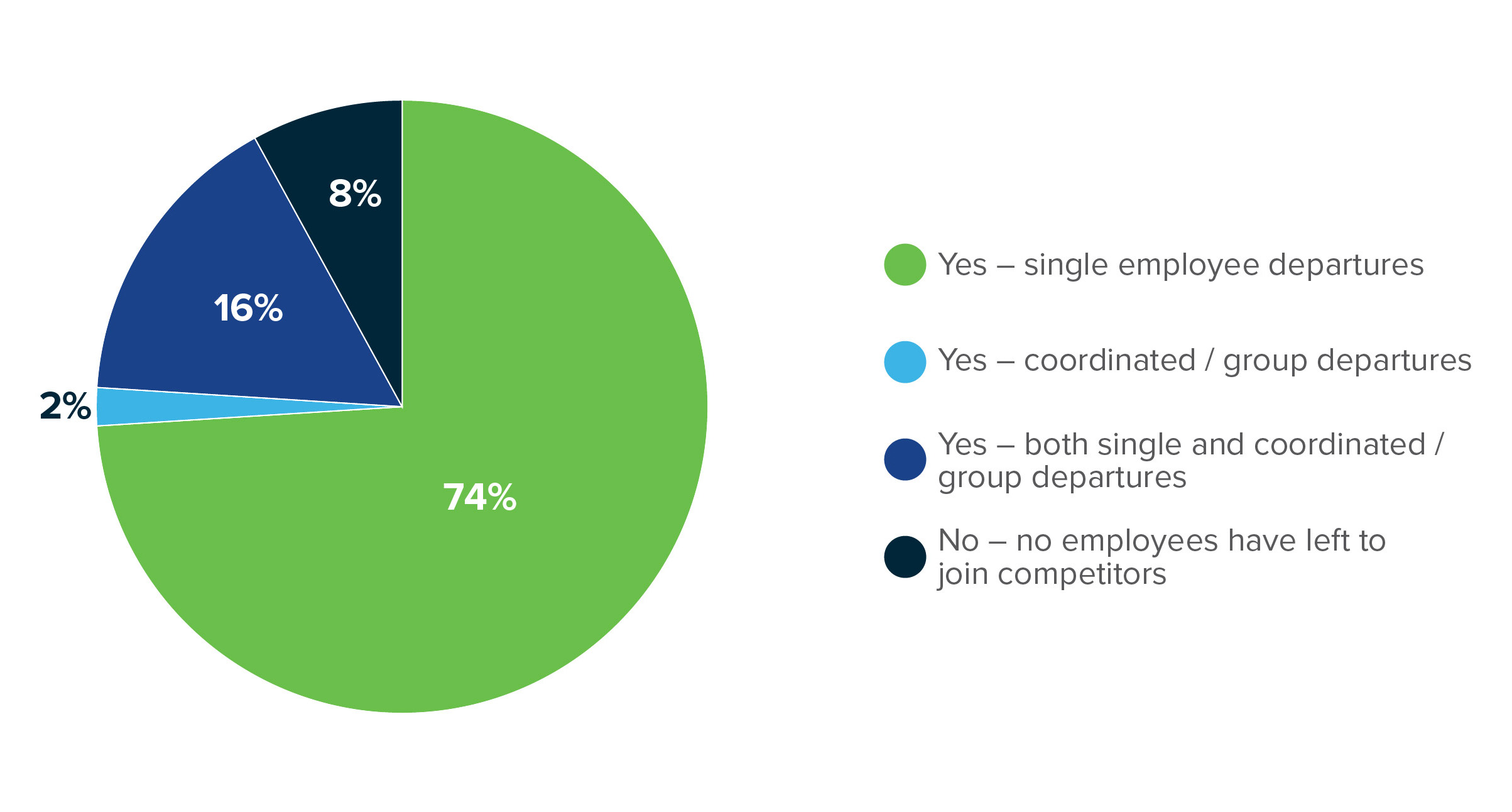
Employers are facing an increasingly complex landscape when it comes to employee mobility. According to the Littler® Annual Employer Survey Report 2026, released in May and completed by more than 300 executives across the U.S., 92% of employers reported employee departures to competitors over the previous 12 months.
For many, the departure was a single employee. But a meaningful share, 18%, experienced something more disruptive: coordinated group exits that can strip businesses of talent, weaken client relationships and expose proprietary information to rival organizations.
Over the past 12 months, have any of your employees departed to competitors?
What types of restrictive covenant and confidential information violations are most common when an employee leaves for a competitor?
Among employers that saw employees leave for rival companies, more than half, 55%, reported that some type of restrictive covenant or confidential information violation occurred. Specifically, respondents reported:
- 37% said employees exiting for a competitor copied, downloaded or removed confidential information
- 33% said employees violated their contractual non-solicit obligations
- 26% said employees violated non-compete agreements
- 23% said employees violated non-disclosure or confidentiality agreements
- 2% of employees used AI tools to access, extract or transfer confidential business information
While only a small percentage cited the use of AI tools to access, extract or transfer confidential information prior to departure, this type of behavior is likely occurring more frequently than employers realize and it is also likely to increase significantly as AI adoption continues to spread.
“We’re seeing a more competitive environment when it comes to employee mobility, with employees and competitors testing boundaries on non-compete agreements and use of confidential information. Employers are responding aggressively, including with litigation, when they believe their business interests are at risk.”
- Melissa L. McDonagh, co-chair of Littler’s Unfair Competition and Trade Secrets Practice Group
What can employers do to prevent – or at least identify – violations of restrictive covenants?
Beyond the traditional methods of taking confidential information, such as bulk email forwards or transfers to personal cloud accounts, it’s important for employers to strengthen monitoring systems to account for AI-enabled access. Can employees query sensitive data? Export it? Delete AI prompts and search histories? These are key questions for organizations to consider as they review confidentiality and computer-use policies on enterprise AI platforms to address these emerging risks.
What do employers do when employees break non-compete, non-solicit and non-disclosure agreements?
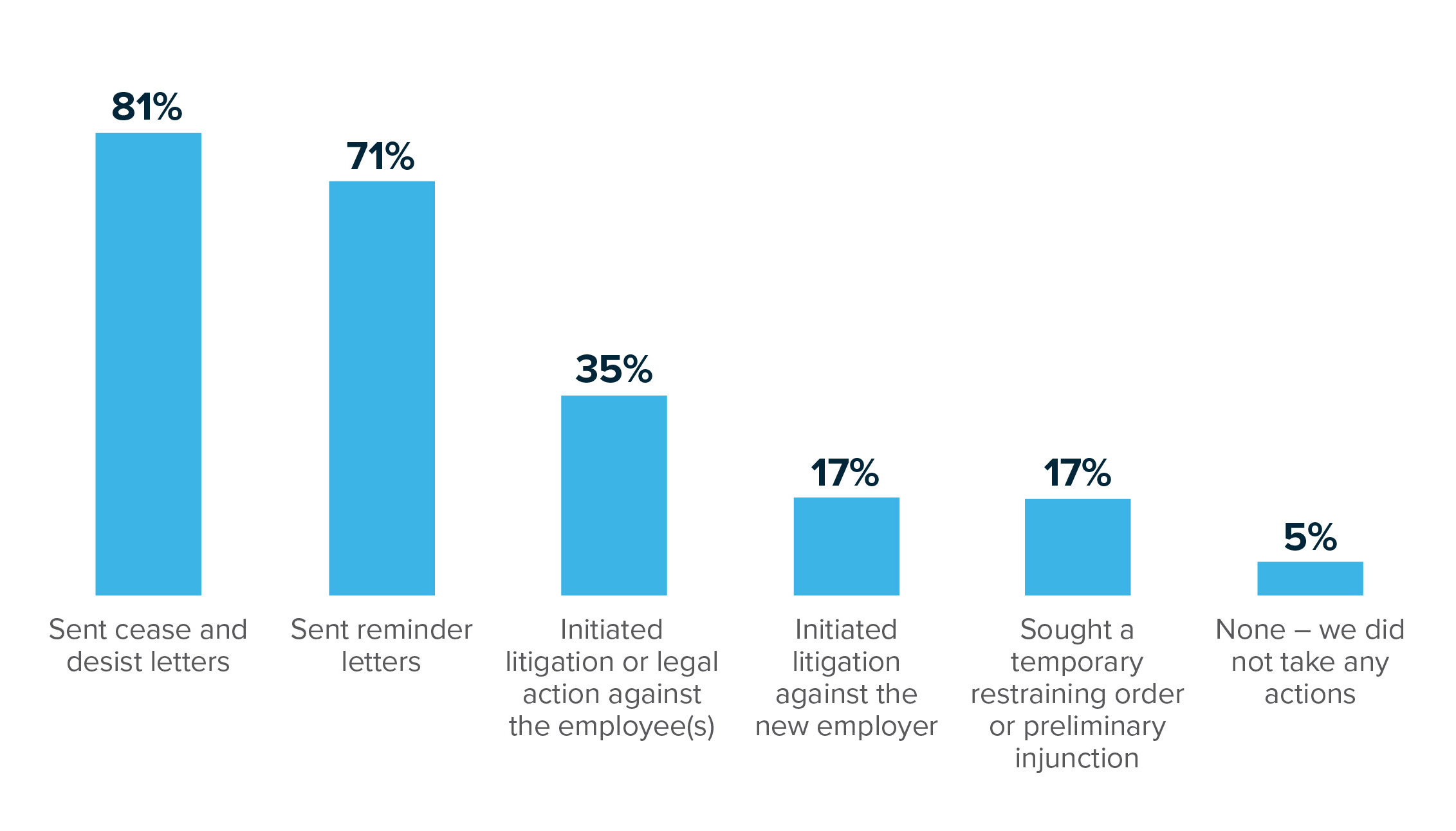
Employers are responding to restrictive covenant violations and/or misuse of confidential information assertively, according to Littler’s survey. When such a violation occurred, the most common first step was sending a cease-and-desist letter (81%), followed by a reminder letter about ongoing obligations (71%).
Only 5% of employers did not take any action following a restrictive covenant or confidential information violation.
What’s notable is how far beyond letters employers are willing to go: 35% of employers initiated litigation or legal action against the employees leaving for rivals. Another 17% initiated litigation against the new employer and an equal share sought emergency relief in the form of a temporary restraining order or preliminary injunction.
Did your organization respond with any of the following in response to the departure(s)? (Select all that apply)
This question was only posed to those whose organizations have had employees depart to competitors and where some type of restrictive covenant or confidential information violation occurred.
That a sizable percentage of employers facing violations chose to pursue litigation or legal action signals both that the stakes are high and that employers increasingly see litigation as a viable path.
Group departures prompt an even stronger response. Of the employers who reported coordinated or group exits and where violations occurred, 51% initiated litigation or legal action against employees, compared with 35% of all respondents – showcasing the significant impact that group exits can have on a business.
How can businesses prevent team lift-outs — and respond when they do happen?
Across industries, companies are increasingly focused on recruiting entire teams as a faster and less-expensive way to accelerate growth, acquire client relationships and bypass the slower process of building capabilities organically. For businesses facing departures, the challenge is not only responding to these events when they occur but also anticipating them as part of broader risk management strategy.
How to avoid an employee exodus in 4 proactive steps:
- Modernize employment agreements.
Employers should review contracts to check that they are current, enforceable and aligned with evolving state and federal law, as well as true legitimate business interests requiring protection. Beyond confidentiality and non-solicitation provisions, companies are incorporating stock forfeitures, clawbacks and deferred compensation provisions. Notice periods can also help slow coordinated exits and create critical response time, while multi-jurisdictional enforceability is increasingly important. - Enhance monitoring.
Implementing systems to detect potential coordinated departures, including monitoring for unusual access to sensitive information or large data transfers, can provide early visibility and time to respond before escalation. - Improve employee retention through culture and incentives.
Compensation matters, but culture is equally critical. Organizations that foster open communication may identify concerns earlier and, in some cases, retain key individuals who can provide insight into coordinated activity. Creating an environment where employees feel comfortable raising external opportunities can serve as an additional safeguard. - Develop a response plan for team lift-outs.
Response planning is an enterprise-wide resilience exercise. Legal, HR, IT and communications teams should align on response protocols, including internal messaging, forensic investigation, client outreach, and potential legal action. Having experienced counsel in place can be critical in time-sensitive situations.
“Group lift-outs remain a top concern for C-suite leaders, driven not only by talent loss but also by the trade secret removal and non-solicitation violations that often follow. Businesses can better position themselves to navigate this evolving dynamic by strengthening employment agreements, monitoring for early warning signs, and strengthening incentives to deter coordinated exits.”
- James M. Witz, co-chair of Littler’s Unfair Competition and Trade Secrets Practice Group
Read the complete Littler 2026 Employer Survey Report
Littler’s Unfair Competition and Trade Secrets Practice Group has extensive experience helping companies guard their valuable assets, effectively hire from rival companies and sustain their competitive edge.
The team has represented thousands of employers on complex and high-stakes matters involving protecting trade secrets, proprietary information and business relationships in today’s fast-paced commercial landscape. Littler attorneys represent companies across a range of sizes, industries and jurisdictions and the practice has been lauded by Lex Machina as a leader in both plaintiff and defense side trade secret litigation.
James M. Witz is a trial attorney and co-chair of the Unfair Competition and Trade Secrets practice group, based in Littler’s Chicago office. He helps businesses protect their confidential information, trade secrets and relationships as well as legally recruit employees from competitors. He has prosecuted and defended high-profile restrictive covenant and trade secret matters, including cases involving emergency and injunctive relief, in courts across the United States. You can follow James on LinkedIn.
Melissa L. McDonagh is co-chair of Littler’s Unfair Competition and Trade Secrets practice group. She partners with employers to protect and grow their businesses, including safeguarding intellectual property, retaining valuable employees and mitigating litigation risk. She works with employers to formulate effective restrictive covenant programs and represents businesses in disputes involving non-compete, non-solicit, trade secret and other unfair competition claims. You can follow Melissa on LinkedIn.