Littler Report
Littler’s Annual Report on EEOC Developments

Introduction
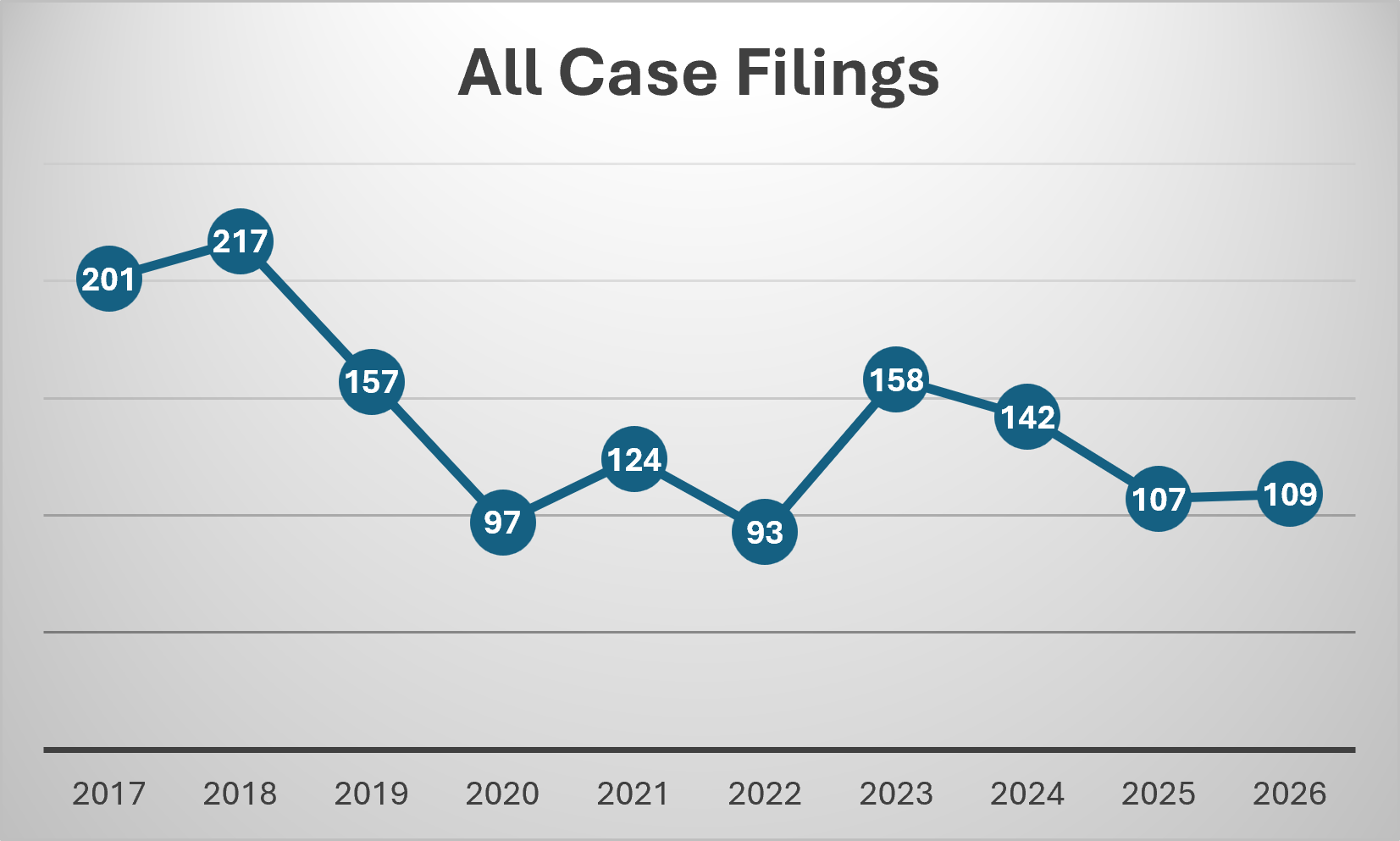
The U.S. Equal Employment Opportunity Commission (EEOC) completed its 2026 fiscal year on September 30, 2026. Based on our preliminary review of EEOC court filings, the EEOC filed approximately 97 “merits”1 lawsuits dealing with substantive issues, plus at least a dozen subpoena enforcement actions.2 This number is similar to the number of court filings in fiscal year 2025 and reflective of a general trend that the EEOC is filing fewer lawsuits.
As we look back over the past fiscal year, on June 4, 2026, the EEOC released its National Enforcement Plan, which highlighted EEOC Chair Andrea Lucas’ priorities and made express reference to the following “substantive categories of priorities”:
- Remedying DEI-related race and sex discrimination;
- Protecting American workers from anti-American national origin discrimination;
- Defending women’s rights to single-sex spaces at work and workers’ rights to express the binary nature of sex; and
- Protecting workers’ religious liberty rights to receive religious accommodations and be free from religious discrimination, harassment, and related retaliation.3
The EEOC court filings during the past fiscal year indicate that although the agency highly publicized litigation that involved its key priorities, the filings reflect a far more broad-based approach, which includes many of the same types of lawsuits the EEOC has filed in recent years. Notwithstanding, it is not “business as usual” at the EEOC.
Section I of this Report includes an overview of the EEOC’s litigation statistics based on the fiscal year that ended on September 30, 2026. Section II of this Report provides readers with some insights into both internal changes at the EEOC, which impact employers on a day-to-day basis in responding to charges of discrimination, and highlights the litigation the EEOC is filing around the country. Section II includes Littler’s “Top Ten Issues of Concern for Employers.”
We are hopeful that this Report will assist employers in their EEO compliance activities.
Section I – The Statistics: A Summary of EEOC Court Filings in FY 2026
Public records indicate the EEOC filed approximately 109 lawsuits in FY 2026.4 Of those lawsuits, at least 97 of them were merits filings, which included one lawsuit to enforce the terms of a settlement agreement, and at least 12 were subpoena enforcement actions. This number is about the same as last year’s filings, but down significantly from the 10-year average of 140 case filings per year.
- Continue reading
Focusing just on merits lawsuits (i.e., not including subpoena and preliminary relief actions), about 38% of cases the EEOC filed in FY 2026 included allegations the employer discriminated against the charging party or parties on account of their disability.
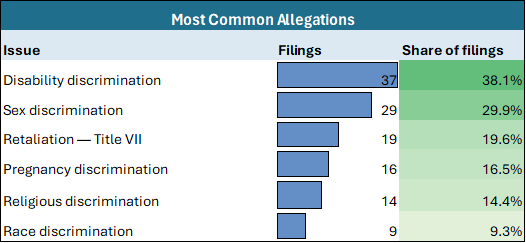
Notably, the number of case filings in FY 2026 alleging violations of the Pregnant Workers Fairness Act (PWFA) nearly doubled that of the prior year.
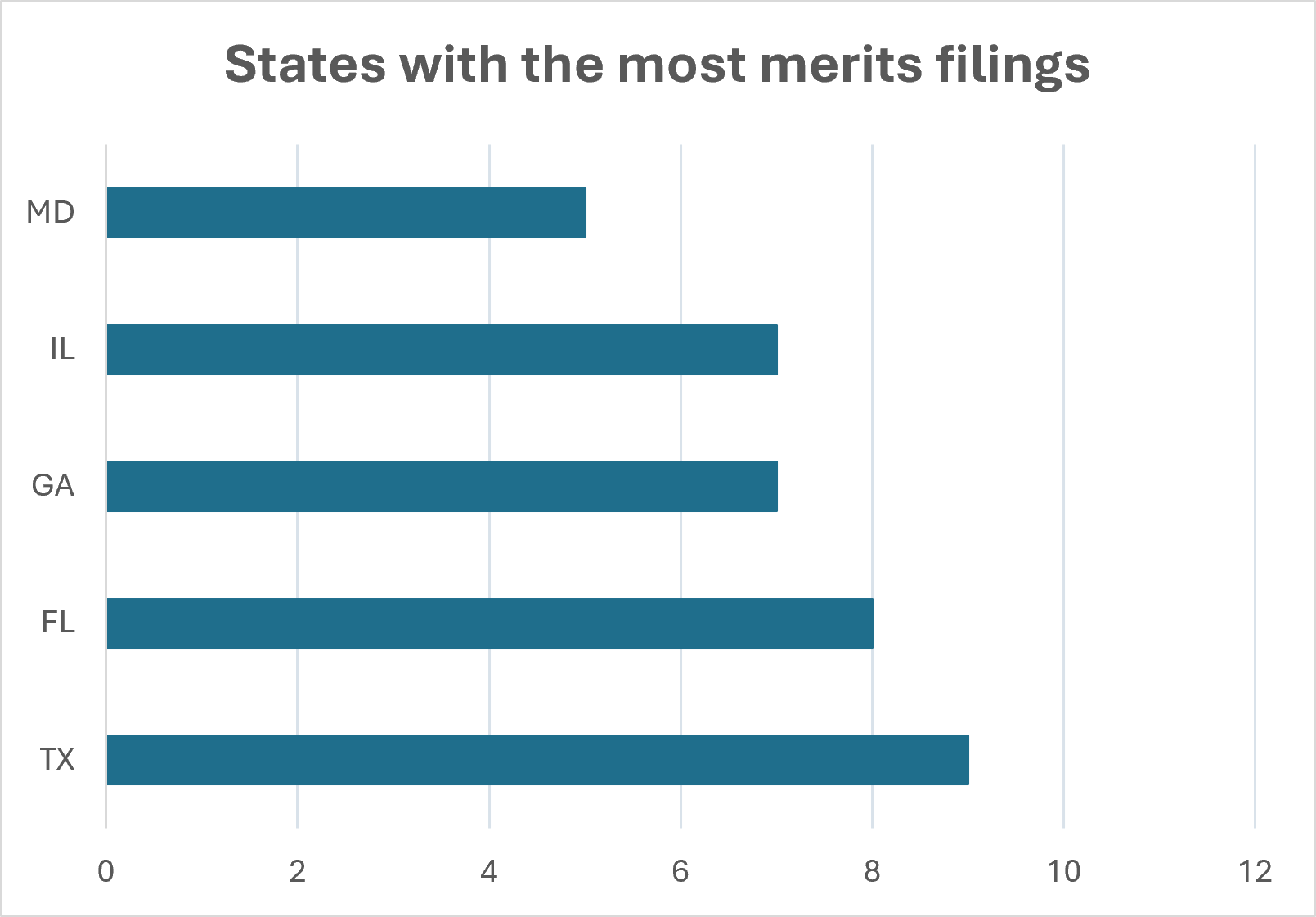
While cases were filed across the country, the most were filed in Texas, Florida, Georgia, Illinois, and Maryland.
Settlement Information at a Glance
Based on publicly available information, the EEOC entered into approximately 140 consent decrees and conciliation agreements in FY 2026, generating about $82 million in awards to affected parties. Note that a few settlement announcements did not disclose any monetary amounts, and not all conciliation agreements are reported. About 43% of FY 2026 settlements included allegations that the employer failed to accommodate an employee’s religion or disability, resulting in nearly $37 million in monetary relief.
Category
Settlements
Recorded Relief
Sex 50 $38.2M Disability 44 $34.0M Religion 19 $29.6M Pregnancy 17 $1.3M Age 11 $7.6M Race 11 $6.3M National Origin 8 $6.2M Sexual Orientation 1 $0.3M The majority of settlements involved allegations of sex discrimination and/or harassment, followed by disability discrimination. In keeping with the EEOC Chair Lucas’s priorities, the next most frequent protected categories represented in settlements were religion and pregnancy.
While review of these statistics is a useful starting point, we have included below a review and analysis of Littler’s “Top Ten” list that employers can consider as they engage in compliance activities with the EEOC.
Section II –Top Ten Issues of Concern in EEO Compliance
As discussed at the outset, over the past year, the EEOC has highly publicized EEOC Chair Lucas’s priorities, so employers need to be mindful of these issues of concern in their EEO compliance activities. Employer initiatives dealing with diversity and inclusion have been placed in the EEOC’s crosshairs. Employers also need to anticipate employees’ increased requests for religious accommodation. The EEOC may closely scrutinize these accommodation efforts in circumstances where employers deny requested accommodations in such circumstances. Employers with global operations and employers that have a practice of hiring foreign workers also must take care based on having to respond to potential anti-American national origin claims.
While we need to consider the chair’s priorities carefully, employers also need to be mindful of their day-to-day dealings with the EEOC. It has become abundantly clear that responses to EEOC charges and requests for information require a greater sense of urgency and timeliness by the employer community.
Based on all these considerations, employers have become aware that it is not “business as usual” at the EEOC. This Report reviews these recent developments at the EEOC
As significantly, aside from these developments, this Report addresses a broad range of claims that impact employers on a day-to-day basis. Various EEO compliance issues remain front and center, particularly failure to accommodate claims under the Americans with Disabilities Act (ADA), and more recently, requests for accommodation under the Pregnant Workers Fairness Act (PWFA). Employers also continue to face significant risk dealing with harassment claims, particular sexual harassment.
All of these issues are addressed below in Littler’s “Top Ten Concerns for EEOC Compliance.” Each item of concern is discussed below, one-by-one, as follows:
1. It Has Not Been Business as Usual at the EEOC
It has not been business as usual from two vantage points: (1) first, in terms of regulatory and administrative developments; and (2) second, in terms of day-to-day practice before the EEOC.
- Continue reading
Administrative and Regulatory Developments
The significant initiatives at the EEOC over the past fiscal year are better understood by looking back to the beginning of the Trump administration and the significant changes that began at that time. Included below is chronology of events, from the dramatic changes at the beginning of the new administration to the recent chain of events at the EEOC.
Date
Development
1/20/25
President Trump issued Executive Order 14151: Ending Radical and Wasteful Government DEI Programs and Preferencing, which seeks to end DEI programs throughout the federal government.
1/21/2025
President Trump issued Executive Order 14173: Ending Illegal Discrimination and Restoring Merit-Based Opportunity, which revokes numerous DEI-related executive orders issued by previous administrations, including a 60-year-old executive order requiring equal employment opportunity in government contracting.
1/21/2025
President Trump designated Andrea R. Lucas as acting chair of the EEOC. Lucas had served a commissioner of EEOC, having been nominated by President Trump during his first term. Her stated priorities include, “rooting out unlawful DEI-motivated race and sex discrimination; protecting American workers from anti-American national origin discrimination; defending the biological and binary reality of sex and related rights, including women’s rights to single‑sex spaces at work; protecting workers from religious bias and harassment, including antisemitism; and remedying other areas of recent under-enforcement.”
1/27/2025
President Trump fired two of the three Democratic commissioners on the five-seat commission. The president also fired EEOC General Counsel Karla McBride, who was confirmed during the Biden administration for a four-year term ending in 2027.
1/28/2025
Andrea Lucas issued a statement on her views on gender identity in the workplace, which occurred on the heels of President Trumps’s issuance of E.O. 14168, Defending Women From Gender Ideology Extremism and Restoring Biological Truth to the Federal Government, which directed all federal agencies to enforce laws governing sex-based rights based on the view that such laws are intended “to protect men and women as biologically distinct sexes.”
1/29/2025
President Trump issued E.O. 14188, Additional Measures to Combat Anti-Semitism.
2/12/2025
President Trump issued E.O. 14202, Eradicating Anti-Christian Bias.
3/19/2025
EEOC and the U.S. Department of Justice issued two technical assistance documents concerning DEI-related discrimination in the workplace.
4/23/2025
President Trump issued E.O. 14281, Restoring Equality of Opportunity and Meritocracy, which expressly provided that “disparate impact liability imperils the effectiveness of civil rights laws,” and further stated, “It is the policy of the United States to eliminate the use of disparate-impact liability in all contexts to the maximum degree possible…”
5/20/2025
Andrea Lucas issued a message affirming her commitment to “deprioritize ‘disparate impact’ enforcement – that is, investigations and lawsuits that challenge neutral employment practices that have unequal outcomes based on race, sex, or other protected characteristics,” explaining, “The EEOC is an executive branch agency, not an independent agency,” and we will fully and robustly comply with this and all Executive Orders.”
10/7/2025
The U.S. Senate confirmed the nomination of Brittany Panuccio to be a commissioner of the EEOC, restoring the agency to a quorum, which would enable the agency to move forward with any planned initiatives.
11/6/2025
President Trump designated Andrea Lucas as chair of the EEOC. Based on having been renominated for another term on March 24, 2025, the Senate confirmed her on July 31, 2025, for a term expiring on July 1, 2030.
1/22/2026
EEOC voted to rescind its Enforcement Guidance on Harassment in the Workplace.
1/23/2026
Although the EEOC historically granted significant authority to the regional attorneys to file suit based on what was described as the “delegation of authority,” the EEOC adopted a resolution to require Commission approval of almost all litigation, explaining, “The resolution returns to the EEOC Chair and Commissioners the authority to approve or disapprove new and intervening litigation.”
5/7/2026
The EEOC issued a lengthy press release highlighting its efforts over the prior 15 months under the leadership of Chair Lucas, captioned, “EEOC Delivers on Administration Priorities and President Trump’s Executive Orders,” focusing on the following for private-sector employers: (1) “EEOC Protects Religious Freedom”; (2) “EEOC Attacks DEI-Related Race and Sex Discrimination”; (3) “EEOC Protects American Workers From Anti-American Bias Involving Preferences for Foreign Workers”; and (4) “EEOC Defends Women’s Sex-Based Rights at Work.”
6/4/2026
EEOC released its National Enforcement Plan for FYs 2025-2029, which includes express reference to the chair’s priorities: remedying DEI-related race and sex discrimination; protecting American workers from anti-American national origin discrimination; defending women’s rights to single-sex spaces at work and workers’ rights to express the binary nature of sex; and protecting workers’ religious liberty rights to receive religious accommodations and be free from religious discrimination, harassment, and related retaliation.
The NEP also included reference to various “Substantive Categories of Priorities,” which: (1) “present a substantial issue of broader enforcement significance beyond the parties to the dispute,” including facially discriminatory policies (e.g., encouraging diverse candidates, guest worker visa holders, “PERM” applicants), mass denials of accommodations and systemic harassment; (2) matters involving intentional discrimination challenging broad-based employment policies on similar grounds; (3) cases having the potential of promoting the development of law supporting antidiscrimination purposes of the statutes enforced by the Commission; (4) cases protecting vulnerable workers (e.g., teenage workers, individuals in low-wage jobs, survivors of sexual assault, workers with developmental or intellectual disabilities); and (5) cases involving the integrity or effectiveness of the Commission (e.g. retaliation claims).
6/9/2026
The U.S. Justice Department issued a 25-page memorandum opinion to the EEOC stating that its guidelines on disparate impact liability under Title VII are “unconstitutional.”
7/10/2026
The EEOC published its 2026 Regulatory Agenda, which includes 10 regulatory projects. Most noteworthy was the EEOC’s reference to rescission of the following: (1) EEO-1 Form; (2) Uniform Guidelines on Employment Selection; and (3) affirmative action appropriate under Title VII.
7/21/2026
EEOC voted to approve a proposed rule to rescind a series of agency demographic reporting requirements, most notably the EEO-1 Form, which private employers of 100 or more employees have been required to file for decades.
8/11/2026
EEOC holds public hearing regarding the EEO-1. The comment period closed on August 24, 2026. The EEO-1 Forms remain in effect until a final decision is made based on review of the comments and hearing testimony.
8/26/2026
The EEOC issued its updated Strategic Plan for 2026-2030. The EEOC focused on the importance of being more strategic based on its limited resources. One minor change from the draft strategic plan, which was published on July 1, 2026, is the wording regarding “Performance Measure 3,” which relates to systemic investigations. Initially, the EEOC sought “targeted equitable relief and at least $1 million in monetary relief” for systemic actions. In the final strategic plan, Performance Measure 3 was modified to read: “The EEOC’s Systemic Program will focus on resolving complex systemic matters involving ten or more aggrieved individuals and will seek to achieve meaningful targeted equitable relief and monetary relief in such matters.”
10/16/2026
As part of the EEOC’s Agenda for 2026, the EEOC identified rescission of the Uniform Guidelines on Employee Selection in two parts: (1) rescission of the interpretive portions of the uniform guidelines (RIN [Regulation Identification Number] 3046-AB43); and (2) rescission of the record keeping portions of the Uniform Guidelines (RIN 3046-AB45).
The EEOC set November 2026 as the date for final action and January 2027 as the effective date for rescission of the interpretive portions of the Guidelines. It has been reported that on October 16, 2026, the EEOC sent to the Office of Information and Regulatory Affairs (OIRA) a final rule (RIN 3046-AB43) that would rescind the interpretive portions of the Uniform Guidelines.
Although the EEOC July Agenda (RIN 3046-AB45) also makes reference to rescinding the record-keeping provisions of the Uniform Guidelines (See, e.g., 29 CFR 1601.15), the EEOC has taken no action to date on this section of the Guidelines.
10/29/2026
The EEOC announced that on October 28, 2026, it voted to rescind the Enforcement Guidance on the Consideration of Arrest and Conviction Records in Employment Decisions. This action was not surprising because the Enforcement Guidance focused on potential liability under Title VII primarily based on the disparate impact theory.
11/3/2026
As a result of the mid-term elections, the House and Senate will be controlled by Democratic members for the remainder of President Trump’s term.
11/9/2026
President Trump nominated Matthew Zandi, a DOJ attorney in the Civil Rights Division, to be a member of the EEOC, for a term expiring July 1, 2031.
Of course, a question on many people’s minds is what effect, if any, will the dramatic shift in congressional power after the 2026 midterm elections have on the EEOC and its activities?
The Commission currently consists of Chair Andrea Lucas, Democratic Commissioner Kalpana Kotagal, and Republican Commissioner Brittany Bull Panuccio, with two vacancies and a vacant general counsel position. The current principal deputy general counsel, Catherine Eschbach, has been nominated to serve as general counsel, with her nomination possibly to be confirmed before this session of the current Republican-led Congress adjourns.
On November 9, 2026, President Trump nominated DOJ attorney Matthew Zandi to fill one of the Republican Commission seats. His nomination must also be confirmed by the Senate. If these nominations are not confirmed this year, a Democratic Senate in 2027 will give Democrats substantial leverage over any Trump nominees for those positions. The practical result may be a prolonged period in which the administration cannot develop the durable Republican majority it would prefer. That could complicate efforts requiring formal Commission action, including adoption or rescission of major guidance and certain litigation decisions, although Chair Lucas will continue to exercise substantial authority over the agency’s day-to-day enforcement agenda.
Regardless of the outcome of the nominees before the Senate, the upcoming Democratic Congress also is likely to exert considerably greater budgetary and oversight pressure on the EEOC’s enforcement choices. The administration’s FY 2027 budget request seeks approximately $455.45 million for the agency and contemplates enhanced enforcement capacity, including greater use of technology and data analytics for systemic investigations. A Democratic House and Senate could protect, or potentially increase, EEOC resources while attaching considerable political attention to how those resources are used. In particular, congressional committees can be expected to scrutinize the agency’s recent emphasis on alleged DEI-related race and sex discrimination, religious discrimination, national-origin discrimination associated with immigration or visa programs, and its retreat from some Biden-era policies concerning sexual orientation, gender identity, and disparate-impact theories. That oversight cannot ordinarily dictate outcomes in particular charges, but hearings, appropriations language, information demands, and investigations can impose meaningful constraints on agency leadership.
Over the longer two-year horizon, therefore, employers should expect an EEOC characterized less by a wholesale reversal of Trump-era enforcement priorities than by political and institutional friction. Chair Lucas can continue directing investigations, enforcement initiatives, technical assistance, and other activities within her existing authority, so employers should not assume that the election ends the agency’s scrutiny of DEI programs, religious accommodation, national-origin preferences, or other issues emphasized since 2025. At the same time, a Democratic Senate can block or extract concessions on nominees, while Democratic congressional committees can aggressively investigate controversial enforcement initiatives and use the appropriations process to protect programs the administration might otherwise reduce.
Over the next year, employers should anticipate that the EEOC will remain an active enforcement agency. Assuming Chair Lucas maintains a quorum, the EEOC most likely will continue to implement its planned initiatives, including elimination of EEO-1s and rescission of the Uniform Guidelines coupled with it disregard of disparate impact claims, coupled with Chair Lucas’ other priorities.
In the event that the new presidential nominee for EEOC commissioner is not approved prior to the Democrats taking over control of Congress, and the EEOC subsequently loses a quorum when EEOC Commissioner Kotagal’s term expires in July 2027, employers anticipated that Chair Lucas’ agenda increasingly will be implemented through individual investigations, commissioner charges, litigation strategy, and informal guidance rather than sweeping new Commission-approved policy initiatives.
Responding to EEOC Charges Has Not Been Business as Usual
In dealing with enforcement and day-to-day interaction with the EEOC, employers responding to discrimination charges filed with the EEOC are facing significantly shorter deadlines, according to our recent experiences. While the agency claims that it has not adopted a nationwide change in policy, the consistency of these reduced deadlines and tighter timeframes are dramatically affecting how employers and counsel respond to EEOC investigations. Whether this change will become permanent remains to be seen.
Over the past year, it has been reported that there have been significant efforts by Chair Lucas to reduce the backlog of discrimination charges at the EEOC. This has resulted in placing greater pressure on the EEOC district offices and investigators in the field to be more demanding of the employer community to have a greater sense of urgency in responding to charges of discrimination on a timely basis. There also has been more pressure on investigators to complete investigations that have been pending for long periods of time, particularly charges that have been pending for two years or more. We have been led to believe that on average investigations are now being completed within 180 days, it being understood that more complex charges obviously will remain pending for longer periods of time.
Under long-standing practice, employers generally have been given 30 days to submit a position statement, which is a written response explaining the company’s position regarding the allegations in a charge of discrimination. Although extensions have become more difficult to obtain in recent years, EEOC offices have often granted additional time when warranted by circumstances and where an employer can demonstrate it has been working in good faith to respond as soon as possible.
In recent months, the EEOC in numerous offices began reducing the required response period from 30 days to 15 days and at the same time adopted a much more restrictive approach to extension requests. While we have seen most EEOC offices return to the standard 30-day response period, the EEOC is currently less-favorably disposed to grant extensions. In circumstances where 30-day extensions previously were common, various offices have reduced the extensions to far shorter periods. As importantly, employers should be prepared to articulate legitimate business reasons for a requested extension. Employers also are being given a far shorter time period to respond to inquiries whether an employer is interested in mediation of a newly filed charge.
The EEOC’s anticipated approach to larger, more complex matters remains in flux. Cases involving multiple employees, extensive personnel records, disability or leave accommodation issues, or broader workplace practices often require substantial factual investigation before a meaningful response can be prepared. A shortened deadline could make that process more challenging.
In addition, employers also need to take care because the EEOC may now be less tolerant of late submissions. In some instances, the agency has issued cause findings days after a response deadline passed, including in cases where an employer requested an extension that was denied shortly before the due date and no subpoena or pre-subpoena letter was issued. These findings can be consequential because they may influence subsequent litigation or settlement discussions. Perhaps even more important, in some jurisdictions a trial court may exercise its discretion to admit EEOC cause findings into evidence in a subsequent lawsuit.
In light of these expected changes, employers may wish to evaluate their internal charge-response processes and implement practices designed to accelerate fact-gathering, witness identification, and internal review. When an employer determines that meeting the EEOC deadline is not feasible and is unable to obtain a workable extension from the EEOC, early coordination with experienced employment counsel can help assess available options, prioritize critical fact-gathering efforts, preserve defenses and objections, and develop an effective strategy for responding under compressed timelines. Employers that regularly respond to EEOC charges may wish to monitor this situation closely and evaluate whether their current procedures would allow them to meet substantially shorter response deadlines.
For the immediate future, employers need to evaluate their approach in responding to charges of discrimination carefully. In short, employers should anticipate that the EEOC will be less inclined to grant significant extensions either in response to charges of discrimination or EEOC requests for information.
As a final caveat, employers need to take care in electing mediation merely to gain additional time to respond to a charge. The agency will be closely scrutinizing both employers and attorneys handling responses to charges in such a manner.
2. EEOC Challenges to DEI Programs Remain Front and Center
Employer diversity, equity, and inclusion (DEI) programs have faced increasing legal and regulatory scrutiny over the past several years. “DEI” is not defined in Title VII of the Civil Rights Act of 1964, and the term may encompass a broad range of employer policies, programs, and practices involving recruiting, hiring, promotion, compensation, training, mentoring, sponsorship, internships, fellowships, leadership development, employee resource groups, and other employment opportunities. The EEOC’s position is that DEI initiatives may violate Title VII when an employer takes an employment action motivated, in whole or in part, by an applicant’s or employee’s race, sex, or another protected characteristic.
- Continue reading
The change in presidential administration in January 2025 brought a significant shift in federal enforcement priorities. On January 21, 2025, President Trump issued Executive Order 14173: Ending Illegal Discrimination and Restoring Merit-Based Opportunity. The executive order revoked Executive Order 11246, restricted federal-contractor workforce-balancing requirements, and directed federal agencies to identify and combat what the administration characterizes as unlawful private-sector DEI discrimination and preferences. The executive order did not amend Title VII, but it placed enforcement against certain DEI practices at the center of the administration’s civil-rights agenda.
On March 19, 2025, the EEOC and the U.S. Department of Justice issued two technical assistance documents concerning DEI-related discrimination in the workplace. The agencies emphasized that Title VII protects all applicants and employees and that an employer’s business justification, diversity objective, or interest in addressing underrepresentation does not authorize employment decisions based on race or sex. The EEOC further stated that an employment action may be unlawful if a protected characteristic was a motivating factor, even if it was not the sole reason for the decision.
The EEOC’s technical assistance document identifies a broad range of employment decisions and opportunities potentially subject to Title VII, including hiring, promotion, demotion, compensation, access to training, mentoring and sponsorship programs, internships, fellowships, and membership in employee resource groups. It also cautions against limiting, segregating, or classifying employees based on protected characteristics in a manner that affects their employment opportunities or status. In addition, the guidance explains that opposition to DEI-related employment practices may constitute protected activity when the employee reasonably believes those practices violate Title VII.
The Supreme Court’s June 2025 decision in Ames v. Ohio Department of Youth Services further reinforced that Title VII applies equally to all employees. In a unanimous decision, the Court rejected the Sixth Circuit’s “background circumstances” rule, under which a plaintiff who belonged to a majority group was required to make an additional evidentiary showing as part of the prima facie case. The Court held that the heightened requirement could not be reconciled with Title VII’s text or the Court’s precedents. Although Ames did not concern a DEI program, the decision removes an additional threshold that had applied to certain majority-group plaintiffs in some jurisdictions and may affect challenges alleging that an employer favored another group in furtherance of diversity-related objectives.
FY 2026 Developments
During FY 2026, the EEOC continued to elevate DEI-related race and sex discrimination as an enforcement priority. The agency’s public activity included direct communications with major employers, DEI-related investigations and subpoena-enforcement proceedings, and the express inclusion of DEI-related discrimination in its National Enforcement Plan.
Notably, on February 18, 2026, the EEOC sued a national corporation, alleging the company violated Title VII by limiting an employer-sponsored trip and networking event to female employees. According to the complaint, participating employees were excused from work and were not required to use paid time off to attend the 2024 event. The EEOC contends that excluding male employees from the event denied them an employment opportunity based on sex. The company moved to dismiss the complaint, arguing the event was a permissible outreach initiative intended to expand the pool of qualified female candidates and address an asserted underrepresentation of women, without altering the company’s selection processes to favor women. It further argued that the complaint did not allege actionable harm because the employees who did not attend the one-day event were not placed in a worse position.
On October 16, 2026, the court denied the company’s motion to dismiss,5 holding that the EEOC plausibly alleged a Title VII sex-discrimination claim. Applying the Supreme Court’s decision in Muldrow v. City of St. Louis, the court explained that a Title VII plaintiff need only show “some harm” with respect to a term, condition, or privilege of employment, and that the harm need not be significant. The EEOC plausibly satisfied that standard by alleging that the excluded male employees lost access to networking and executive-development opportunities, paid time away from their regular duties, and employer-funded benefits associated with the event, including lodging, food, and beverages. The court emphasized that the event’s status as a formal, employer-sponsored program supported the inference that these opportunities and benefits were connected to the participants’ employment.
The court also rejected, at the pleading stage, the company’s argument that the event was a permissible effort to expand the pool of qualified female candidates for promotion. The court distinguished neutral outreach or recruitment efforts that merely broaden a candidate pool from a program that allegedly provides current employees with employment-related opportunities and benefits based on sex. Even accepting the company’s position that attendance did not affect ultimate promotion decisions, the asserted pool-expansion objective did not necessarily justify excluding male employees from the networking, development, and other benefits associated with the event. The court therefore permitted the case to proceed, while leaving the company free to renew its arguments on a developed evidentiary record at summary judgment.
The EEOC’s FY 2026 DEI-focused activity has not been limited to merits litigation. On November 20, 2025, as part of the investigation of alleged discriminatory practices, the EEOC filed a subpoena-enforcement action in federal district court against a national insurance company arising from an employee’s allegation that the company denied him advancement based on sex, race, color, and national origin and retaliated against him after he complained about the company’s diversity policy. According to the EEOC, its subpoena sought information concerning advancement within the employee’s work group, the company’s DEI practices, its human-resources information systems, metrics used for financial rewards, and an interview with the company’s vice president of diversity and inclusion. The agency filed the action after it contended that the company had not voluntarily produced the requested information.
On February 4, 2026, the EEOC announced a separate subpoena-enforcement action against another national corporation. According to the agency, the investigation concerns alleged systemic disparate treatment of white employees, applicants, and training-program participants in hiring, promotion, demotion, separation and layoff decisions, internships, mentoring, leadership development, and other career-development programs. The subpoena sought, among other things, information regarding the criteria used to select employees for layoffs, the company’s tracking and use of race and ethnicity data, the possible use of demographic data in setting executive compensation, and 16 programs that allegedly provided race-restricted mentoring, leadership, or career-development opportunities. Some of the requests sought information dating to 2018.
These actions are significant not merely because of the underlying allegations, which remain to be adjudicated, but because they demonstrate the breadth of information the EEOC may seek when investigating an individual or systemic charge involving DEI programs. An investigation originating from a particular employment decision may expand to encompass company-wide demographic objectives, promotion and layoff criteria, executive compensation, internships, mentoring programs, employee-development opportunities, historical program materials, and workforce data.
The EEOC further emphasized its DEI enforcement posture on February 26, 2026, when Chair Andrea Lucas sent a letter to the chief executive officers, general counsel, and board chairs of 500 of the nation’s largest employers. According to the agency, those companies collectively employed more than 30 million workers. The letter reminded the recipients of the EEOC’s DEI-related technical assistance and stated that the agency was prepared to use its full range of enforcement tools, including education, administrative enforcement, and litigation, to address unlawful race- or sex-based employment practices.
The letter also emphasized that the EEOC will evaluate a program according to its substance rather than its name. It expressly identified functionally similar programs using labels such as “Inclusion & Diversity,” “Belonging,” “People & Culture,” and “Opportunity & Inclusion.” Thus, changing a program’s name will not address the underlying concern if the program continues to allocate employment opportunities or benefits based on protected characteristics.
On May 7, 2026, the EEOC issued a report describing actions taken during the first 15 months of the administration to implement the president’s executive orders and EEOC Chair Lucas’ enforcement priorities. The agency acknowledged that much of its investigative work remains confidential before a public settlement or the filing of a legal action. Accordingly, the number of publicly announced lawsuits and subpoena proceedings does not necessarily reflect the full scope of the agency’s DEI-related investigative activity.
The EEOC formally incorporated this enforcement position into its June 4, 2026, National Enforcement Plan for Fiscal Years 2025 through 2029. The plan identifies repeated, overt, or facially discriminatory policies, practices, and programs, as well as intentional discrimination resulting from broad-based employment policies or programs, as matters with a potential impact beyond the immediate parties. It also emphasizes the use of prevention, voluntary resolution, and litigation as components of the agency’s enforcement strategy.
Implications for Employers
The EEOC’s focus does not mean that all employer efforts to increase diversity, expand recruiting, remove employment barriers, or foster inclusion are unlawful. The principal concern under Title VII is whether an employer uses race, sex, or another protected characteristic in making an employment decision or determining access to an employment opportunity. Accordingly, employers should distinguish broadly accessible initiatives, neutral outreach efforts, and efforts to remove barriers from programs, which are not viewed as unlawful, as contrasted with employer policies or programs that utilize protected-class eligibility requirements, preferences, exclusions, or demographic quotas in recruitment, hiring, or other step in the employment process.
Programs warranting particular review include those involving race- or sex-based eligibility requirements; demographic objectives tied to individual employment decisions; interview or candidate-slate requirements; internships, fellowships, mentoring, sponsorship, or leadership programs restricted by protected status; employee resource groups that control access to tangible workplace opportunities; and incentive-compensation arrangements that may encourage decision-makers to favor particular demographic outcomes. The October 2026 decision discussed above illustrates that an employer-sponsored program need not directly determine hiring or promotion outcomes to create Title VII exposure. After Muldrow, restricting access based on a protected characteristic may be actionable where the program provides even comparatively modest employment-related benefits, such as networking with executives, professional-development opportunities, paid release from regular duties, travel, meals, or lodging. Employers should therefore evaluate not only formal selection criteria, but also who is eligible to participate in company-sponsored events and what tangible or intangible employment benefits participation provides.
Employers should also be mindful that historical materials may remain relevant to an EEOC investigation. One of the aforementioned subpoenas reportedly sought some information dating back to 2018, while another sought company-wide information regarding DEI practices and systems in connection with an individual employee’s charge. An employer therefore should not assume that renaming, revising, or discontinuing a program will eliminate scrutiny of earlier policies, communications, or employment decisions.
Ultimately, the relevant question is not whether an initiative carries a DEI-related label, but whether it causes an individual’s protected characteristic to affect access to employment, advancement, compensation, training, or another term, condition, or privilege of employment. Given the EEOC’s technical assistance, its FY 2026 subpoena-enforcement activity, and the priorities announced in its National Enforcement Plan, DEI-related policies and programs are likely to remain a significant area of agency scrutiny.
3. Employers Are Confronting Increased Religious Accommodation Challenges Involving Both Individual and Class-Based Claims
On her first day leading the EEOC, then-Acting Chair Andrea Lucas (now officially designated as “chair”) identified a number of her substantive priorities for the agency, including “protecting workers from religious bias and harassment.” This is unsurprising insofar as during the prior Trump administration, then-Commissioner Lucas co-chaired a working group that focused on the rights of religious workers and anti-religious discrimination in the workplace. She also supported the Commission’s revision of its guidance on religious discrimination, still in effect today, which places heavy emphasis on the need for employers to accommodate the religious practices of their employees.
- Continue reading
In the second Trump administration, Lucas has made good on her promise to prioritize the rights of religious workers in the Commission’s investigation and enforcement efforts. As detailed below, the Commission’s litigation docket has included a significantly increased number of cases involving allegations of religious discrimination and/or employers’ failure to provide reasonable accommodation for an employee’s religious beliefs or practices. Some have involved single-plaintiff allegations, while others rapidly developed into class-wide, multi-plaintiff actions. Indeed, religious-discrimination litigation appears to have become a larger share of the EEOC’s enforcement docket since the start of the second Trump administration (even before the Commission regained its quorum), and we predict that trend will continue.
All of this occurs at a time when an employer’s duty to provide religious-based accommodation remains an uncertain and developing area of the law since the Supreme Court’s decision in Groff v. DeJoy, which dramatically increased the burden on employers to deny a requested religious accommodation as an undue hardship.
Given Lucas’s stated priorities and long-standing interest in religious discrimination, and the favorable climate in many courts, we expect that the EEOC in its investigations and litigation will seek to construe DeJoy as broadly as possible in favor of religious workers and continue to make investigation and enforcement of charges of religious discrimination or harassment a focus. Lucas previously indicated her desire to hold employers accountable for what she views were overbroad actions involving religious employees during the COVID-19 pandemic, and indeed, a number of cases the agency has brought or resolved have focused on pandemic-era vaccine mandates.
In May 2026, the agency highlighted its litigation efforts on behalf of employes during the first 15 months of the administration, with protection of the “religious freedom” of employees first on the list. The report details not only the agency’s litigation and investigation efforts, but also the actions the agency has taken pursuant to White House executive orders, consistent with the chair’s publicly stated position that the EEOC is not an independent or quasi-independent agency, but rather an agency within the executive branch that reports directly to the president.
Under Executive Order 14202: Eradicating Anti-Christian Bias, Lucas was named a member of the Task Force to Eradicate Anti-Christian Bias, which, in April 2026, published a report alleging that the Biden administration’s prosecutions, policies, and practices demonstrated anti-Christian bias throughout the federal government. The EEOC worked closely with the Department of Justice to advance this effort, with a section of the report spotlighting the EEOC’s findings and work.
Relatedly, Executive Order 14188: Additional Measures to Combat Anti-Semitism, declared that it is the policy of the United States to combat anti-Semitism vigorously, using all available and appropriate legal tools, to prosecute, remove, or otherwise hold to account the perpetrators of anti-Semitic harassment and violence. Consistent with this order, in July 2025 the EEOC obtained a $21 million class settlement from a university to resolve charges alleging antisemitic harassment, including a Commissioner’s Charge brought by Chair Lucas on behalf of a class of Jewish employees. This resolution represents the largest EEOC public settlement in nearly 20 years for any form of discrimination or harassment. In addition, in the EEOC’s 60-year history, this is both the largest EEOC settlement for victims of antisemitism to date, as well as the most significant EEOC settlement for workers of any faith or religion.
More recently, in March 2026, the EEOC won a subpoena enforcement action against another university that the agency had filed in November 2025 as part of an antisemitism investigation arising out of a commissioner’s charge filed by Chair Lucas in December 2023. The university and the agency subsequently reached an agreement under which the EEOC would not enforce the district court order or otherwise seek the subpoenaed information for the duration of its existing investigation, while the university agreed to drop its appeal.
FY 2026 Litigation
In FY 2026, the EEOC brought more than a dozen lawsuits in federal court alleging discrimination on the basis of religion, representing almost 13% of the agency’s litigation docket. This represents a sizeable increase in the proportion of religion-based cases the agency has brought in recent years. The following are some examples of such litigation. In the majority of these lawsuits, the EEOC made an announcement about the case within a day of filing suit.
- On December 18, 2025, the EEOC filed suit against an Illinois health care system in the U.S. District Court for the Northern District of Illinois. The EEOC alleges that the company required employees to receive a COVID-19 vaccine unless they qualified for a religious exemption. A nurse requested an exemption based on her religious beliefs, but the company denied it even though it had previously given her a “lifetime” religious exemption from the flu vaccine. According to the EEOC, the company fired the nurse after she declined the COVID-19 vaccine because of her beliefs.
- On February 3, 2026, the EEOC filed suit against a hotel group in the U.S. District Court for the Northern District of Illinois. The lawsuit includes both pregnancy- and religion-related claims. The religious claims concern a front desk clerk who served as an assistant pastor at a Baptist church. In 2023, he asked not to work Saturday overnight shifts because they interfered with his ability to attend and sometimes lead Sunday morning church services. Although the company reportedly agreed to the request, it continued scheduling him for Saturday nights and later cut his hours after he objected.
- In March 2026, the EEOC sued a security services company. According to the EEOC’s complaint, in February 2024, the company told a security guard, a disabled veteran who had worked for the company part-time with Sundays off since March 2021, that his schedule would be changed to Saturday and Sunday. The guard told his supervisor that the new schedule would interfere with his religious beliefs because he is a devout Baptist and a deacon, and his faith requires him to attend church on Sundays. The company allegedly refused to alter the new schedule to accommodate his religious obligations, and the EEOC claims the guard was forced to resign.
- On March 24, 2026, the EEOC filed suit against a nationwide retailer in the U.S. District Court for the Middle District of Georgia. According to the EEOC, a Jewish assistant store manager had successfully worked for several months under a schedule that allowed him to observe the Sabbath. In early 2024, however, a newly assigned store manager demoted him and reportedly said she needed an assistant manager who could work on Saturdays.
- On March 26, 2026, the EEOC filed suit against another Illinois hospital in the U.S. District Court for the Northern District of Illinois. The EEOC says a certified surgical technologist requested an exemption from the hospital’s COVID-19 vaccine requirement in August 2021 because of her Christian beliefs. The hospital denied the request and terminated her employment in November 2021. The EEOC claims the hospital could have accommodated the employee without creating a significant burden and that firing her amounted to retaliation.
- On May 14, 2026, the EEOC sued a franchise restaurant in the U.S. District Court for the Western District of Texas. The EEOC alleges that an employee asked not to work on Saturdays because she observed Saturday as her Sabbath. According to the lawsuit, the company refused to adjust her schedule and fired her instead.
- On September 23, 2026, the EEOC filed suit against a hospital in the U.S. District Court for the Northern District of Ohio. The EEOC alleges that the hospital treated a Jewish orthopedic surgeon less favorably in the terms and conditions of his employment and later fired him because of his religion and race. According to the EEOC, this treatment occurred shortly after the October 7, 2023, terrorist attacks in Israel.
- On September 24, 2026, the EEOC sued a hospitality group in the U.S. District Court for the District of Nevada. The EEOC alleges that an employee requested permission to wear a headscarf as part of her religious practice, but the company failed to accommodate the request. The complaint further alleges that a human resources manager required the employee to obtain a clergy letter validating her religious practice because her practice did not comport with his personal views of Judaism. The employee informed human resources that she was unable to obtain a letter because she did not belong to a synagogue. The EEOC claims the employee was not allowed to return to work and was ultimately fired in July 2024.
Conciliation Agreements and Consent Decrees
In addition to the cases currently pending above, the EEOC settled a large number of cases either prior to instituting litigation, or by way of a consent decree resolving a previously filed case. The following are examples of such settlements.
- In December 2025, the EEOC settled for $175,000 a religious discrimination lawsuit against a company filed in May 2025. The lawsuit alleged the company failed to accommodate a sales executive’s request to observe the Sabbath in accordance with her faith in violation of Title VII, forcing her to choose between showing up for work or adhering to her religious practice, and leading her to resign. According to the EEOC, the companies initially allowed a Seventh-day Adventist employee not to work Saturdays because it was her Sabbath, but after management changed, the companies withdrew that accommodation and began scheduling her on Saturdays. The EEOC claimed that the employee repeatedly complained, but the Saturday scheduling continued, allegedly hurting her sales and commissions and forcing her to choose between her job and her faith.
- This conciliation agreement resolved a single-person matter through the EEOC’s New York District Office for $303,758. The case involved claims that the company failed to accommodate an applicant, refused to hire him for a management position, and retaliated against him. The EEOC found reason to believe that the company did not hire the applicant for a managerial job after he requested Friday evenings and Saturdays off to observe the Sabbath. The company allegedly offered him a lower-level position with a more flexible schedule but withdrew that offer after he again requested a religious accommodation.
- In August 2025, the EEOC announced a $1 million public conciliation with a national health care system. The conciliation followed a class-wide cause finding that the system failed to grant its employees religious accommodations to the employer’s vaccine mandate, instead terminating employees or withholding pay. In addition to recovering substantial monetary compensation for a class of employees, the EEOC also secured a commitment that the employer would offer to reinstate employees terminated for refusing to comply with the organization’s COVID-19 vaccine policy.
- In March 2026, the EEOC settled a single-plaintiff case against the non-profit association for $100,200. The matter involved claims that a Christian employee who was also a church leader needed time away from work to attend Sunday services and required church meetings. According to the EEOC, the employer did not provide the requested accommodation and retaliated against her, ultimately causing her to resign.
- In March 2026, the EEOC settled a lawsuit against a health care employer for $150,000 involving allegations of failure to accommodate an employee’s religious objections to a vaccine mandate. According to the EEOC’s lawsuit, the company unlawfully denied a remote employee’s request to be exempted from the provider’s mandatory COVID-19 vaccine policy as a religious accommodation. Ultimately, the EEOC alleged the company fired her in November 2021 for refusing to comply with the mandate.
- In September 2025, the EEOC reached an $80,000 public conciliation with a national restaurant chain to resolve an EEOC charge alleging that the company did not hire an applicant because of his request for a religious accommodation of Sundays off to observe his religious beliefs. The settlement required the company to provide back pay, compensatory and punitive damages, and revise written policies and procedures about religious accommodations. The restaurant also agreed to require training for employees, supervisors, managers, and human resources personnel on equal employment opportunity rights and responsibilities, with an emphasis on religious accommodation.
- One conciliation agreement resolved a class matter through the EEOC’s Phoenix District Office for $15 million. The matter involved both religion and disability, with claims that the company denied accommodations and terminated employees. The EEOC found reason to believe that the company rejected employees’ requests for religious or disability exemptions from its COVID-19 vaccination requirement and fired employees who declined vaccination.
- This consent decree resolved a class case in the U.S. District Court for the Northern District of Oklahoma for $4.25 million. The matter involved religion and disability, with claims that the company failed to provide accommodations and terminated over 40 employees. According to the EEOC, the company announced in fall 2021 that all employees had to receive a COVID-19 vaccine and that no exemptions would be allowed. Several employees nevertheless requested exemptions based on their religious beliefs, and one employee also submitted a doctor’s note concerning a medical condition. The company allegedly refused to discuss the requests and fired all employees who did not provide proof of vaccination on October 15, 2021, including those who had requested accommodations.
- This May 2026 conciliation agreement resolved a class matter through the EEOC’s Chicago District Office for $325,000. The matter involved religion and claims that the employer failed to provide accommodations. The EEOC found that the medical center denied faith-based exemptions from its mandatory flu vaccination policy at facilities across Illinois beginning November 10, 2023. According to the EEOC, affected employees were also prevented from earning an annual “vaccine incentive bonus” intended to encourage compliance with the vaccination requirement.
- This conciliation agreement resolved a class matter through the EEOC’s Los Angeles District Office for $358,000, along with changes to the company’s practices. The agreement resolved 12 discrimination charges involving religion. The EEOC contended that the employer improperly questioned whether employees’ religious beliefs were sincere and failed to provide accommodations to employees who objected to receiving a COVID-19 vaccine.
- This consent decree resolved a single-person case in the U.S. District Court for the Eastern District of Virginia for $150,000. The case involved religion and claims that a technology company failed to accommodate an employee who needed to be off from Friday sundown through Saturday sundown to observe the Jewish Sabbath. The company allegedly rejected the request because it conflicted with a new weekend scheduling policy. The EEOC also alleged that the store manager who denied the accommodation later fired the employee in January 2024 because of his religion and because he complained about the manager’s negative religious comments and the denial of his accommodation request.
- This consent decree resolved a single-person case in the U.S. District Court for the Southern District of Georgia for $65,000. The matter involved religion and a claim that the employer failed to provide an accommodation. The EEOC alleged that the grocery employer denied the employee an adjustment that would have allowed her to practice her religion. She is a member of the Church of Jesus Christ of Latter-day Saints and observes Sunday as the Sabbath.
- On September 29, 2026, the EEOC filed suit against a coffee bar in the U.S. District Court for the Southern District of New York. The EEOC alleges that the company failed to accommodate an employee’s Islamic religious practice and then terminated his employment. The EEOC also claims that the company retaliated against the employee after he requested a religious accommodation. In October 2026, the parties entered a consent decree requiring the company to pay $22,500 in damages to the employee, review its accommodations policy, and provide religious accommodation training.
- On March 31, 2026, the EEOC sued a contractor in the U.S. District Court for the District of Nevada. According to the EEOC, a Christian truck driver asked to return to a weekday shift so that he could attend Sunday morning church services. According to the EEOC’s complaint, the company continued requiring him to work Sunday mornings even after hiring a replacement, causing him to resign. The EEOC announced the lawsuit on April 3, 2026. The case settled in September 2026 for $60,000.
- On April 29, 2026, the EEOC filed suit in the U.S. District Court for the Southern District of Florida. The EEOC alleges that the employee, a Seventh-day Adventist, observed the Sabbath from Friday sundown through Saturday sundown and could not work during that period. She reportedly explained this restriction when she applied for a cabin service agent position and was hired in October 2023. Soon afterward, the company began scheduling her for Friday evenings and Saturdays. Although she repeatedly raised the conflict with supervisors and human resources, the company did not change her schedule and warned that she could be disciplined for missing Sabbath shifts. She resigned in December 2023. The case settled in May 2026 for $55,000.
- This conciliation agreement resolved a single-person matter through the EEOC’s Charlotte District Office for $65,231. The matter involved claims that the employer failed to provide a religious accommodation and terminated the employee. The EEOC found reason to believe that an employee requested time away from work for a Muslim religious holiday, but the company denied the request. Although the company knew she needed a religious accommodation, it allegedly did not meaningfully discuss possible arrangements with her and instead fired her in June 2025 when she did not report to work.
- This consent decree, announced in September 2026, resolved a single-person case in the U.S. District Court for the Eastern District of Wisconsin for $20,000. The matter involved religion and a claim that the employer terminated the employee because of his religious expression. According to the EEOC’s complaint, the employee regularly posted religious messages on his personal social media account. The posts did not mention his coworkers or his workplace, and the business received no customer complaints about them. In June 2023, an operations manager asked him to stop posting religious messages that expressed anti-gay views. Three days later, he posted a Bible verse, and the company allegedly fired him that same day because of the post alleged.
- This conciliation agreement resolved a class matter through the EEOC’s Memphis District Office for $2.8 million. The matter involved religion and disability, with claims that a national security company failed to provide accommodations and retaliated against employees in connection with a COVID-19 vaccine mandate. After a broad investigation, the EEOC found reason to believe that the company had denied accommodations based on employees’ sincerely held religious beliefs or disabilities.
- This conciliation agreement resolved a single-plaintiff matter through the EEOC’s Milwaukee Area Office. The settlement amount is not available, but additional non-monetary terms relating to accommodation requests and training are included in the settlement agreement. The matter involved religion and a claim that the company failed to provide an accommodation. The EEOC found reason to believe that the company did not fully consider a religious employee’s request to use pronouns based on biological sex when referring to a transgender employee. The employee had explained that using other pronouns conflicted with his sincerely held religious beliefs. According to the EEOC, problems in the company’s handling of the accommodation request contributed to the employee’s resignation.
- This conciliation agreement resolved a single-person matter through the EEOC’s Houston District Office for $650,000. The EEOC alleged that an employee asked not to participate in providing gender-affirming care to minor patients or performing related duties because of her religious beliefs. According to the charge, the hospital discharged the employee after she requested the accommodation.
Nothing suggests to us that the EEOC will be less vigilant in policing the rights of religious employees in the remaining two years of the Trump administration. Given the uncertain and evolving legal standards governing religious accommodation in the workplace, the increased focus and attention of the agency and its leadership, and the increased receptiveness of courts to claims of religious discrimination and failure to accommodate, employers are advised to treat any such request seriously and in consultation with counsel.
4. ADA Lawsuits and Related Claims Remain One of the Most Significant Risks to Employers
Historically, EEOC charge filings involving ADA claims have been among the highest number of charges filed against employers, and the same can be said regarding ADA lawsuits filed by the EEOC. First, with respect to discrimination charges, ADA claims generally have involved over 35% of the charges filed, and during the prior fiscal year over 40% of all discrimination charges filed at the EEOC included an alleged disability discrimination claim.6 Similarly, a large percentage of lawsuits filed by the EEOC have included ADA claims. Over the past several years, on average, over one-third of all EEOC lawsuits include disability discrimination claims.7
- Continue reading
While the EEOC typically delays making available charge filing statistics until at least several months after the end of the fiscal year, and discrimination charges are not subject to disclosure under FOIA, lawsuits filed by the EEOC are a matter of public record. Based on our preliminary review of lawsuits filed by the EEOC during FY 2026, approximately 37 out of 97 “merits” based lawsuits filed by the EEOC involved disability and related claims, or 38%. In short, similar to prior years, for FY 2026 (which ended September 30, 2026), ADA and disability-related claims involved an extremely large percentage of lawsuits filed by the EEOC.
In reviewing the ADA lawsuits filed by the EEOC during FY 2026, it is helpful to understand the issues the EEOC is focusing on. Aside from the typical EEOC lawsuit challenging an employer’s termination that immediately followed denial of an employee’s request for a purported “reasonable accommodation,” the lawsuits filed over the recently completed fiscal year focus on claims such as:
- Failure to hire;
- Denials of return-to-work following leaves of absence including challenges to “100% healed” and “fully recovered”-type policies and/or practices;
- Failing to accommodate disabilities (and pregnancy) based on attendance policies;
- Failure to accommodate pregnancy, which includes Pregnant Worker Fairness Act (PWFA) claims coupled with ADA claims;8
- Failure to accommodate applicants and/or employees with hearing and/or visual impairments: and
- Denial of the accommodation of remote work based on medical-related grounds.
Among these lawsuits filed by the EEOC, at least five involve class-type claims. Discussed below is a more detailed review of various ADA lawsuits filed by the EEOC.
Failure to Hire Lawsuits
The EEOC’s National Enforcement Plan (NEP), signed off on by Chair Lucas on June 4, 2026, included “several categories of substantive priorities, including cases that present a substantial likelihood of broader impact beyond the parties involved,” and one area identified was “Company-wide policies or practice that run afoul of antidiscrimination employment laws such as mass denials of accommodations.”
Over the past fiscal year, the EEOC’s failure-to-hire lawsuits have been included among the lawsuits involving “mass denials of accommodations.” As an example, one recent court filing involves a “class claim” challenging a pre-employment test in which the employer relied on a third party to conduct a post-offer physical examination that included a Pulmonary Function Test (PFT).9 The PFT measures the lung volume and airflow of the applicant to purportedly determine if the applicant is medically able to use a respirator. The EEOC alleges that the employer, which builds and designs aircraft, did not maintain an adequate process for applicants with disabilities to request reasonable accommodations in connection with the PFT test and alleges that the employer “uses the PFT test as an exclusionary qualification standard rather than a safety driven assessment.”10
In a second failure-to-hire class claim, the triggering action involved an employer that allegedly unlawfully questioned a job applicant about using methadone as part of medication-assisted treatment for opioid addiction and then refused to hire him because of his answer. The EEOC used this as a springboard to bring a class claim alleging that the employer maintained a longstanding company policy prohibiting employment of workers who take methadone and unlawfully excluded a class of workers based on this policy.
The remaining failure-to-hire claims involve a broad range of issues, including: (1) denial of a request by a driver to allow her to drive with a service dog as an accommodation; (2) rejection of an applicant for a housekeeping position after disclosing that she was deaf; (3) failing to hire an applicant with ADHD by refusing the reasonable accommodation of being permitted to provide his prescription medication list in order to pass a drug test;11 (4) allegedly rescinding a job offer for work as deckhand on a towboat and barge company based on the results of an applicant’s pre-employment color vision test; (5) denying employment to a registrar position at a health care facility after a conditional offer and subjecting him to an occupational health evaluation and using the results of the medical exam and related inquiries; and (6) rescinding a job offer to a military veteran following a post-offer medical examination in which he disclosed a past medical injury.
Leaves of Absence and “100% Healed” and “Fully Recovered” Policies Prior to Being Permitted to Return to Work
The courts have long held the “100% healed” and similar types of restrictions are unlawful based on the obligation to make reasonable accommodations for employees to return to work following a leave of absence.12 Over the past year, the EEOC also filed several lawsuits challenging employer policies that were viewed as having “100% healed” or “fully recovered” policies prior to returning employees to work. As an example, the EEOC recently filed a lawsuit against a health care facility based on the allegation that the employer “failed to accommodate an employee’s disability and discharged him from employment when he was not able to return to work at 100% capacity,” underscoring in its press release, “Engaging in an interactive process with the employee to identify reasonable accommodations is a key component of that process, and should be a good-faith, collaborative dialogue between the employer and the employee.”
The EEOC filed a similar claim against another health care entity in circumstances in which the employee applied for reassignment to another position based on certain work limitations. The employee was unable to perform his prior job based on having a fractured foot with torn tendons, but applied for a vacant receptionist position. The EEOC filed suit based on the employee’s rejection for the receptionist position and subsequent termination by the employer, explaining, “Although a vacant receptionist position in which the employee could perform with her restrictions existed, [the employer] did not reassign her. Instead, [the employer] fired the employee and stated in its termination letter that she would not be eligible for rehire until she was ‘fully recovered’ or had ‘a release for full duty.’”
Risks Posed by Employer Attendance Policies that Fail to Accommodate Disabilities (and Pregnancy)
Over the years, numerous employers have set up attendance policies with “incidents” or “points” that lead to progressive discipline, up to and including termination. In general, courts have upheld the view that regular, reliable attendance is an essential function of the job.13 EEOC guidance also has long accepted the view that unreliable attendance may result in the employee being unqualified for a job, but this basic standard must be balanced against the general requirement of making reasonable accommodations if requested by employees based on a disability.
The EEOC’s views on attendance are best stated in the EEOC longstanding ADA guidance that includes the following Q&As:
19. Does the ADA require employers to modify attendance policies as a reasonable accommodation, absent undue hardship?
Yes. If requested, employers may have to modify attendance policies as a reasonable accommodation, absent undue hardship. Modifications may include allowing an employee to use accrued paid leave or unpaid leave, adjusting arrival or departure times (e.g., allowing an employee to work from 10 a.m. to 6 p.m. rather than the usual 9 a.m. to 5 p.m. schedule required of all other employees), and providing periodic breaks.
20. Does the ADA require that employers exempt an employee with a disability from time and attendance requirements?
Although the ADA may require an employer to modify its time and attendance requirements as a reasonable accommodation (absent undue hardship), employers need not completely exempt an employee from time and attendance requirements, grant open-ended schedules (e.g., the ability to arrive or leave whenever the employee’s disability necessitates), or accept irregular, unreliable attendance. Employers generally do not have to accommodate repeated instances of tardiness or absenteeism that occur with some frequency, over an extended period of time and often without advance notice. The chronic, frequent, and unpredictable nature of such absences may put a strain on the employer’s operations for a variety of reasons, such as the following:
an inability to ensure a sufficient number of employees to accomplish the work required;
a failure to meet work goals or to serve customers/clients adequately;
a need to shift work to other employees, thus preventing them from doing their own work or imposing significant additional burdens on them;
incurring significant additional costs when other employees work overtime or when temporary workers must be hired.
Under these or similar circumstances, an employee who is chronically, frequently, and unpredictably absent may not be able to perform one or more essential functions of the job, or the employer may be able to demonstrate that any accommodation would impose an undue hardship, thus rendering the employee unqualified.
While the above-referenced EEOC guidance provides that reasonable accommodations may not be required for employees with disabilities who have “chronic” attendance problems, several recent lawsuits filed by the EEOC illustrate that care must be taken in the administration of attendance policies, which should include accommodations for those with protected disabilities.
Risks also may arise when relying on third parties who assist in the administration of an employee leave, such as under the Family and Medical Leave Act (FMLA) as well as leaves based on disabilities and pregnancy, particularly when there are communication missteps with such third-party administrators. This is best illustrated by a recent EEOC lawsuit, which refers to a claim stemming from a long-term employee informing the company of her cancer diagnosis and need for intermittent leave to receive and recover from chemotherapy treatments. The employer referred the employee to its third-party benefits administrator, but the leave was never granted. According to the EEOC, the employee allegedly accrued attendance points for cancer-related absences and was thus improperly fired for violating the company’s attendance policy because the employer failed to make reasonable accommodation for the employee based on its attendance policy.
In another EEOC lawsuit the EEOC again challenged an employer’s attendance policy in circumstances in which it failed to accommodate an employee whose absences stemmed from her pregnancy, and such actions led to the employee’s termination. In a detailed, 130-paragraph complaint, the EEOC challenged the employer’s administration of its attendance, taking the view that the employee “did not accrue the 12 points necessary to trigger termination pursuant to Defendant’s attendance policy, but even if she had, the assessment of such points was discriminatory and/or retaliatory,” and the employee “was entitled to reasonable accommodation in the form of excusing absences related to pregnancy and/or related medical conditions and/or disability or refraining from assessing points for them.”14
Visual and Hearing Impairments
Over the past year, we have seen a continued focus on various claims on behalf of individuals with both hearing and visual impairments. This included claims challenging an employer’s refusal to hire a deaf applicant for a warehouse job, despite having several years of prior experience in comparable roles, and refusing to hire an individual for a housekeeper position after learning the about the applicant’s deafness based on reported prohibited medical inquiries and qualification standards requiring applicants “to hear and see within normal ranges and communicate verbally.”
Failing to Permit Remote Work as an Accommodation
While various employers have begun to cut back on remote work or eliminate it entirely, failing to permit remote work as an accommodation may pose risks under the ADA, particularly where justified by an employee on medical grounds.
Noteworthy ADA Settlements
While several ADA settlements approached or exceeded $500,000, the only reported settlements that exceeded $1 million involved ADA claims that were coupled with religious discrimination claims based on employees who refused to be vaccinated based on reported disabilities or based on their religious beliefs during the COVID pandemic.
5. Sex Discrimination Lawsuits, Particularly Those Alleging Pregnancy Discrimination, Are on the Rise
Increased Protection for Pregnant Workers
As most readers are aware, in December 2022, Congress enacted the Pregnant Workers Fairness Act (PWFA), which became effective June 27, 2023.
The requirements of the PWFA go beyond the requirements of the ADA because the statute expressly covers physical or mental conditions related to “pregnancy, childbirth, or related medical conditions,” even in circumstances where such conditions do not meet the definition of a “disability” under the ADA. As significantly, the reasonable accommodation obligations are broader than those under the ADA. While a “qualified individual with a disability” under the ADA must be able to perform the “essential functions” of the job with or without reasonable accommodation, the PWFA goes one step further. In short, based on the PWFA, a “qualified employee” is not required to be able to perform the essential functions of the job if: (1) any inability to perform an essential function is for a temporary period; (2) the essential function could be performed in the near future; and (3) the inability to perform the essential function can be reasonably accommodated.
- Continue reading
While the status of the regulations interpreting the PWFA, which became effective on June 18, 2024, are in flux because Chair Lucas voted against the regulations when they were approved by the Commission,15 the express terms of the PWFA will remain in effect. Based on litigation filed by the EEOC over the past several years, including the time period that Andrea Lucas has served as acting chair and chair, it is abundantly clear that the EEOC will vigorously enforce the PWFA.
Increased Annual Court Filings Under PWFA
There has been a steady increase in EEOC lawsuits based on the PWFA each year since the Act went into effect. Among the lawsuits filed since the effective date of the PWFA, 5 lawsuits were filed in FY 2024, 7 in FY 2025 and at least 12 in FY 2026. As an example, in the final days of FY 2026, the EEOC filed four PWFA lawsuits.
Failure to accommodate claims appear to be at the heart of many of the pregnancy discrimination lawsuits filed over the past fiscal year. While some lawsuits have involved the failure to hire applicants who disclose their pregnancy during the hiring process, the vast majority of claims have involved failure to accommodate pregnant workers. A review of recent EEOC court filings demonstrate the broad range of circumstances in which risks may arise under the PWFA:
- One lawsuit allegedly followed shortly after a pregnant desk clerk asked for a suitable chair, which was provided and then taken away, and her termination followed soon thereafter.
- In another EEOC lawsuit, the employee, who was a nursing mother, allegedly requested an accommodation at her workstation to maintain her breast milk supply, continued such requests and others, including being permitted to keep a water bottle at her workstation, and was terminated following these accommodation requests.
- A third lawsuit by the EEOC dealt with an experienced equipment operator who requested transfer from “working on the most physically jarring machinery” to perform other work within her job description as an accommodation during her high-risk pregnancy, but instead was placed on an involuntary leave for several weeks. Although she subsequently was permitted to return to work, the company allegedly first “assigned her to work inconsistent with her medical restrictions” and then moved her again into a “menial office job with reduced earning potential. Pregnancy discrimination allegations were coupled with a retaliation claim.
Overlap Between ADA and PWFA
When bringing claims against employers involving pregnant workers, employers should expect that the EEOC frequently will assert claims on behalf of both the ADA and Pregnant Workers Fairness Act, where appropriate. As an example, in one of its recent filings, the EEOC asserted three causes of action: (1) PWFA violations; (2) Title VII violations alleging that the employer’s actions adversely affected her status as an employee because of her sex, including pregnancy and/or related medical conditions; and (3) ADA violations because the employee was discriminated against on the basis of a disability and the failure to make reasonable accommodations on behalf of the employee.16
While the EEOC may seek relief based on both statutes, employers need to be reminded that the PWFA has provisions that are unique, and as referenced above, obligations also may arise in circumstances in which an employee’s pregnancy or medical condition do not rise to the level of a “disability” under the ADA. In short, employers need to be mindful of the unique issues that may arise under the PWFA.
Other Sex Discrimination Lawsuits Filed by the EEOC
While many sex-based claims the EEOC has filed in recent years focus on sexual harassment,17 the EEOC also filed various lawsuits over the past fiscal year tied to sex discrimination involving disparate treatment in pay and conditions of work:
- The EEOC filed a class-based claim lawsuit against a trucking firm alleging unlawful disparate treatment of female student drivers, which included a practice of allowing male trainers to refuse to train female student drivers because of their sex; maintaining a sex-discriminatory compensation policy that denied pay to female student drivers who indicated a preference for a female trainer while not denying pay to male student drivers who indicated a sex-based trainer preference or other student drivers who stated other trainer preferences; and implementing a sex-discriminatory policy requiring female student drivers to certify that they notified their spouse and/or partner that they opted to potentially be trained by a male trainer while not requiring male student drivers to do the same.
- The EEOC also allegedly refused to hire a class of female job applicants for field positions in a tree-trimming business.
- The EEOC did not limit its legal actions to class-type claims, as illustrated by a lawsuit pursued on behalf of an individual charging party involving a claim of disparate treatment, alleging that an employer held the charging party to a heightened standard of discipline compared to a male counterpart. According to the EEOC, the employee fired a longtime female employee who worked as a van driver, despite the fact it allegedly did not discipline or terminate a male employee who was involved in nearly identical conduct only months earlier.
- Similarly, the EEOC filed an Equal Pay Act claim against a university that paid a “female solutions architect” less than a male employee holding the same position. The EEOC charged that the employer continued to pay the male employee a higher salary even after the female employee obtained a master’s degree in a related field, which fell under the preferred qualifications for the job.
Noteworthy Sex Discrimination Settlements
In addition, over the past fiscal year, the EEOC reported a number of seven-figure settlements tied to allegations of sex discrimination involving failure to hire, pay discrimination, discriminatory working conditions, and retaliatory conduct, demonstrating that these cases can present significant risks to employers, such as the following:18
- A $5.5 million settlement was announced on April 30, 2026, in a lawsuit filed in the District of Arizona involving a claim that a trucking firm engaged in a nationwide practice of failing or refusing to hire qualified female truck drivers because of their sex.19
- On June 9, 2026, in a settlement in the District of Massachusetts, an employer agreed to a $2.8 million settlement involving an alleged pattern or practice of discrimination against female production workers based on a claim that jobs were segregated by sex and female production workers were paid less than male production employees despite performing similar and comparable manufacturing work.20
- A $2.6 million settlement was announced on July 22, 2026, in the Northern District of Alabama involving an employer engaged in removing, recycling, and disposal and repair of electrical equipment based on allegations of a pattern or practice of failing to hire a class of women available to accept laborer positions at its facility.21
On October 1, 2025, in the Northern District of Ohio, a machining and steel fabrication company agreed to a $2 million settlement involving an alleged pattern or practice of denying production positions to women job seekers who applied or were available for work and otherwise discriminating against women hired for production jobs and engaging in retaliatory conduct.22
6. Harassment Lawsuits by the EEOC Continue to Create Risks for the Employer Community
While the EEOC’s vote to rescind the EEOC’s harassment guidance on January 23, 2026, which previously had been approved in April 2024 during the Biden administration, was not surprising, this rescission of the Guidance should not be interpreted as the agency’s turning its back on harassment claims.
- Continue reading
Longstanding View by Chair Lucas that Harassment Guidance Was Overly Broad
The EEOC previously approved and issued its “Enforcement Guidance on Harassment in the Workplace” by a 3-2 vote in 2024 during the prior administration. Andrea Lucas, then sitting as one of two Republican-appointed commissioners on the EEOC, voted against the guidance based on her view that there are only two sexes, and that based on the guidance, unlawful harassment included “denial of access to a bathroom or other sex-segregated facility consistent with [an] individual’s gender identity”; and that harassing conduct include[d] “repeated and intentional use of a name or pronoun inconsistent with [an] individual’s known gender identity.”
Following President Trump’s election, based on Executive Order 14168: Defending Women from Gender Ideology Extremism and Restoring Biological Truth to the Federal Government, President Trump directed the EEOC to rescind portions of the guidance that conflicted with the executive order. Immediately in response to issuance of this executive order, newly appointed Acting Chair Lucas declared, “The Commission’s harassment guidance was fundamentally flawed….It ignored biological reality, effectively eliminated single-sex workplace facilities, and impinged on all employees’ rights to freedom of speech and belief. In unlawfully expanding past Bostock’s dictates, the EEOC exceeded its authority. The EEOC must rescind the guidance and protect the sex-based privacy and safety needs of women.”
Then-Acting Chair Lucas’ views subsequently received further support on May 15, 2025, based on a Texas federal court ruling that “the Biden-EEOC’s expansion of the definition of ‘sex’ …[based on the Guidance] was ‘contrary to law.’”
Less than one year later, on January 23, 2026, after Chair Lucas had the needed quorum following the approval of Brittany Panuccio as the third commissioner, the EEOC voted 2-1 to rescind the guidance. Notwithstanding, Chair Lucas made it abundantly clear that, “Rescinding this guidance does not give employers license to engage in unlawful harassment…The agency will continue to be dedicated to preventing and remedying unlawful workplace harassment.”
The EEOC Meant What it Said in Continuing to Attack Harassment in the Workplace
It did not appear to be mere coincidence that immediately prior to and shortly after rescission of the Harassment Guidance, the EEOC announced settlement of five separate harassment lawsuits, including a $900,000 settlement involving claims of alleged harassment in the workplace.23
Over the past fiscal year, the EEOC also announced four seven-figure harassment settlements among the 34 consent decrees involving allegations of sexual harassment in the workplace. Illustrative of the lawsuits publicized by the EEOC are the following:
- A restaurant chain with 15 locations agreed to pay $3 million to settle a claim that it created a sexually hostile work environment. In announcing the settlement, the EEOC reported that supervisors and employees at various restaurant locations repeatedly subjected female employees, including teens, to sexual harassment, and included graphic claims of alleged forceful groping, grabbing female employees’ bodies, requesting sexual favors, and making explicit references to sexual activities. The EEOC alleged that despite employee complaints, the employer failed to stop the harassment and retaliated against certain employees, which led to various constructive discharge claims. The EEOC lawsuit, which was filed in the Central District of California in August 2022, spanned a period of four years until the settlement was announced on October 6, 2026.
- A restaurant paid $2 million in settlement of a lawsuit that involved allegations that male supervisors and coworkers made repeated unwanted sexual advances, sexual comments and otherwise engaged in offensive conduct and unwelcome physical contact. Here, too, the EEOC alleged that the employer failed to take appropriate corrective action, despite employee complaints, and subjected some employees to retaliation following their complaints. The complaint, which was filed in August 2023 in federal court in the District of Nevada, settled in July 2026 after three years of litigation.
- After nearly four years of litigation, a winery agreed to pay $1.49 million to settle a lawsuit involving allegations that a class of female employees were subjected to sexual harassment by male supervisors, co-workers and customers. According to the EEOC’s announcement of the settlement, the alleged harassment included recurring, frequent and offensive sex-based remarks, advances and unwelcome touching, employee complaints and alleged retaliation. The lawsuit, which was filed in the Central District of California in August 2022, settled nearly four years later, based on a consent decree entered into on August 23, 2026.
- In yet another harassment settlement in the hospitality industry, a casino agreed to pay $1.2 million to settle a lawsuit involving allegations of verbal and physical sexual harassment by co-workers and supervisors. Here, too, the EEOC alleged that the company knew of the harassment and failed to effectively address complaints, which resulted in adverse working conditions, and resignations by female employees. The lawsuit, which was filed in the District of Nevada in August 2023, settled over two years later on October 14, 2025.
Common factors leading to the significant settlements in each of the above-referenced EEOC lawsuits involved alleged harassment by supervisors, the failure to adequately address the conduct despite employee complaints, and adverse working conditions and/or retaliatory conduct that led to resignations by various female employees. The above-referenced settlements also are noteworthy because they not only included standard requirements of policy revisions, training and reporting provisions, but also appointment of an external “Equal Employment Opportunity Monitor,” approved by the EEOC, to engage in a broad range of activities to ensure the employer’s compliance during the term of the decree.24
The upshot based on the above developments is that the absence of EEOC guidance will have no impact on EEOC investigations and related litigation. Employers need to take care that any individual harassment charge can easily expand into a more expanded investigation by the EEOC. As part of an employer’s compliance efforts, in developing harassment prevention strategies, employers should still consider review of resources, including the EEOC’s Select Task Force on the Study of Harassment in the Workplace and the related technical assistance report on Promising Practices for Preventing Harassment.
7. Anti-American National Origin Claims Are on the Rise
On February 19, 2025, shortly after Andrea Lucas was made acting EEOC chair, she announced, “The EEOC is putting employers and other covered entities on notice: if you are part of the pipeline contributing to our immigration crisis or abusing our legal immigration system via illegal preferences against American workers, you must stop. The law applies to you, and you are not above the law. The EEOC is here to protect all workers from unlawful national origin discrimination, including American workers.” After formally being confirmed as chair, Andrea Lucas restated these views on November 19, 2025, in a press release that reaffirmed Chair Lucas’s “commitment to advancing robust enforcement and awareness around national origin discrimination and Anti-American bias,” which was coupled with issuance of a one page-technical assistance document entitled, “Discrimination Against American Workers is Against the Law.”
- Continue reading
Over the past year, including over the past month, the EEOC has made it abundantly clear that the agency is focusing significant time and attention on actions it views as “anti-American bias.” This is best illustrated by a $5 million settlement announced on October 20, 2026, in tandem with the U.S. Department of Justice, involving an online delivery service. The settlement addressed allegations that the employer discriminated against U.S. and American workers based on citizen status and national origin. The gist of the EEOC’s claim was the employer’s “hiring and recruitment practices undertaken as part of the Permanent Labor Certification (PERM) intentionally discriminated against U.S. and American workers by preferring workers with temporary employment visas.”
The EEOC has also asserted allegations of anti-American bias in other recent actions:
- On September 30, 2026, the EEOC filed suit in federal district court in the Northern District of California alleging that a Texas-based employment agency specializing in information technology staffing and recruitment engaged in national origin discrimination when it purportedly refused to refer an American applicant for a California-based position. The recruiter allegedly included a notification regarding the position referring to “ONLY H-1B” in large, highlighted text, and refused to continue to interact with an American developer who questioned the legality of such a visa requirement. The recruiter allegedly thereafter referred two candidates of Indian and Nepali origin.
- A similar type of lawsuit was filed by the EEOC in the Central District of California on June 30, 2026, against a grocery store chain in which it asserted that following a leadership change, the company terminated recently hired non-Chinese managers at multiple locations and subjected non-Chinese store-level employees to discrimination based on failing to promote them because they are not Chinese and allegedly paid them less and scheduled them for fewer hours compared to their Chinese counterparts.
- On the same day, June 30, 2026, the EEOC filed a lawsuit in federal court in the District of Colorado asserting that a cleaning service unlawfully excluded qualified American and non-Hispanic applicants. According to the lawsuit, the EEOC asserted that the workforce was “near uniformly comprised of workers of Latin American origin for open positions,” and alleged that the named defendant companies “routinely rejected American applicants to preserve a workforce they believed would tolerate unlawful working conditions and several American applicants were turned away even when the companies were actively seeking new employees.”
The above developments occurred on the heels of a May 7, 2026, EEOC announcement that “over the past 15 months of the second Trump administration” the Commission had “deliver[ed]” on its various priorities, which including attacking anti-American bias. The EEOC highlighted the following achievements:
- Filing and prevailing in a subpoena enforcement action in December 2025 based on an ongoing systemic investigation that the employer appeared to be showing preference to Hispanic individuals to the detriment of others on the basis of and national origin.
- Filing a lawsuit against a dairy involving the employer’s alleged preference for foreign workers.
- Identifying the November 2025 release of new and updated educational materials on national origin discrimination, including anti-American national origin discrimination.
- Highlighting a partnership between the EEOC and the DOJ to combat national origin discrimination against American workers.
- Filing a race and national origin lawsuit in November 2025 on behalf of Black workers of American national origin.
- Highlighting Chair Lucas’ February 2025 announcement that she would be prioritizing enforcement against unlawful national origin discrimination against American workers in favor of foreign workers in cooperation with the Department of Homeland Security, the Department of Labor, and the DOJ.
Entering a $1.4 million settlement in February 2025 to resolve a foreign-preference national origin discrimination lawsuit against a major hotel and resort in Guam on behalf of non-Japanese employees.
The above developments clearly demonstrate that the EEOC will continue to closely monitor actions by multi-national employers, particularly in circumstances in which applicants and/or employees allege preference toward foreign workers.
8. Certain Types of Claims Are Being Disregarded by the EEOC, But the Private Bar Will Step Up
LGTBQ+ Discrimination Claims
EEOC Chair Lucas has continued her efforts related to the executive order on “defending women from gender ideology.” Following a year in which Chair Lucas withdrew the EEOC’s involvement in several cases alleging discrimination against transgender individuals, on January 23, 2026, the EEOC rescinded Biden-era guidance on transgender rights in the workplace. In a 2-1 vote, the EEOC scrapped enforcement guidance requiring employers to provide bathroom, dress, and pronoun accommodations to applicants and workers. Although Democratic Commissioner Kalpana Kotagal cautioned that the rule could only be lawfully rescinded through a formal notice-and-comment process, Chair Lucas said the rule went beyond the EEOC’s authority to enforce the civil rights law at issue. Notably, in May 2025 a federal judge had already struck down relevant parts of the guidance and the Trump administration has long pledged to remove gender ideology from agency materials.
- Continue reading
The EEOC’s formal recission of the guidance has little practical effect for employers. Given the Supreme Court’s 2020 decision in Bostock v. Clayton County, Title VII continues to prohibit employment discrimination based on sex – including sexual orientation and gender identity – and courts remain free to interpret Title VII independently of the EEOC’s current enforcement position. Furthermore, many states and localities have their own laws prohibiting workplace discrimination based on sexual orientation and gender identity.
Notably in 2026, the EEOC reversed course in two federal sector cases involving transgender rights. In Selina S. v. Driscoll, the Commission overruled an earlier decision, saying that “Title VII permits a federal agency employer to maintain single-sex bathrooms and similar intimate spaces,” finding that Bostock did not control on the issue of the legality of single-sex bathrooms. In Sam T. v. Kupor, the Commission overturned an earlier decision holding that denial of health insurance coverage for gender-affirming care violated Title VII.
Disparate Impact Discrimination Claims
DOJ OLC Opinion
The disparate impact theory of discrimination, first recognized by the U.S. Supreme Court in Griggs v. Duke Power Company, is when a facially neutral practice has a disproportionately adverse effect on a protected class of individuals. Unlike disparate treatment liability, which requires proof of intentional discrimination, disparate impact liability arises from use of a neutral practice and requires no showing of intent to discriminate.
In the Civil Rights Act of 1991, Congress codified disparate impact liability in Section 703(k) of Title VII. Under Section 703(k), an individual has the burden of proof to show that a particular employment practice has a disparate impact (usually by use of statistical evidence). The burden then shifts to the employer to show that the practice is “job related for the position in question and consistent with business necessity.” If the employer can prove that the practice is justified by business reasons, a plaintiff may still prevail if it can show an equally effective alternative employment practice that does not have an adverse impact and which the employer refused to adopt.
On April 23, 2025, President Trump issued Executive Order 14281, which called for an end to any focus on disparate impact discrimination by the federal government. The order announced the administration’s intent to “seek to eliminate the use of disparate-impact liability in all contexts to the maximum degree possible to avoid violating the Constitution, Federal civil rights laws, and basic American ideals.” The order directed all federal agencies to “deprioritize” enforcement of statutes and regulations that include disparate-impact liability, to consider ways to repeal or amend regulations that impose disparate-impact liability under Title VII, to assess all pending investigations, lawsuits and consent judgments that rely on a disparate-impact theory of liability and to take appropriate action.
The EEOC complied, announcing it would close almost all pending charges based solely on disparate impact discrimination allegations by September 30, 2025. The agency has been issuing right-to-sue letters to charging parties whose charges will be closed, allowing them to proceed on their own in federal court. Charges that allege both disparate impact and disparate treatment theories remain open, but agency staff have been directed to investigate only the disparate treatment claims. It appears reasonably certain the agency will not file any litigation premised on disparate impact theory going forward.
On June 9, 2026, at the request of EEOC Chair Lucas, the Department of Justice’s Office of Legal Counsel (OLC) issued a Memorandum Opinion, stating that the EEOC’s current interpretive rules and guidance interpreting Title VII’s disparate impact provisions are unconstitutional. Regarding the OLC opinion, Chair Lucas stated: “We believe this opinion will provide clarity regarding the Constitutional limits of disparate impact in employment discrimination matters.”
In the opinion, OLC stated that EEOC’s guidelines are unconstitutional because “[r]ather than treating disparate impact as an evidentiary mechanism to smoke out intentional discrimination – imposing liability only when disproportionate adverse effects give rise to a strong inference of intentional discrimination – EEOC’s historic interpretations contemplate liability based on disproportionately adverse effects alone, without regard to an employer’s likely intent.” OLC further stated that “[b]cause EEOC’s approach divorces liability from circumstances giving rise to a strong inference that intentional discrimination occurred, it functions as a qualified racial proportionality mandate and spurs employers to engage in race-based decisionmaking to avoid liability” and “[t]hat approach is unlawful and unconstitutional.” The OLC opinion further says that the Uniform Guidelines on Employee Selection Procedures “unconstitutionally saddles employers with an atextual and onerous validation requirements for employment practices that are presumptively job-related and matters of business necessity.”
The OLC identified three principles that would, in the DOJ’s view, appropriately limit the EEOC’s approach and avoid constitutional concerns with disparate impact theory. One, the business necessity defense should not impose a high bar. Employers should only have to show that a challenged practice rationally serves a valid business purpose. Two, plaintiffs must identify the specific employment practice alleged to cause disparate impact and prove causation as to that practice. Three, plaintiffs must identify an available alternative practice that would be equally effective in serving the employer’s valid business purpose and cause less disparate impact.
The OLC opinion further states that workplace requirements and selection procedures such as background checks, aptitude tests, and other facially neutral tools are “presumptively job-related, and only irrational or arbitrary practices with no plausible job-relatedness” can create disparate impact liability.
The immediate effect of the OLC opinion is a further reduction in federal enforcement risk. It is very unlikely that EEOC or DOJ will pursue new investigations or litigation based on disparate impact theory for the foreseeable future. Employers that have felt constrained in adopting selection tools, standardized testing, credential requirements or criminal history screening will now face much reduced federal scrutiny in deploying them.
But reduced federal scrutiny is not the same as no legal risk. Multiple reasons exist to view the DOJ’s opinion with caution. First, an OLC opinion does not bind the courts. It is an internal executive branch legal conclusion which carries no force in federal litigation. It neither overrules Supreme Court precedent nor does it have any effect on Section 703(k) of Title VII.
Second, private litigation remains fully available. Even with the EEOC stepping away from disparate impact enforcement, private plaintiffs retain the right to bring disparate impact claims under Section 703(k) of Title VII.
Third, several states uphold disparate impact theory apart from federal enforcement priorities. California’s Fair Employment and Housing Act, New York’s Human Rights Law, and similar statutes in other jurisdictions continue to recognize and enforce disparate impact liability.
Fourth, a future administration could reverse course. Executive orders and OLC opinions are creatures of the sitting administration. A change in political leadership could restore prior enforcement priorities, leaving employers that undo their compliance programs scrambling to reinstate them.
Recission of Criminal History Guidance
Consistent with its views on disparate impact discrimination, on October 29, 2026, the EEOC rescinded its 2012 enforcement guidance addressing the circumstances under which employers’ consideration of criminal history information in employment decisions may violate Title VII. The rescission is a change in the EEOC’s enforcement approach, but employers remain subject to federal, state, and local anti-discrimination laws governing the use of criminal history information in employment decisions. The rescission of the guidance does not amend Title VII or eliminate potential liability arising from employers’ consideration of arrest and conviction records in employment decisions. But the rescission formalizes another part of the EEOC’s existing approach, deprioritizing investigations and enforcement actions involving disparate impact theory.
Uniform Guidelines
In addition, on October 16, 2026, the EEOC asked the Office of Information and Regulatory Affairs (OIRA) to review a final rule rescinding the interpretive portions of the EEOC’s version of the Uniform Guidelines on Employee Selection Procedures (Uniform Guidelines), 29 C.F.R. Part 1607. The Uniform Guidelines have been the federal government’s principal guidance on validating selection procedures since the EEOC, the U.S. Department of Labor, the U.S. Department of Justice, and the Civil Service Commission adopted them in 1978. The EEOC’s regulatory agenda projected final action in November 2026 with an effective date in January 2027. The rule would withdraw what the EEOC describes as the Uniform Guidelines’ “interpretive” portions, which likely include its guidance on identifying adverse impact and validating employment tests and other selection procedures. The recordkeeping requirements of the Uniform Guidelines are subject to a separate, earlier-stage proposal. This is another step in the rollback of disparate impact enforcement, consistent with the administration’s priorities.
9. More than a Third of the EEOC’s lawsuits Have Involved Multiple Victim and Pattern or Practice Claims
As discussed earlier in this Report, the EEOC issued its updated Strategic Plan for 2026-2030, which focused on the importance of being more strategic based on its limited resources. The EEOC underscored that based on these considerations the EEOC needed “to think strategically about how to allocate its resources to ensure the strongest impact possible in its efforts to stop unlawful employment discrimination.”
- Continue reading
In short, the EEOC made it abundantly clear that as part of its “Systemic Initiative,” the EEOC would make “the identification, investigation, and litigation of systemic discrimination cases (pattern or practice, policy, and/or class cases where the alleged discrimination has a broad impact on an industry, profession, company, or geographic area) a top priority.”
Over the past fiscal year, based on a review of litigation filed by the EEOC, the EEOC has continued this initiative based on a broad range of class and multiple victim lawsuits filed by the EEOC. As an example, based on a preliminary review of EEOC court filings, the multiple claimant and class claims included the following:
- Six (6) class and/or multiple claimant lawsuits involving alleged disability discrimination;
- Six (6) class and/or multiple claimant lawsuits involving alleged sexual harassment;
- Five (5) class and/or multiple claimant lawsuits involving alleged pregnancy discrimination;
- Four (4) class and/or multiple claimant lawsuits involving alleged sex discrimination;
- Four (4) class and/or multiple claimant lawsuits involving alleged race discrimination and/or racial harassment;
- Three (3) class and/or multiple claimant lawsuits involving anti-DEI claims;
- Three (3) class and/or multiple claimant lawsuits involving alleged anti-American bias;
- Two (2) class and/or multiple claimant lawsuits involving alleged age discrimination; and
- One (1) class and/or multiple claimant lawsuit involving alleged genetic discrimination.
10. The EEOC Filed a Broad Range of Subpoena Enforcement Actions in FY 2026
As part of the investigation process, the EEOC has statutory authority to issue subpoenas and pursue subpoena enforcement actions if an employer fails to provide requested information or data or to make requested personnel available for interview. The EEOC continues to exercise this option, particularly when dealing with systemic investigations. The EEOC’s authority to issue subpoenas and conduct investigations is quite broad. Thus, the EEOC “may, to the extent warranted by an investigation reasonably related in scope to the allegations of the underlying charge, seek relief on behalf of individuals beyond the charging parties, who are identified during the investigation.”
- Continue reading
Title VII also authorizes the EEOC to issue charges on its own initiative (i.e., commissioner’s charges), based upon an aggregation of the information gathered pursuant to individual charge investigations. Under a commissioner’s charge, the EEOC is entitled to investigate broader claims. The EEOC also may initiate a systemic investigation under either the Age Discrimination in Employment Act or the Equal Pay Act. Under both statutes, the Commission can initiate a “directed investigation” even in the absence of a charge of discrimination, seeking data that may include broad-based requests for information and initiating a lawsuit for violation of the applicable statute. By statute, the Commission’s authority to request information arises under Title VII, which permits it “at all reasonable times have access to . . . any evidence of any person being investigated or proceeded against that relates to unlawful employment practices covered by this subchapter and is relevant to the charge under investigation.”
EEOC Continues Aggressive Posture in Seeking Court Enforcement of Subpoenas
Based on our monitoring, the EEOC filed 12 new subpoena enforcement actions in FY 2026. This is consistent with recent trends:25
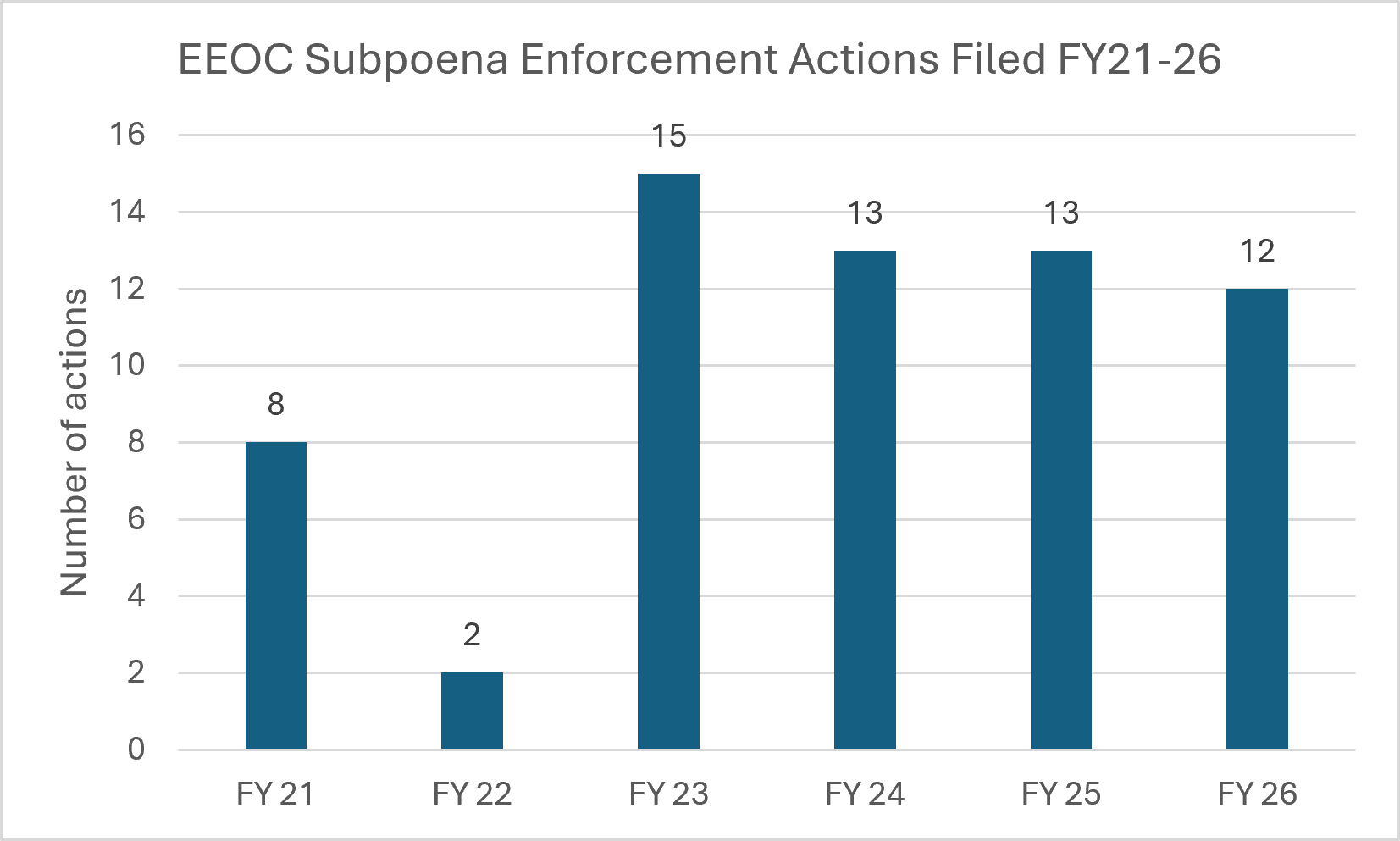
Not surprisingly, many of the subpoena enforcement actions filed this past fiscal year (i.e., ending September 30, 2026) reflect the EEOC’s enforcement priorities, with two subpoena enforcement actions involved investigation of claims of religious discrimination, three actions involved claims of discrimination related to discrimination related to DEI initiatives.
The EEOC has been highly successful in seeking enforcement of its administrative subpoenas. In FY 2026, courts enforced compliance with the subpoenas in seven cases, reached voluntarily compliance in three cases. In just one case, a respondent was successfully in blocking enforcement of EEOC’s subpoenas and EEOC is appealing that ruling.
Summary of EEOC Subpoena Enforcement Actions filed in FY 2026:
Commissioner’s Charge Regarding Religion
The EEOC filed a subpoena enforcement action related to a commissioner’s charge brought by then-Acting Chair Andrea Lucas alleging antisemitic harassment affecting faculty and staff at a university. The subpoena sought identity and contact information related to campus Jewish groups. The district court enforced the subpoena and the university and the EEOC resolved the matter pending appeal.
DEI Charge
The EEOC’s charge investigation and subpoena sought information about advancement within the aggrieved individual’s work group; the respondent’s diversity, equity, and inclusion practices; the firm’s human resources information systems; and company metrics used for financial rewards. The EEOC also asked to interview the company’s vice president of diversity and inclusion in connection with the allegations. The district court enforced the subpoena. The court rejected challenges to the respondent’s arguments that the subpoena exceeds the agency’s authority because the underlying charge, and corresponding notice, lack the detail necessary to support an investigation into the alleged systemic discrimination and objections to some of the information requests in the subpoena.
Religious Discrimination Charge
The EEOC issued a subpoena to a nationwide retailer in connection with an investigation of claims the company had failed to provide accommodations due to religious reasons. The subpoena sought broad information regarding availability guidelines, including names, contact information, and employment information for 3,000 employees, and documentation regarding all the company’s religious accommodation requests. The district court enforced the subpoena requiring that the respondent produce the information requested in the subpoena and ruled that the EEOC could directly contact former managerial (and human resources) employees, as opposed to going through the company to set up interviews of former managerial employees.
Sexual Harassment Investigation
The EEOC investigated companywide sexual harassment allegations. The EEOC subpoenaed a list of all employees nationwide with contact information for a four-year period. On December 22, 2025, the court enforced the request for nationwide employee contact information, rejecting relevancy and burden objections and noting that Rule 26 does not apply. The court denied the EEOC’s request for fees.
Disability Accommodation Investigation
The EEOC issued a subpoena in connection with an investigation of a medical center’s failure to accommodate disabilities. The EEOC subpoenaed a position statements and information related to disability accommodations. The matter was resolved when the respondent complied with subpoena.
DEI Investigation
The EEOC investigated systemic allegations of DEI-related intentional race discrimination against a nationwide retailer that may have engaged in “a pattern or practice of disparate treatment against white employees, applicants and training program participants in hiring, promotion, demotion, or separation decisions, including selection for layoffs; internship programs; and mentoring, leadership development and other career development programs.” The EEOC’s subpoena sought the criteria used in selecting employees for layoffs; information related to the company’s tracking and use of worker race and ethnicity data, including as a factor in setting executive compensation; and information about 16 programs which allegedly provided race-restricted mentoring, leadership, or career development opportunities. Before the court ruled on the enforceability of the subpoena, the parties who reached agreement on the issues in dispute.
Sexual Harassment and Disability Investigation
The EEOC investigated a charge of sex harassment and disability and retaliation against a national restaurant chain and issued a subpoena seeking information about eight employees allegedly discharged for the same reason as the charging party, including their name, sex, job title, disability, last known address, last known phone number, date of discharge, and reason for discharge, as well as personnel files for each. The EEOC sought enforcement of the subpoenas and the district court rejected the respondent’s objections to the production on the grounds that the documents and information are confidential, sensitive, and irrelevant and enforced the subpoena.
Racial Discrimination in Hiring
The EEOC investigated Commissioner Kalpana Kotagal’s commissioner’s charge alleging an auto parts company may have engaged in a nationwide failure to hire and recruit Black job candidates since 2019. During its investigation, the EEOC issued a subpoena seeking data and documents evidencing its hiring and recruitment practices, including information about its job applicants and employees, identification of company locations and positions available, material showing its hiring and recruitment procedures, and any related complaints of discrimination at the company. The district court has yet to rule on this subpoena.
Sex and Race Discrimination
The EEOC investigated a charge that the company discriminates against job applicants on the basis of sex and race. The EEOC issued a subpoena seeking applicants’ names, contact information, sex, race, position(s) applied for, date of hire or reason(s) not hired, and certain information about individuals who made the hiring decisions. Before the district court ruled on the subpoena, the parties reached agreement.
National Origin Discrimination in Hiring
The EEOC chair filed a commissioner’s charge against a school district alleging that it engaged in a pattern or practice of discrimination against Native American job applicants and current employees. The EEOC requested that the respondent provide information about applicants and former and current employees over a period of roughly five years, including the name, race, ethnicity, date of hire, position, department and contact information for candidates and employees. The EEOC sought to enforce the subpoena and the respondent filed its own action seeking declaratory judgment and injunction alleging the EEOC violated the Administrative Procedure Act, which was dismissed by the district court. The subpoena enforcement is pending.
Hiring Discrimination
The EEOC investigated charges against a county alleging a pattern or practice of discrimination in violation of Title VII, the ADA, ADEA, PWFA, GINA, and the EPA. The allegations included concerns about the charging party’s being required to undergo psychological testing with a third party. The EEOC subpoenaed the third-party provider about the psychological testing and petitioned the district court to enforce that subpoena The district court declined to enforce the subpoenas to the third-party contractor over pre-hiring questionnaires, finding it was "unwilling to hold that the EEOC’s authority to investigate discrimination in the workplace is unlimited, or that an individual’s claim that she lost a job opportunity due to discrimination opens the door to compelling a third party to produce information that has nothing to do with the discrimination allegedly suffered by the claimant." The EEOC is appealing this ruling and has filed a second subpoena enforcement action against the same third party for another set of subpoenas.
DEI Discrimination
The EEOC investigated race and gender discrimination claims against a municipality brought by a nurse manager who alleged she was required to attend “Anti-Racism Fellowship Seminars” after an allegation of racial insensitivity was made against her. The charging party alleged that during these seminars the instructor made derogatory statements about white people. She also alleged her supervisor talked down to her, and that these instances led to her constructive discharge. The EEOC subpoenaed information about the seminars, and claims the respondent has failed to adequately respond. This matter remains pending.
Conclusion
Despite the mid-terms, it is anticipated that the EEOC will move “full speed ahead” with its various initiatives. While the upcoming Democratic Congress is likely to exert considerably greater budgetary and oversight pressure on the EEOC’s enforcement choices, it is unlikely that this will sway Chair Lucas based on her continued efforts to support President Trump and the various executive orders that she has committed the EEOC to enforcing in dealing with EEO claims. As an example, the recent appointment of Stephen Miller as President Trump’s chief of staff sent a very strong message regarding DEI based on Miller’s prior role (during the Biden administration) as co-founder of America First Legal, which has focused on litigation efforts to dismantle DEI programs at companies throughout the United States.
During the coming year, the EEOC will also continue to place pressure on employers to respond timelier to EEOC charges, as part of Chair Lucas’ efforts to reduce the backlog of charges and engage in efforts to complete many investigations in 180 days. The EEOC will also continue to place pressure on employers that fail to cooperate in the investigation process, based on its subpoena enforcement power. In circumstances where the EEOC ultimately seeks to enforce such subpoenas in federal court, employers need to be mindful that the agency generally prevails in such actions.
The upshot is that it clearly is not “business as usual” based on the EEOC chair’s current priorities, such as the challenging DEI programs and her increased focus on religious discrimination and related accommodation claims, coupled with the EEOC’s demand for a greater sense of urgency in responding to all charges of discrimination filed with the agency. These changes represent the “new normal” at the EEOC.
Notwithstanding, the EEOC docket of discrimination charges and litigation most likely will continue to be dominated by other types of charges, particularly the defense of ADA claims, and a broad range of sex discrimination claims, including an increasing number of pregnancy discrimination charges, plus a steady stream of harassment claims, aside from the broad range of other charges typically handled by the EEOC.